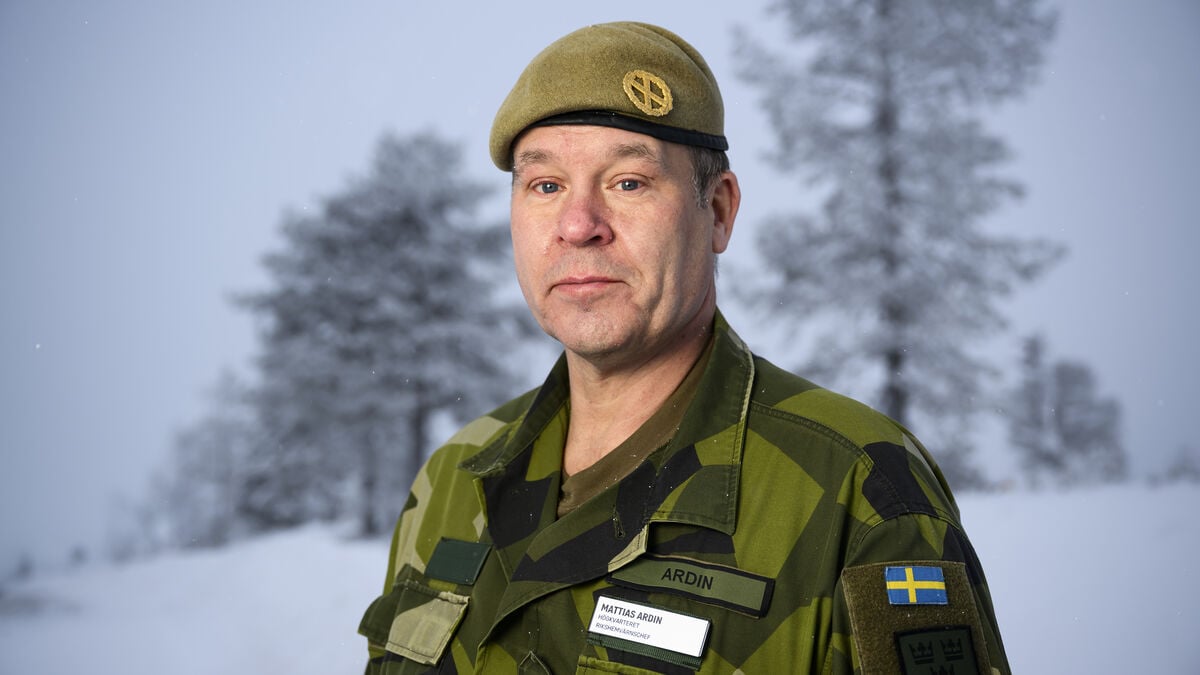
"It is a clear indicator that the will to defend is high," says Chief of the Swedish Home Guard, Mattias Ardin.
Since Russia launched its full-scale war against Ukraine in 2022, the Home Guard has grown by 2,500 soldiers. It could have been more.
"We had a hard time meeting the avalanche of volunteers who wanted to join us after the war started," says Ardin.
"We haven't been fast enough to accommodate everyone who wants to."
Since then, the Home Guard has worked to streamline the process, primarily through digitalization. In addition, new avenues into the Home Guard are being opened.
"We are getting better and better, but we are not finished."
Fresh figures
The goal is 26,000 Home Guard soldiers by 2030, distributed across 40 battalions in Sweden. Recent figures for 2025 show that there are now 22,610.
To make it easier for interested parties who lack conscription training, the Home Guard will hold the five-week Voluntary Military Training course this summer in eight different locations.
A pilot project was held in Härnösand last year.
"It was a success," says Ardin.
He estimates that there are places to train up to 800 prospective Home Guard soldiers.
"The applications have started coming in. There is a good influx right now."
No physical exam
The requirements to join the Home Guard are that you are a Swedish citizen, have reached the age of 18 and pass a security clearance. Military training is required if you want a combat position.
No physical test is needed.
"But being a soldier is basically physical work, so you have to have some basic physical ability," says Ardin.
The average Home Guard soldier is 44 years old and male. The proportion of women was 14 percent before Russia began its full-scale war, but has since dropped slightly.
"There are too few women," says Ardin.
Is the fastest on site
The Home Guard is not only growing, but is also undergoing modernization. Most of the units' equipment is to be replaced by 2030. They are also being provided with night-vision equipment, drones, and other types of sensors.
However, the Home Guard's main task remains to protect and guard mobilization and military installations during heightened alert.
The requirement for a Home Guard soldier in peacetime is to serve and train between 4 and 15 days per year. However, in the event of a heightened state of alert, some units must be in place within six hours and the entire unit within 24 hours.
"The Home Guard is the fastest on site, knows its place, knows the people, knows the terrain," says Ardin.