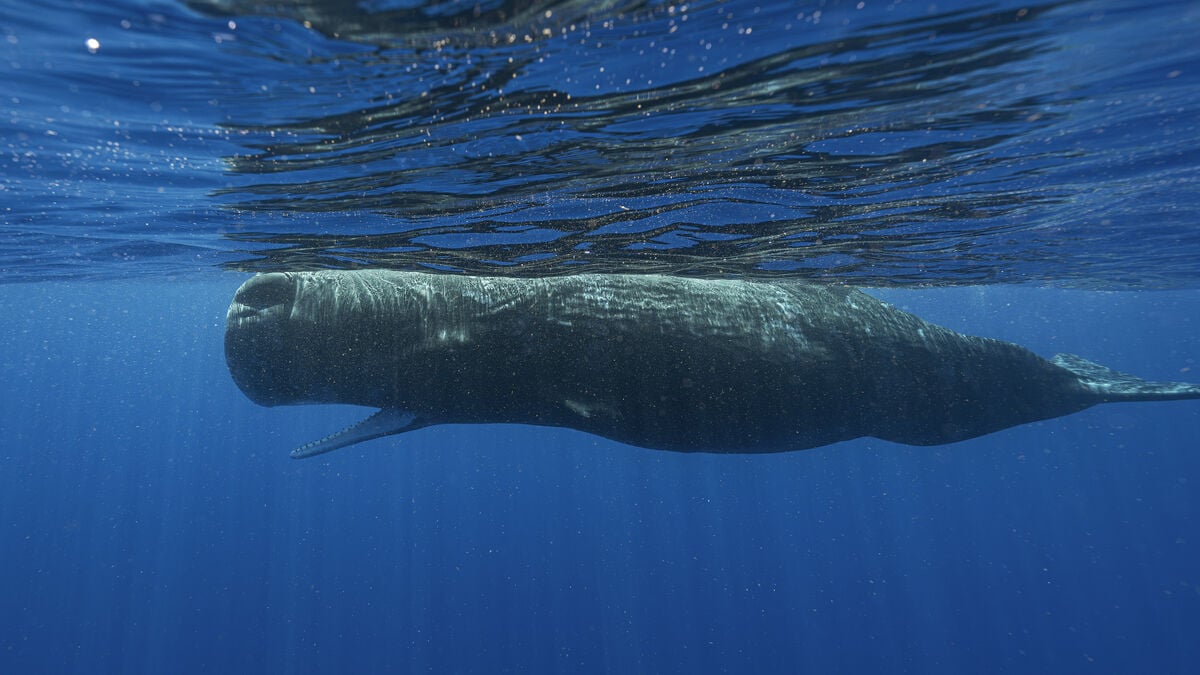
The study, published in the Proceedings of the Royal Society, is based on analyses of recordings from sperm whales in the sea off the island of Dominica in the Caribbean. Around 200 individuals live in the area year-round, and the researchers, who are conducting the research as part of a project called Ceti, have focused on a group of 15 females and their young.
Similar to language
The clicking sounds of whales are generated from their enormous heads, which are filled with spermaceti oil. They are the loudest known sounds of biological origin on Earth and can reach a volume of 236 decibels - far more powerful than a jet engine.
Animals communicate with each other through sounds, sometimes over long distances. According to analyses, clicks are not uniform but appear to have the same structure as our spoken languages. Clicks, which are scientifically called codas, form patterns that are very similar to human vowel sounds. They can be long or short, with high or low pitch.
Individual differences
All in all, it can be said that the vowel sounds resemble an alphabet. It is obvious that they contain some kind of information in communication between animals. Interestingly, there are also individual differences - some “speak” quickly and loudly while others express themselves more slowly, just like humans.
Recently, researchers in another study discovered that different populations of sperm whales have specific dialects - a form of cultural evolution. They may even have some trouble understanding each other if they happen to meet.
The overall impression, according to animal communication researchers at the University of California in the US, who conducted the current study, is that sperm whales' vocalizations show striking parallels with human language structures. It is possible that in time we may learn to decipher more precisely what these enormous animals are "saying" to each other.
The sperm whale (Physeter macrocephalus) is the largest of the toothed whales. Males can grow to 16 meters long and weigh 45 tons, while females can reach 11 meters and 15 tons.
They can dive to depths of 2,250 meters, where they mainly hunt giant squid.
The sperm whale has the largest brain in the animal kingdom. Its volume is approximately 8,000 cubic centimeters and its weight is 6.4 to 9.2 kilograms - six times larger than our own brain.
Source: Proceedings of the Royal Society