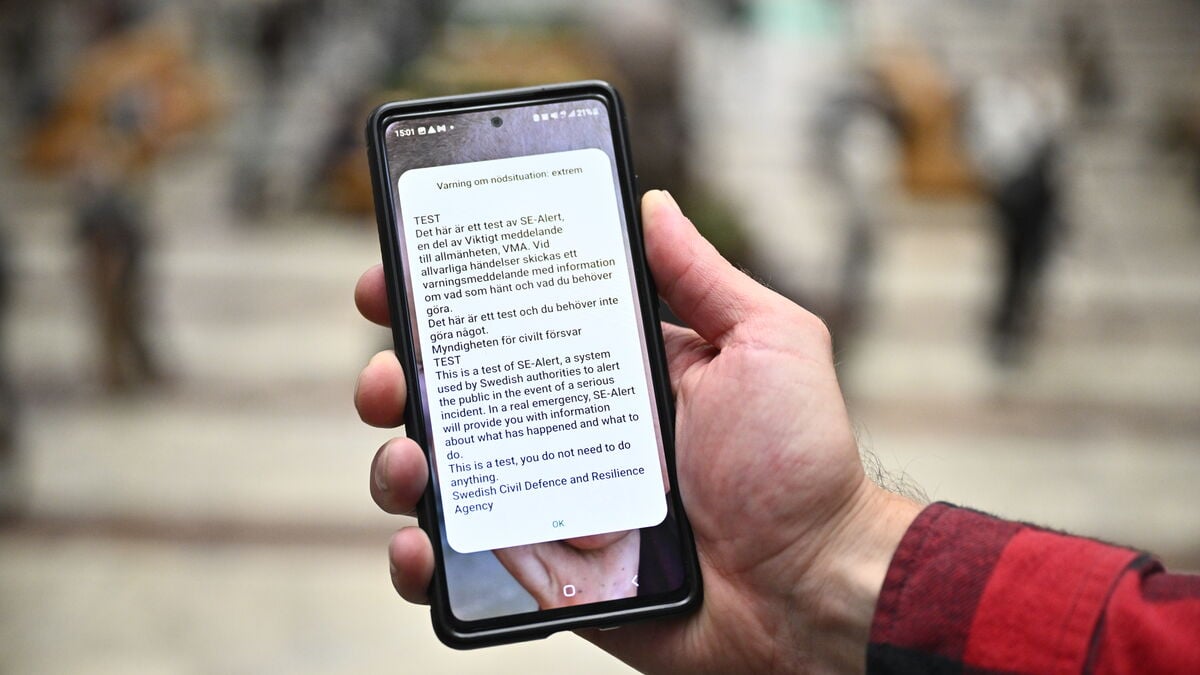
The problem was due to a configuration error, he says:
Telia has not followed the requirements we have set. They had set the character limit too low. Then the entire message and sending would be blocked.
Telia has identified and fixed the problem, according to Mikael Frisell.
"I have spoken to Telia's management several times during the evening. They have now tested it and it works," he says.
The Civil Defence Agency will conduct a new test of the alarm system on December 7 throughout Sweden.
“Failed to deliver”
The Minister for Civil Defence, Carl-Oskar Bohlin (M), is dissatisfied.
"Telia has not managed to deliver its messages. In some ways I am not satisfied, but in other ways I am satisfied in the sense that it is good to practice, then these types of events are detected before it is a critical situation," he says in a written comment to TT.
Telia is aware that the test did not reach all mobile phones, says Anna Rosman, press officer at Telia.
We are aware that the test did not reach all mobile phones as expected. That is why the test is being conducted in this way to help us ensure that it works. We are now analyzing the test to ensure that it works going forward.
Two counties, 26 municipalities and approximately 2.6 million people were to be affected by the test. Mobile phones in Stockholm and Gotland counties sent out a sharp signal when the clock struck 3 pm, which was followed by a text message. About five minutes later, a message came that the test was over.
Long preparation
The preparations have been going on for a long time, says Mikael Frisell.
We have been working hard for over a year. We have tested in a test environment and worked closely with SOS Alarm, PTS and the mobile operators.
The system is developed taking into account the external situation, but can also be used in the event of serious accidents and dangerous emissions, for example.
The advantage of this is that we can target the warning to a geographic location without the system getting bogged down like with text messages, so we get the right information out at the right time and place so we can save lives, says Frisell.
On September 7 at 3 pm, everyone with an updated phone in Stockholm or Gotland County would receive a notification with a sharp signal and a vibration. After a while, everyone would also receive a message that the danger was over.
People in neighboring counties such as Uppsala, Södermanland or Västmanland could also be reached by the test message. SE-Alert is sent out via mobile towers and it is their range that determines, not the exact county border.
Source: Civil Defence Agency