A marginal change, says Elinor Odeberg, chief economist at the union-funded think tank Arena Idé.
The overall trend remains, she reminds us. Since the 1990s, wealth has increasingly been concentrated in “a few.”
And the wide income gaps are very large, she adds.
“It is deeply unfair”
She calls – like Piketty and his team – for investments in redistribution policies with progressive taxes to even out the gaps. For example, by reintroducing or increasing the property tax, the wealth tax and/or the tax on ISK savings.
"Today we have a large tax gap between wage earners and people who get their income from capital. It is deeply unfair," she says.
Professor Daniel Waldenström at the Institute for Business Research warns against drawing too many conclusions from the World Inequality Report. And he is not as concerned about the gaps in Sweden.
The gaps are very much about young adults – as students, Waldenström argues:
They have almost no savings and no income.
The Piketty report shows that the top ten percent of earners in Sweden last year earned eleven times more than the bottom half. Ten years earlier, in 2014, those with the highest salaries earned twelve times more.
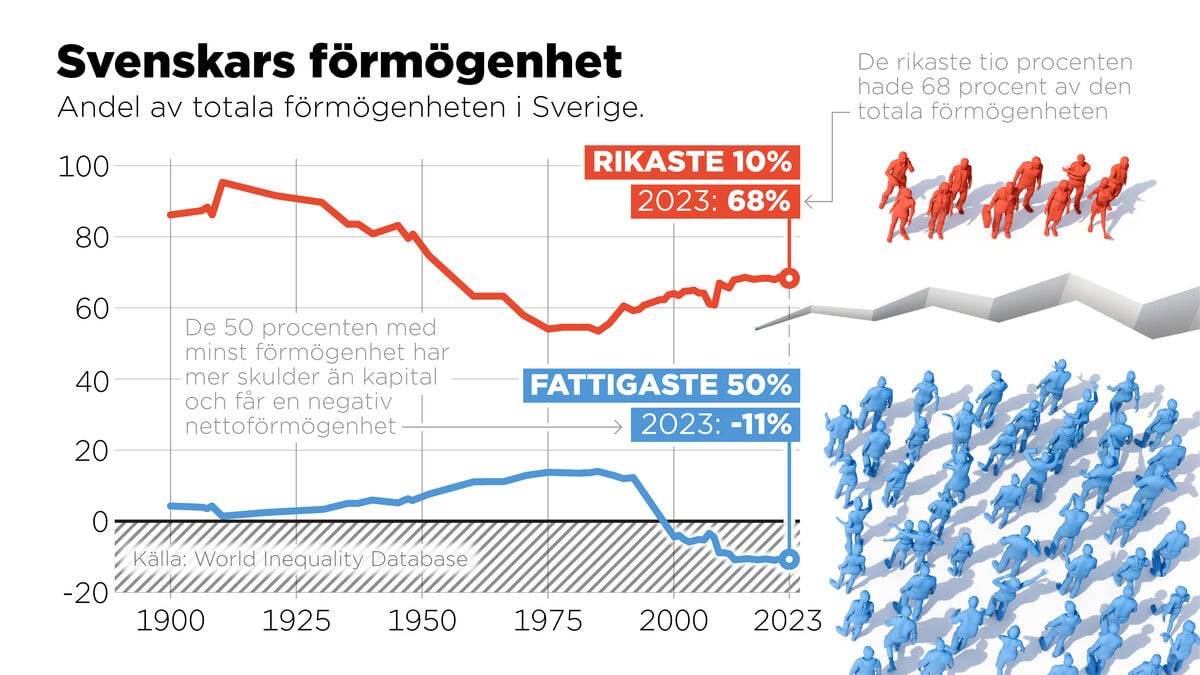
For the bottom 50 percent of the population in Sweden, negative net wealth grows to 11 percent of total wealth, according to the report. In comparable countries – the rest of the Nordic countries, Germany, the UK and the Netherlands – the bottom 50 percent have a plus.
“A proof of success”
According to Waldenström, there will be a deficit in Sweden as "approximately 15 percent have more debts than assets", while the remaining 35 percentage points of this group hover around the zero line in the balance sheet.
The richest 1% in Sweden own 27% of assets, marginally less than 28% ten years ago. However, this is clearly above the levels in the Nordic neighboring countries, which range between 18 and 23%.
"We have more entrepreneurs who have become super rich. But in many ways it is a testament to the success of our business climate," he adds, pointing to profiles such as Spotify founder Daniel Ek and the H&M Persson family.
The World Inequality Report is the third in a series of reports, which began publication in 2018. Over 200 researchers have contributed to the work on the large database that has been built by the World Inequality Lab at the Paris School of Economics, to map economic gaps in the world.
Behind the report, with a foreword by economics laureate Joseph Stiglitz, is, among others, the French economist Thomas Piketty, who became world famous after the publication of the book "Capital in the Twenty-First Century" in 2013.
Globally, the report shows a record-breaking world, with extreme differences between rich and poor and enormous wage gaps – both at the individual level and when comparing countries against each other.
One thousandth of one percent of the world's population – the richest 60,000 – owns three times as much as the poorest half of the world. And in almost every region of the world, the richest one percent owns more than the combined wealth of 90 percent of the population, according to the report.
Source: World Inequality Lab, Paris School of Economics