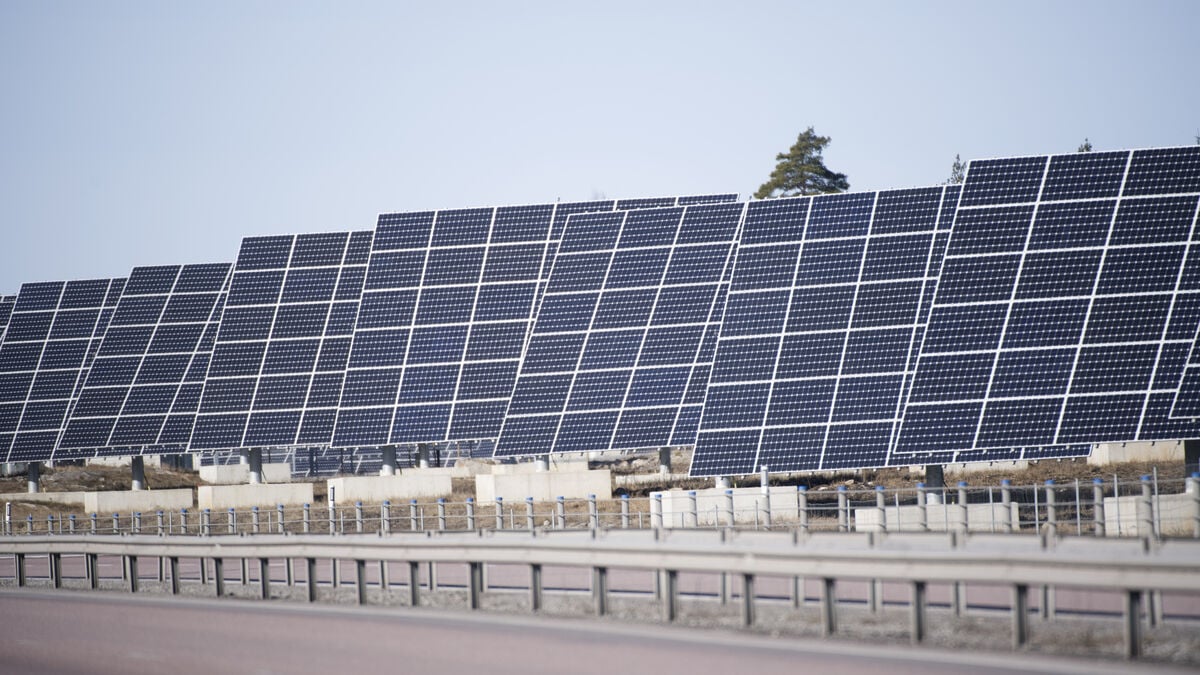
Solar power still makes up a very small part of the Swedish electricity market. According to the industry organization Green Power Sweden, solar parks produced just over 1 TWh last year, a little over 25 percent of the country's total solar power. The majority of solar power is generated by private homes.
"This is where Sweden differs from other countries, such as Denmark, where the majority of solar power comes from solar parks," says van der Veer.
A total of just over 168 TWh of electricity was produced in the country in 2025, of which Sweden used around 135 TWh. But solar parks are on the rise, a new report from the organization shows.
180 were approved last year
In 2025, county administrative boards and land and environmental courts approved 180 solar parks (out of approximately 280 applications) with a total annual electricity production of 3.1 TWh. Since 2019, solar parks with a total capacity of 9.4 TWh have been given the green light.
"We are seeing a very sharp increase in the number of solar parks that are quite large, not just in the number of applications. Many of those approved are several hundred hectares," says van der Veer.
The larger the solar parks, the better the conditions for profitability and for them to actually be built, according to van der Veer.
It is also becoming more common to develop solar parks in connection with wind farms and large-scale batteries to store electricity.
Bottleneck
But the pace of expansion is being slowed by long lead times and high costs for connecting to the electricity grid.
"If politicians do not start to focus on how we can quickly bring about new electricity production, especially in southern Sweden, there is a risk that we will lose large amounts of investment in new generation," says van der Veer.
This, she says, will contribute to making the transition to a fossil-free energy system difficult and expensive.
At the end of 2025, there were applications with a total possible electricity production of 20.7 TWh, which had not yet been decided by the county administrative boards or the land and environmental courts. Together with the approved solar parks, the potential is around 30 TWh, and van der Veer believes that a large part can be realized in ten years.
"Previously, we said we could have 30 TWh of solar power in place by 2030. We won't get there by then, but perhaps by 2035-2040."
Total expected production, GWh, is given in brackets.
Blekinge County 4 (51)
Dalarna County 2 (20)
Gotland County 0 (0)
Gävleborg County 1 (95)
Halland County 9 (259)
Jämtland County 1 (11)
Jönköping County 15 (182)
Kalmar County 6 (60)
Kronoberg County 15 (603)
Norrbotten County 0 (0)
Skåne County 24 (523)
Stockholm County 4 (91)
Södermanland County 4 (99)
Uppsala County 7 (117)
Värmland County 22 (268)
Västerbotten County 3 (80)
Västernorrland County 0 (0)
Västmanland County 3 (15)
Vastra Gotaland County 41 (485)
Örebro County 5 (42)
Östergötland County 14 (123)
Source: Green Power Sweden