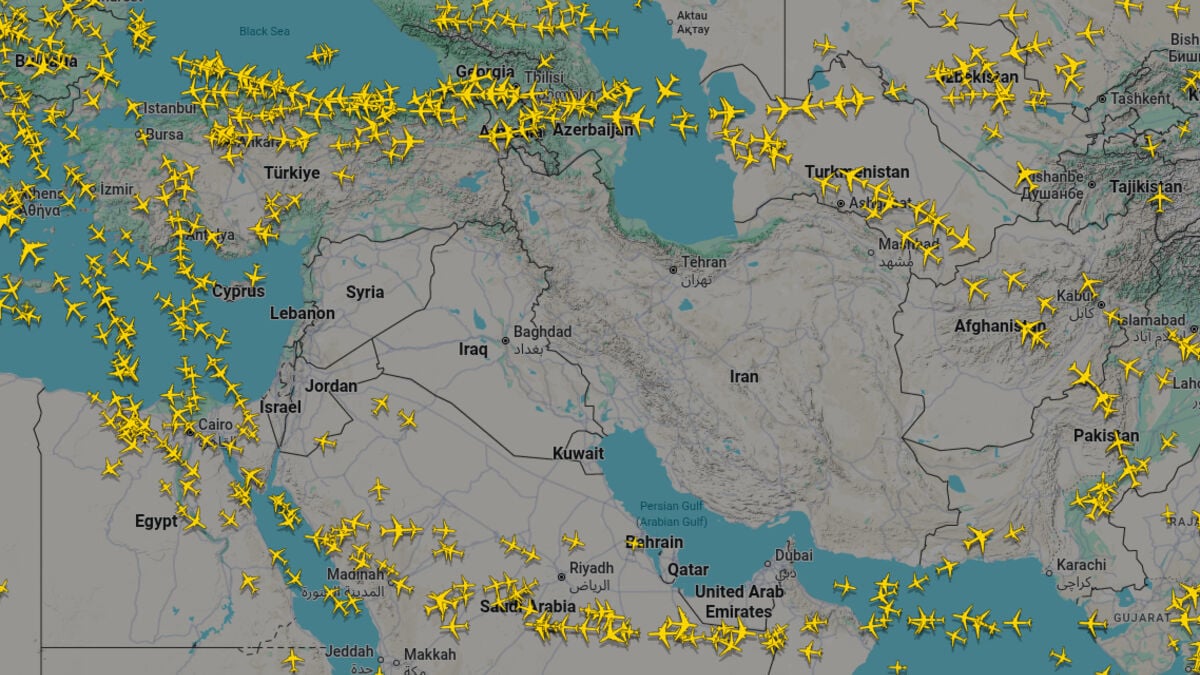
Air traffic around the Gulf is still paralyzed, with thousands of flights canceled since Israel and the United States attacked Iran on Saturday and Iran responded with its own attacks on neighboring countries.
"You avoid the area around Iran and the Gulf, either north by passing over the Caspian Sea or by flying south of it," says David Learmount, a former pilot and instructor.
On Monday and Tuesday, the first flights were able to take off from the air hubs of Dubai and Abu Dhabi to various destinations around the world, although all regular flights in the United Arab Emirates are canceled at least until Wednesday.
In total, over 12,300 departures from airports in the affected countries have been canceled, Bloomberg reports, citing Flightradar 24.
Most airports in the region remain completely closed. Learmount says the disruptions are inevitable in a war situation - and will likely continue as long as the war continues.
"It is unusual for planes to be shot down in conflict zones by mistake, but it happens," he says.
Hit airport
The fact that Iran appears to have targeted civilian targets, including airports in Bahrain, Dubai and Doha, makes the situation even more serious. One person was killed and seven were injured when debris fell from an Iranian drone targeting Zayed International in Abu Dhabi, the airport said on Monday.
Learmount explains that some flights can take off - but not all - saying that it is up to each country's aviation safety authority and the airlines to decide.
Qatar Airways, the airline giant with Doha as its hub, said on X that the airspace over Qatar remains closed, and promised an update only on Wednesday.
"You can theoretically take off from Doha, but Qatar seems to keep its planes on the ground, perhaps because they consider themselves more of a target," he says.
Increased traffic in the corridors around the area also complicates the situation.
"There is not enough space, and therefore the planes must receive permission from air traffic control, which can mean major delays."
Forced to turn
Traffic data also shows that the situation remains fragile. Flightradar24 reports that several aircraft heading to the area were forced to turn around, fly to safer airports or circle after alerts about missiles from Iran.
David Learmount believes that the image of the aviation hubs, of which Dubai is one of the world's busiest, is being damaged.
"I'm pretty sure of that. But people have short memories, and if the problems go away, they forget about it pretty quickly."