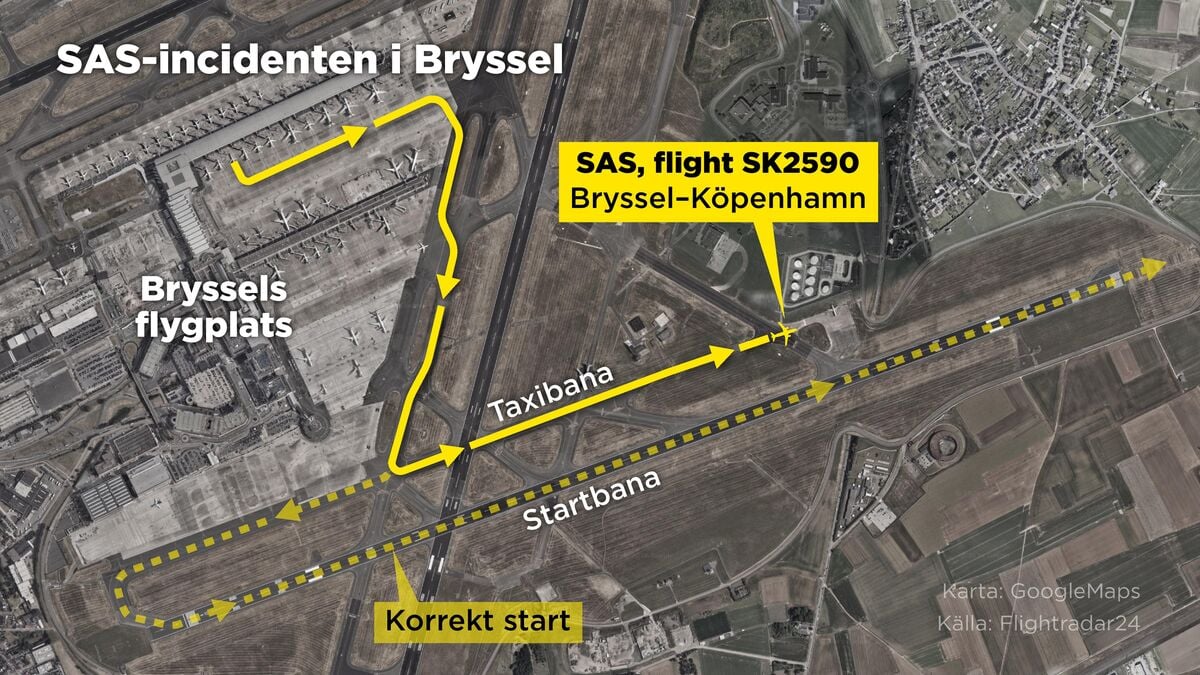
The incident occurred while the plane was en route from Brussels to Copenhagen on Thursday evening. According to Flightradar24, the plane reached speeds of almost 200 kilometers per hour on a taxiway before braking sharply.
"When we had gained enough speed to take off, the brakes were applied, all the flaps on the wings were opened and the engine was put into reverse so that everything shook," passenger Anders Bork Hansen tells Danish TV2.
Sören Runsteen also reported strong movements.
"Very sharp braking after just a few seconds and a sharp evasive maneuver," he tells Ekot.
“It is life-threatening”
Aviation journalist Christer Åström says that there are many risks in trying to take off from the taxiway, as they are narrower and shorter than the main runways and can also be angled.
"It is clear that it is life-threatening. You can encounter other aircraft that are also on a taxiway. It is only by chance that nothing really serious happens."
SAS confirms that the flight to Copenhagen in question was cancelled following an "irregularity". SAS has launched an internal investigation into the incident.
"Before it is ready, we cannot speculate," says SAS's communications manager, Alexandra Lindgren Kaoukji.
According to a passenger interviewed by Expressen, it took a while before those on board received any information about the incident.
"Then they said they had made a mistake but had not received any guidance from the air traffic control tower. They should have seen that they were taxiing on the wrong runway," the passenger tells Expressen.
"I think the staff were also quite shocked."
No one injured
Christer Åström says that the air traffic control towers do not always have oversight of the entire area.
"There are blind spots where you can't see the entire taxiway system."
According to SAS, neither passengers, crew nor the aircraft were injured in connection with the incident.
"It's unfortunate that you couldn't come home as planned, but that's the only effect on the passengers in that way: they had to fly home today instead of yesterday," says Alexandra Lindgren Kaoukji.
A taxiway is used by aircraft to move around the airport, for example between the runway and the gate.