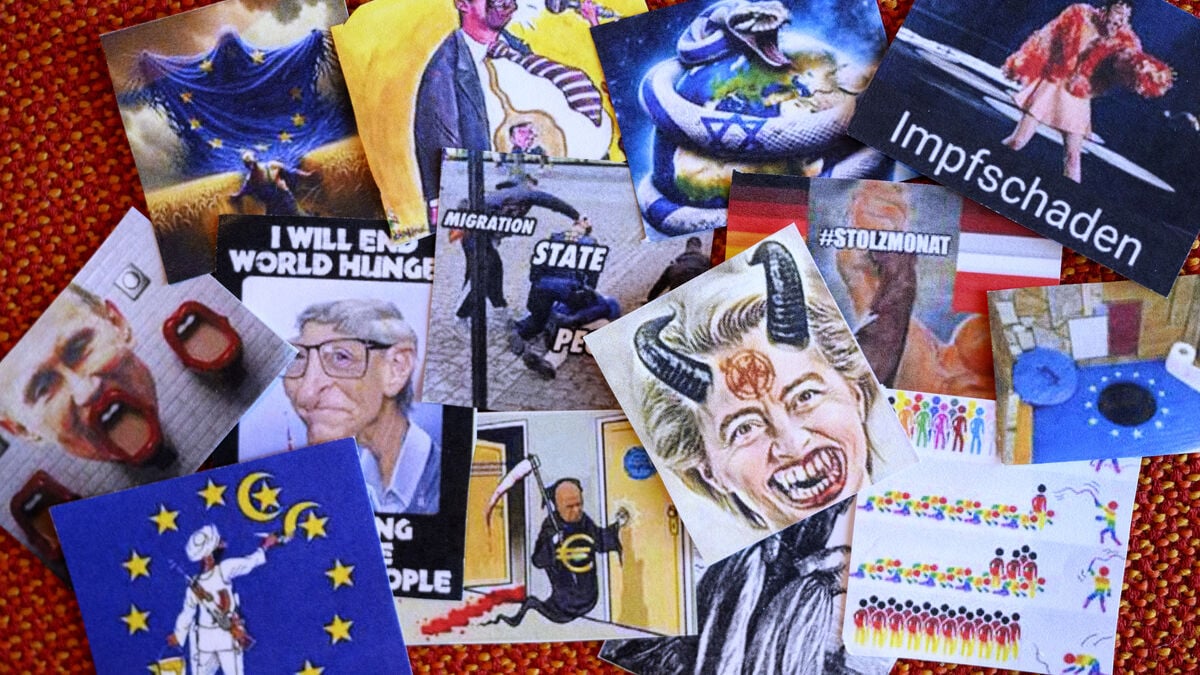
She is part of a research group that has taken a closer look at the debate on social media ahead of the 2024 EU elections in Sweden, Bulgaria and Austria, with a focus on memes (humorous images, videos or text).
There was surprisingly little difference. It was often the same images, with the same message, but translated," says Julietta Stoencheva.
The researchers created new profiles and began following political parties, major media outlets, political commentators and others who were involved in the election - all in order to study what a politically interested citizen encounters in the comment sections.
“Coded and subtle”
The researchers' conclusion is that memes with hate, threats and violence-promoting messages have spread widely over the past decade.
What, a number of years ago, mainly occurred in closed chat forums with anonymous senders is now something that virtually any politically interested person active on platforms such as Instagram, TikTok, Facebook and X encounters.
Professor Tina Askanius, who is also behind the study, describes it as global imagery that is coded and subtle. She sees a generation gap.
I meet high school teachers who ask where they can learn more about this. They say, “Apparently it’s something my students know about that I have no idea what it means.”
Politicians like pigs
One such example is an emoji in the shape of an airplane, which could mean “deport them.”
Another is the image of a red and a blue pill. It is a metaphor taken from the movie "The Matrix", which stands for the fact that now is the time to either "wake up" and confront an uncomfortable truth, or to remain in ignorant submission.
Many of the memes the researchers examine in the study are more straightforward, such as when politicians are dehumanized by being portrayed as animals, often pigs. Examples include a humorous image of a person standing on a cliff with the text “jump for the climate” and a hateful image of a Muslim with a drawn sword being kicked in the butt with the text “Islam – Get out of Europe”.
The researchers call it "everyday extremism" and believe it causes a dulling.
It's so easy. You spontaneously don't take it seriously, but in the long run you can embrace these ideas without thinking that this is serious," says Julietta Stoencheva.
The researchers created new profiles on Instagram, X, TikTok and Facebook.
In the period leading up to the 2024 European Parliament elections, they followed political parties, major media outlets, political commentators and others involved in the elections in Austria, Bulgaria and Sweden.
They focused on memes in the comment sections.
They found everything from hints of violence to direct threats and violent images that dehumanize entire population groups.
This was often directed at women, sexual minorities and migrants, as well as politicians, the latter group being portrayed as corrupt, incompetent and malicious.
The researchers' conclusion is that political parties appear to be losing control of their campaigns and agendas as online political debates evolve into bitter and dehumanizing language on platforms that increasingly abandon content moderation.
The study is part of a three-year EU project on everyday extremism.
Source: Popular Communication: The International Journal of Media and Culture