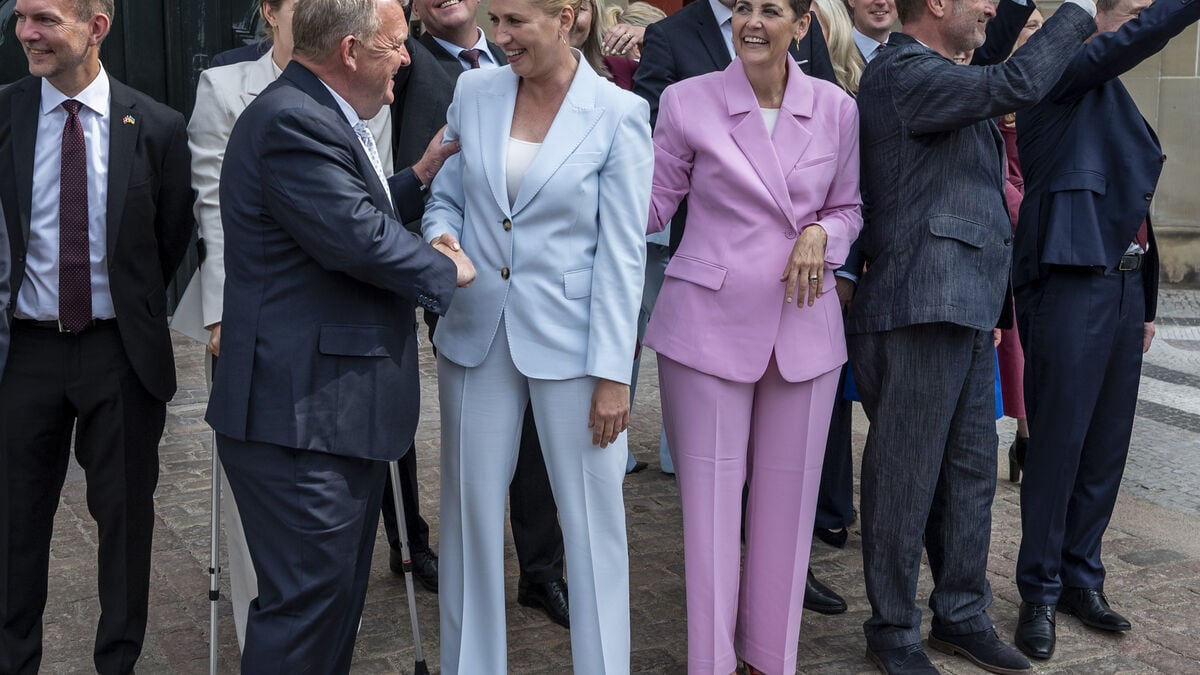
Red flags flutter outside Amalienborg Palace as the government is presented. Recently, criticism has been directed at key figures in the record-breaking government negotiations.
The Danes have been waiting for over two months, but waiting a little longer in a summer-warm Copenhagen that almost makes you sweat will do no harm, says Alfred Anhøj Soelberg, chairman of the Social Democratic Youth Union DSU.
"This is the third time that Mette has managed to form a Social Democratic government. I think it's admirable," he told TT in connection with Wednesday's presentation of the government in Copenhagen.
“Not very stable”
However, there is a certain amount of concern in the air. High school student Maya, who sneaked into Amalienborg during her lunch break out of curiosity, believes that it “doesn’t take much” for the government to fall.
Denmark's new, left-leaning coalition government includes the Social Democrats, the Moderates, the Socialist People's Party and the Radical Left.
"I'm actually very happy with the government's policy. There's a lot of focus on the climate, education and young people, but it doesn't feel very stable. I have a hard time seeing how the Moderates and the Unity Party will unite over time," says Maya.
The high-profile Foreign Minister Lars Løkke Rasmussen (Moderates) will continue in his post. Alongside Prime Minister Frederiksen, Peter Hummelgaard (S) and Nicolai Wammen (S) will swap ministerial posts within the Social Democrats.
Important to “weed out”
Wammen will thus become Minister of Justice, and Hummelgaard's move to finance has led Danish media to believe he has been positioned to take over when Frederiksen retires. She has already served two terms as Prime Minister and is not expected to want to stay for the entire third.
According to Danish tradition, outgoing ministers give a gift to their successors. Hummelgaard gives a paving stone from Pusher Street in Christiania to Wammen, saying that an important task in the Ministry of Justice is to "weed out the weeds" because many want to "turn the tide" on Danish society.
But he avoids commenting on today's speculation that the finance minister position would "mean something."
"You don't need to overinterpret everything," Hummelgaard says with a big smile to journalists at the Danish Ministry of Finance.
Facts: All ministers in Denmark's new government
There are 11 women and 10 men in Mette Frederiksen's third government, where Nicolai Wammen and Peter Hummelgaard are changing jobs.
Prime Minister Mette Frederiksen (S)
Minister of Economic Affairs and the Interior Pia Olsen Dyhr (SF)
Minister of Foreign Affairs Lars Løkke Rasmussen (M)
Minister of Enterprise and Competition Martin Lidegaard (R)
Minister of Finance Peter Hummelgaard (S)
Minister of Justice Nicolai Wammen (S)
Minister of Research, Education and Digitalisation Christina Egelund (M)
Minister of Climate, Energy and Supply Samira Nawa (R)
Minister of Urban Affairs, Land and Transport Signe Munk (SF)
Minister of Immigration and Integration Morten Bødskov (S)
Minister of Education Magnus Heunicke (S)
Minister for Gender Equality Ane Halsboe-Jørgensen (S)
Minister of Defense Jeppe Bruus (S)
Minister of Taxation and Growth Jakob Engel-Schmidt (M)
Health Care and Church Minister Ida Auken (S)
Minister for Nature and Animal Welfare Christian Rabjerg Madsen (S)
Culture Minister Zenia Stampe (R)
Minister for Civil Protection and Emergency Preparedness Lisbeth Bech-Nielsen (SF)
Minister for Children, the Elderly and Housing Jacob Mark (SF)
Minister for Social Affairs and Minister for Nordic Cooperation Monika Rubin (M)
Minister of the Environment Maria Reumert Gjerding (SF)
Source: Ritzau