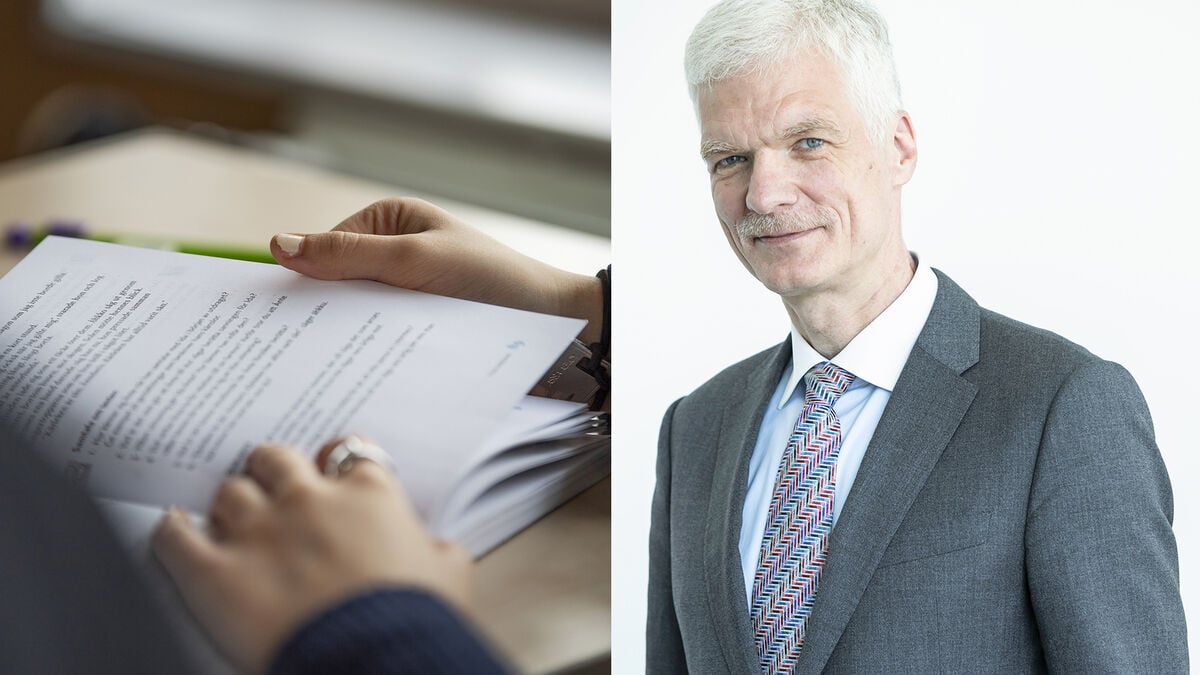
The recent decline in the PISA test, especially in reading comprehension, has had a global impact. PISA director Andreas Schleicher admits that he was disappointed - but not surprised, given that scores among OECD countries began to decline a decade ago. Increasing screen reading, distracting mobile phones and a pandemic have been among the many explanations.
But why have 15-year-olds lost so much between 2022 and 2025? In Sweden, one in three students can now only read at the most basic level.
Andreas Schleicher's answer is direct:
AI has become a tool for simplifying things, rather than making you think and make an effort.
Building the foundation
This does not mean that ChatGPT should be banned in schools. But education must start at the right end, Andreas Schleicher emphasizes.
It is in school that we can build the analogue foundation for a digital world. It is about learning to navigate complex information, weighing different perspectives against each other and making wise decisions. You don't learn that on a screen. It is about having a teacher who teaches you to think for yourself, he says.
Andreas Schleicher mentions a result from a previous PISA survey, which showed that the students with the best reading skills were not those who had spent the most time in front of a screen, but those who had read books of at least 100 pages.
If you read a more demanding book, you need to build an internal picture of the characters, how they relate to each other, and why they act the way they do. That's exactly the ability you need in the AI world.
Take control
His advice to Swedish decision-makers is: Take control of AI use in schools.
If AI is just unleashed, it will actually be a pandemic. But we have dealt with pandemics before. Don't capitulate, but implement a smart AI strategy for schools. Also, give teachers more time to connect with students, figure out who they want to be, and follow them on their journey.
Schleicher points out that parents also play a big role.
They need to explain to their children that school is not a game. It's about laying a foundation, and that requires hard work.
PISA tests 15-year-old students in reading, mathematics and science.
PISA is conducted by the OECD every three years, with the latest being in 2025.
PISA has grown step by step. In PISA 2025, 91 countries or regions participated.
Sweden has participated since the start in 2000, from the beginning with very good results.
Sources: OECD and Swedish National Agency for Education
Sweden had a historically poor result in reading comprehension and mathematics in PISA 2025. The result in science also deteriorated. Sweden is now at the OECD average, not above.
The loss is greatest in reading comprehension, which is a central skill for passing other subjects.
The proportion of students who do not reach a basic level in reading and mathematics rises to one third.
Persistent differences in results depending on the student's family background - students from socially and economically weaker homes perform worse. But new in PISA 2025 is that students from affluent homes fall back the most.
Other Nordic countries also had historically weak results in reading comprehension and mathematics. Results are also falling in a majority of OECD countries.
Countries and regions in East and Southeast Asia performed best.
Reading ability (change since 2022 in brackets):
Sweden, 466 points (–21)
OECD average: 463 points (–14)
Mathematics:
OECD average: 465 points (–9)
Sweden, 464 points (–18)
Science:
Sweden, 485 points (–8)
OECD average: 484 points (–3)
Sources: OECD and Swedish National Agency for Education