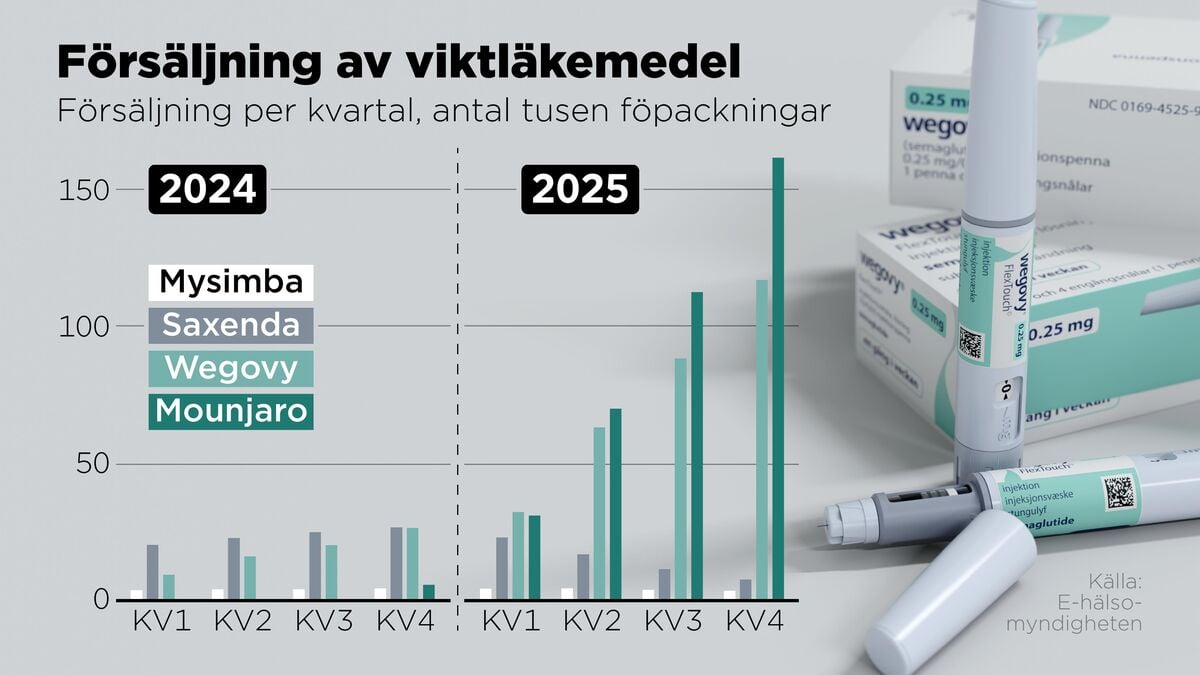
The demand for weight loss drugs has exploded. The new drugs have dramatically changed the way we treat obesity, and the long-term positive effects on public health are expected to be significant.
Above all, it is GLP-1 analogues such as Wegovy from Novo Nordisk and Mounjaro from Eli Lilly that are the bestsellers. At the end of 2025, the two together sold for 230 million SEK in a single month. In December, Mounjaro topped the list of Sweden's best-selling drugs.
None of these are subsidized for weight loss alone, which means that patients who are prescribed them for obesity and who do not have type 2 diabetes must cover the entire cost themselves. Depending on the dose, it can be up to 4,000 SEK per month.
Want to stretch supplies
Cost is one of the reasons why users change doses on their own initiative, something that pharmacy staff have reacted to.
"We have noticed that customers ask if they can change their dosage and experiment themselves, for example to make the medicine last longer. When I ask, I have been told that it may be because of the money," says Roro Wirlander Beydoun, pharmacy manager at Apotek Hjärtat in Örebro.
He says he understands that cost can be a problem, but that a change in dosage should always be discussed with a doctor.
"Tinkering with doses on your own can negatively affect the treatment or lead to side effects," he says.
Staffan Sundquist, specialist pharmacist at Apoteket in Jönköping, also says that they have noticed that customers are asking if they can change the dosage.
Suggested on forum
On social platforms, there are plenty of tips on how to adjust the dose of the medicine, which is taken with syringes.
"If you pay several thousand a month, it's no wonder you want to economize on them," says Ylva Trolle Lagerros, professor at the Karolinska Institute and chief physician in obesity in the Stockholm Region.
She says that it is not automatically bad to be treated with a lower dose than recommended. Studies show that a lower dose means fewer side effects. It can also reduce the risk of significant weight gain when you stop. But it should not be done without discussion with the healthcare provider.
"The purpose of the medicine is for the person taking it to feel full and therefore eat less. If the effect is achieved at a lower dose, that is not wrong."
"But anyone who wants to change the dose should talk to their doctor. It's not a good idea to tinker with it yourself," she says.
She is reacting to the "click schemes" that are being spread online and are also being marketed for a fee. These show how the injection pens can be adjusted to deliver a different dose than the preset one.
"It's not something we recommend. I don't think it's medically right to 'click'," says Trolle Lagerros.
An article in Läkartidningen states that there is no scientific support for the medical safety of dosing with the click method. They address, among other things, the risks of incorrect dosing and lack of durability of the liquid that is injected.
Ylva Trolle Lagerros sees problems with so many people having to pay for the medicines themselves.
"I have patients who are really sick with their weight who would need medication for much longer but are forced to stop because of the cost," she says.
Warns of counterfeits
At Apotek Hjärtat, the staff has also noticed questions about purchasing similar medicines on their own, without a prescription.
"There are customers who have received advertisements with offers for cheaper variants and ask why it is more expensive at the pharmacy. But you absolutely should not buy them because you don't know what they contain," says Roro Wirlander Beydoun.
The Swedish Medical Products Agency has issued warnings that there are fake weight loss drugs for injection on the internet. Ylva Trolle Lagerros has not met patients who have bought from unscrupulous actors. She believes that it may partly be a group that is not obese and therefore not prescribed drugs by healthcare.
"You should absolutely not buy and inject anything if you don't know what it is," she says.
Today, six types of drugs for obesity are approved in the EU:
Xenical and Beacita (orlistat), Mysimba (bupropion-naltrexone), Qsiva (phentermine-topiramate), Saxenda (liraglutide), Wegovy (semaglutide), and Mounjaro (tirzepatide).
Orlistat reduces the absorption of fat from the diet. The others mainly affect appetite regulation and increase the feeling of satiety.
Saxenda, Wegovy and Mounjaro are taken as injections. These belong to the class of GLP-1 analogues.
Only Orlistat is subsidized for obesity; for other medications, the patient must pay the entire cost themselves.
Ozempic, a GLP-1 analogue that has become synonymous with weight loss, contains the same substance as Wegovy (semaglutide) and is only approved for diabetes in Sweden.
Source: Fass, Ylva Trolle Lagerros