During the 1994 World Cup, he was a young researcher, mowing stadium grass, among other tasks. He is now a professor of turf science at the University of Tennessee, and for the past decade has had his sights set on this year's championship.
Much of it is about grass varieties.
We have Mexico City at high altitude, a warm tropical Miami, a hot and perhaps dry Kansas City, and a cooler Seattle.
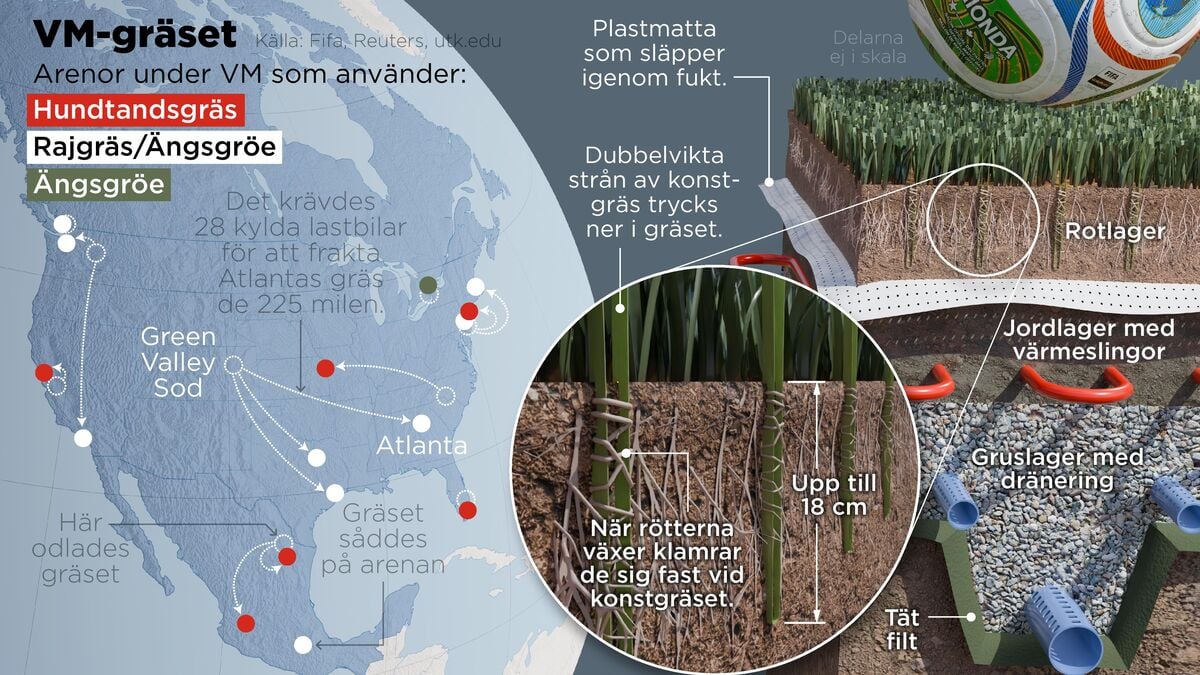
Toronto has opted for meadow grass, while Guadalajara has been given dogtooth grass. Many stadiums use a mixture of meadow grass and English ryegrass.
The research is about how to manage grass types in different environments. When the players step into the arenas, the ball should roll and bounce in the same way, says Sorochan.
Grass on top of artificial turf
Half of the World Cup stadiums usually have artificial turf, but for the World Cup the base must be natural.
To achieve this, there is a drainage and ventilation structure on top of the artificial turf, followed by a few decimetres of sand. The system removes excess liquid - for example, when it rains.
It's extra insurance. You can also use it the other way around and blow extra air into the sand, which the roots like.
The grass itself is grown in fields across North America. In most cases, the grass is cultivated on a type of plastic mat that allows it to be rolled up, loaded onto trucks, and transported to the arenas.
It's almost 2,000 kilometers from Denver, where the grass is grown, to Atlanta. It took 28 refrigerated trucks to transport it.
Once there, it is rolled out onto the arena, flattened and sewn together. The grass is watered and treated with nutrients to help it take root quickly.
“Biggest challenge”
Some arenas, like the one in Houston, are indoor arenas.
Like all plants, grass needs sunlight to grow. So we need to have special grow lights over the grass, says John Sorochan.
That is clearly the biggest challenge.
To survive an entire tournament, the natural grass is mixed with artificial grass made from plastic fibers. Either they are sewn together, or the grass is grown from the beginning on a mat of plastic turf.
Then the grass grows over it, so it's not noticeable. But the fibers act like rebar to stabilize the sand, so you don't get big holes or rips if a player stops quickly or puts their heels in the ground.