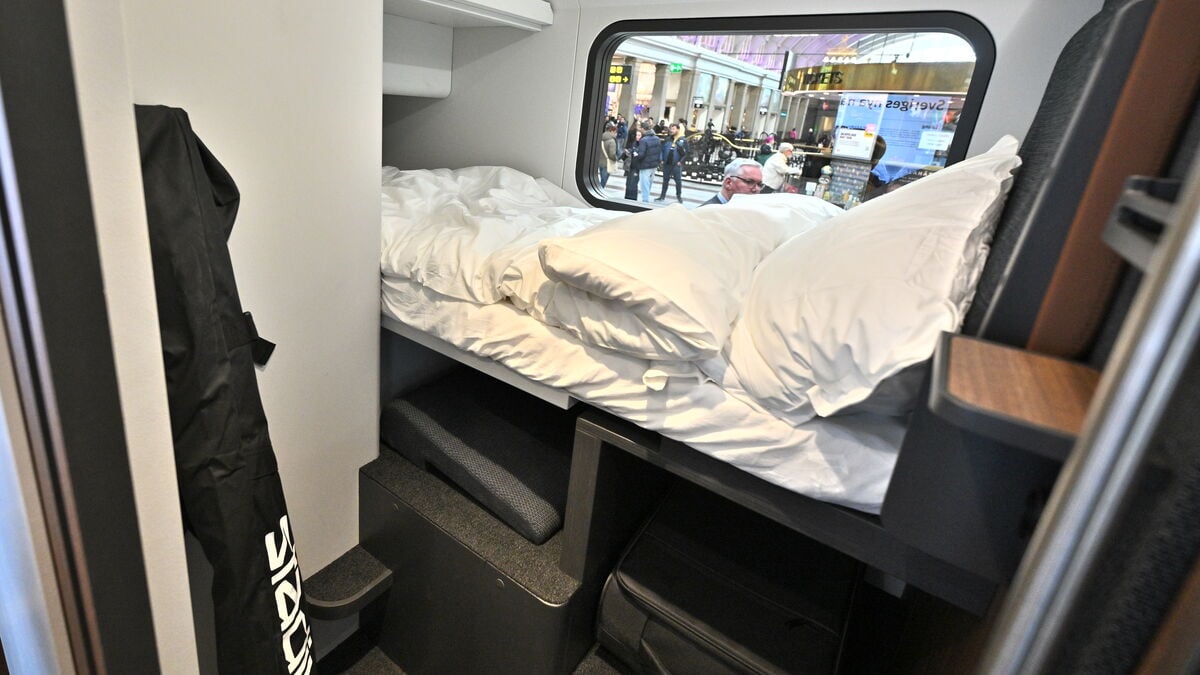
Spaciousness, comfort and privacy are guiding principles for the compartment designs as Sweden orders 91 new night carriages for trains to upper Norrland from Spanish Talgo.
"They are modern, robust and future-proof night train services for a long time to come," said Minister of Infrastructure Andreas Carlson (KD) as the contracts were signed at Stockholm Central Station.
The new Swedish night trains are being purchased in light of a recent European trend in which night trains are making a comeback in some places, according to Mark Smith, who runs the well-known train site The Man in Seat 61.
"Night trains used to be everywhere. Some disappeared in the 1990s because high-speed trains made them redundant. If it only takes three hours to get from Amsterdam to Paris, or from Paris to Geneva, you don't need night trains," he says.
“Odds against”
But there are more explanations. The sleeping cars take fewer passengers, there are long shifts with inconvenient working hours and it has been difficult to compete with subsidized flights, which, for example, do not pay fuel tax. SJ announced last autumn that the company would discontinue the Stockholm–Hamburg–Berlin night trains after the summer (although the German RDC later announced that the line would be saved).
The odds are against night trains, says Smith.
At the same time, there are many who find flights uncomfortable, and who want to take the train out into Europe for environmental reasons, according to Smith.
That combination makes people travel further by train than they used to.
Among other things, the Belgian-Dutch European Sleeper started a line between Hamburg and Paris in March, and the Austrian ÖBB has invested in new sleeping cars - including mini cabins reminiscent of Japanese capsule hotels.
Critical of the solution
However, Smith is critical of the Swedish purchase of more space-consuming and probably more expensive single compartments - or four-bed compartments - which he believes will deter price-sensitive travelers.
Nobody cared in the 1950s, but in 2026 people don't want to lie in a bed in a room with strangers. It's a shame Sweden didn't see that when they placed the order.
The Swedish Transport Administration's Director General Roberto Maiorana says that several solutions were considered, but disagrees that the compartments will be expensive.
I think it's early to make that assessment, but we assume that today six people share a compartment. From a comfort perspective, this will be better.
Facts: New night trains
The Swedish Transport Administration has ordered 91 carriages from Spanish Talgo and ten locomotives from Siemens that will run to and from upper Norrland.
The compartments include family compartments (four people), premium compartments with toilet and shower (two people), single compartments and accessible compartments.
In addition, there are "business class-style" folding chairs and more traditional chairs in the salon.
The deal is worth SEK 8 billion and delivery will take place from 2030.
Austrian ÖBB has invested heavily in night trains on a number of routes and announced in 2021 that it would order 33 trainsets from Siemens. The order was hit by delays and is said to have been limited to 24 sets.
European Sleeper launched its first line in 2023 and now operates Brussels–Berlin–Prague, Paris–Berlin and Brussels–Milan.
In May, the direct Copenhagen–Prague line will start in a collaboration between German DB, Danish DSB and Czech CD.
France has expanded its Intercités de Nuit network in the 2020s, and has plans to expand it even further.