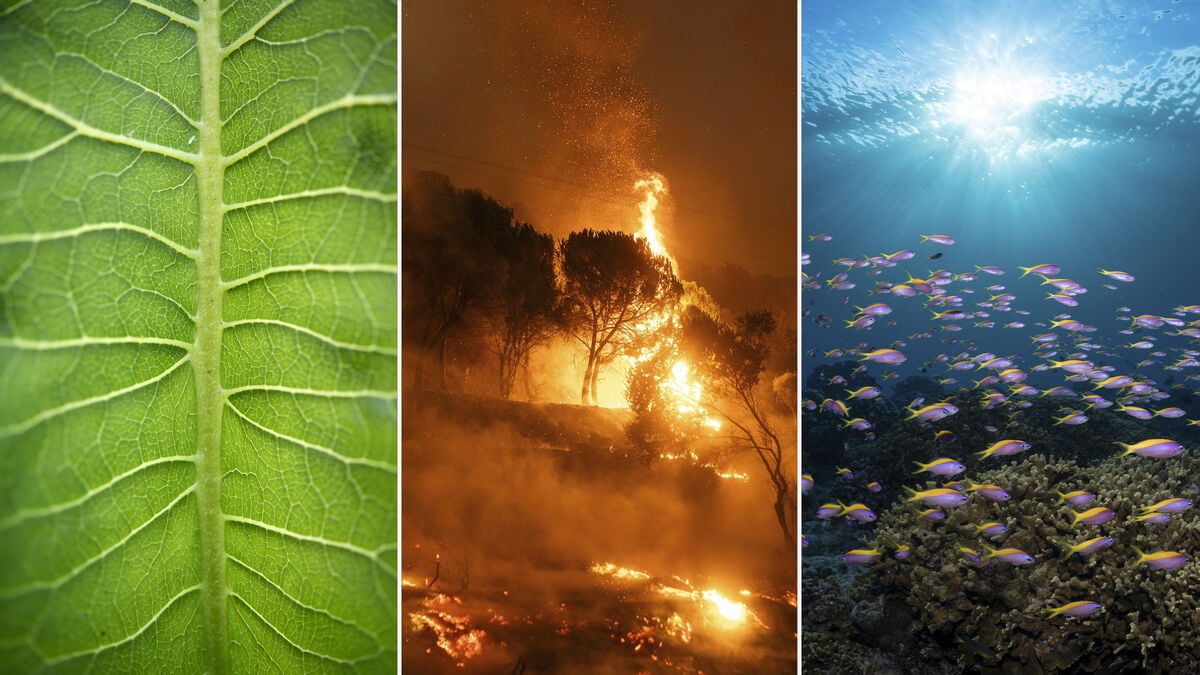
When plants absorb sunlight and, through photosynthesis, convert water and carbon dioxide into oxygen, they also emit a faint glow, called fluorescence. The human eye cannot distinguish this glow from other light, but the sensitive sensor on the Flex satellite can.
It feels like an incredible sci-fi thing. Imagine being able to see fluorescence - and managing to do it from more than 800 kilometres away, says Marco Celesti, a scientist studying the Earth's surface at the European Space Agency, ESA.
In early September, ESA will launch Flex into orbit around the Earth, from where it will follow this light.
We get an instant snapshot of actual photosynthesis.
Visible immediately
Other satellites can track how green the vegetation is over time. Flex sees what is happening in the plant at the same time it is happening.
So when photosynthesis changes, for example due to a lack of water or nutrients, it reacts immediately. So we can detect stress factors before they are visible, says Celesti.
The researchers hope to gain new knowledge about how photosynthesis varies, and the connection to the amount of carbon dioxide in the atmosphere that causes global warming.
We will hopefully understand how plants and vegetation will adapt in the future.
“A workhorse”
Flex will be joined on the rocket by Sentinel-3C, which will take its place in orbit alongside its siblings 3A and 3B. It will primarily look towards the oceans and collect data on temperature, colour, levels and how they are doing.
"If I had to describe it in one word, it's 'workhorse.' It does so many different things and is crucial for much of the information we collect about weather, climate and pollution," says Simon Proud, an optical space scientist at ESA.
Where Flex specialises is Sentinel-3C, which is packed with instruments that can also provide information about the atmosphere and land. New for this satellite is that data will be sent faster, to be able to warn of forest fires within an hour, following a request from the Swedish Meteorological and Hydrological Institute (SMHI).
Places like northern Sweden and Finland have large unpopulated forest areas. If we can detect fires within an hour, it can really help the fire service find them before they get too big.
Flex is a satellite equipped with a spectrometer that can detect the weak light that plants emit during photosynthesis, with a resolution of 300 by 300 metres.
Sentinel-3C is part of the European Copernicus climate service, whose satellites orbit the poles and collect a wealth of data. The satellite is the third in the Sentinel-3 series (after 3A and 3B), and its instruments measure sea levels, colours and temperatures.
The satellites' central computers come from Beyond Gravity in Gothenburg, which also made a data link antenna for Flex.
The satellites will be launched with a Vega-C rocket from ESA's launch site in Kourou, French Guiana, as planned on the night of September 15.
Sources: ESA, Beyond Gravity