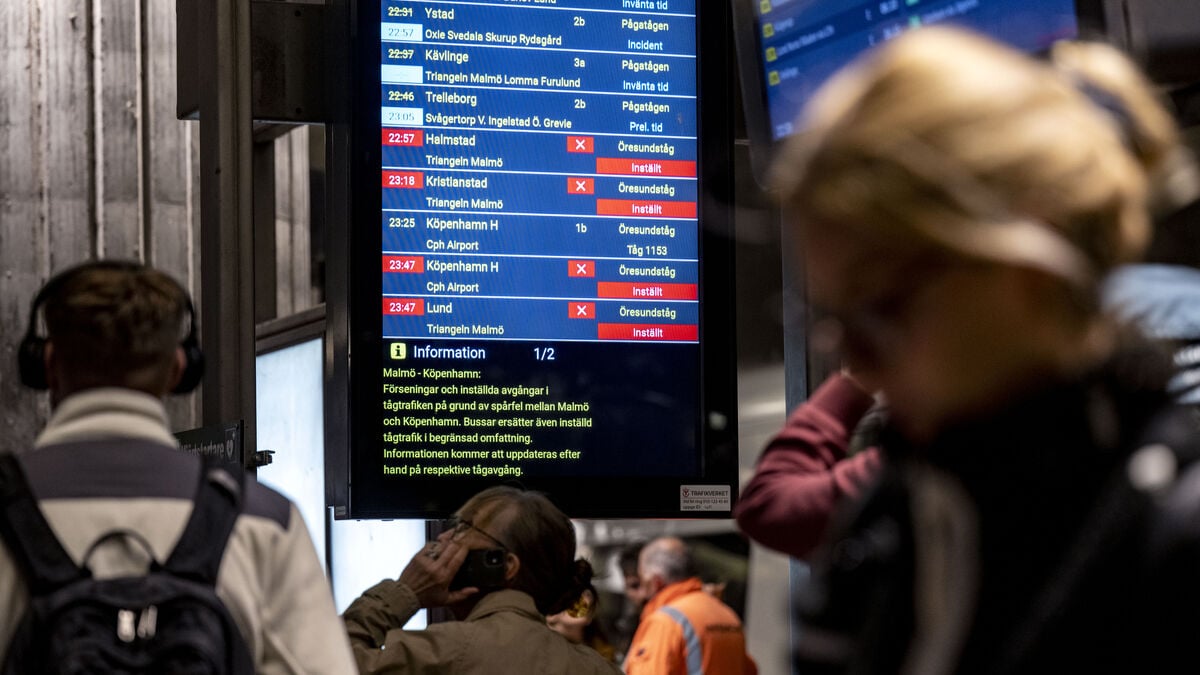
"Nine out of ten trains on time" was the message when the Swedish Transport Administration presented the preliminary statistics on passenger train punctuality for last year earlier this year.
However, it is a truth with some qualifications, according to Carl-William Palmqvist, a senior lecturer at Lund University who researches delays and punctuality for passenger trains.
What the numbers show and how the numbers are presented are slightly different things. They announced that almost nine out of ten trains arrive on time as if that were a good thing. But punctuality remains at rock-bottom levels.
“Doesn’t get dark”
In recent years, cancelled trains have also not been included in the official statistics. This has attracted some criticism, admits Thomas Andersson, head of unit at the Swedish Transport Administration.
"Of course we are not hiding any figures. But when it comes to cancelled trains, we have had technical limitations for a period of time in obtaining reliable figures," he says.
At the same time, we know that cancelled trains also affect travelers, so we are working hard both to improve the statistics and to reduce the number of cancelled departures.
Starting Thursday, when Traffic Analysis publishes its final statistics for 2025, urgently cancelled trains (trains cancelled less than a day before departure) will be reported again.
However, the change itself does not play a big role, says Carl-William Palmqvist.
In general, punctuality is too poor, and if you count the cancelled trains, it gets even worse.
But I don't really think there's anything wrong with the punctuality measure itself. It's just that the level of ambition is too low.
“Positive trend”
Last year, according to Traffic Analysis, 88.6 percent of trains arrived within five minutes of schedule.
However, if you include the cancelled trains, the figure drops to 86.9 percent. This represents an improvement of 2 percentage points compared to 2024 - which was, however, a record low.
But it is still a step in the right direction, says Thomas Andersson.
We are seeing a positive trend in punctuality, while we are running more trains and also carrying out more maintenance and upgrades of the infrastructure than ever," he says.
There was a slight dip in the curve in the first half of January. But if we look at the whole picture, I hope the positive trend continues.
Last year, 86.9 percent of passenger trains arrived no more than 5.59 minutes behind schedule. The rest arrived later or were cancelled with less than a day's notice.
This is 2.0 percentage points better than in 2024, but still represents the third lowest reading in the last ten years.
Last year, 19,245 out of a total of 1,050,731 trains were cancelled at short notice. This corresponds to 1.8 percent and is 0.7 percentage points better than in 2024.
Excluding cancelled trains, 88.6 percent of trains were on time.
Late trains caused just over 63,000 hours of delay last year. This is an improvement of 13.5 percent compared to 2024.
Source: Traffic Analysis
There are several different ways to measure train punctuality.
The Swedish Transport Administration uses the industry metric RT+5 (right time + five minutes). This means that a train must have reached its final station no later than 5.59 minutes after the scheduled time to be considered punctual.
Traffic Analysis, which publishes the official statistics, will reintroduce the STM (weighted reliability measure) as of Thursday.
STM includes all trains that have been operated as well as trains that are urgently cancelled (i.e. trains that are cancelled within 24 hours of scheduled departure).