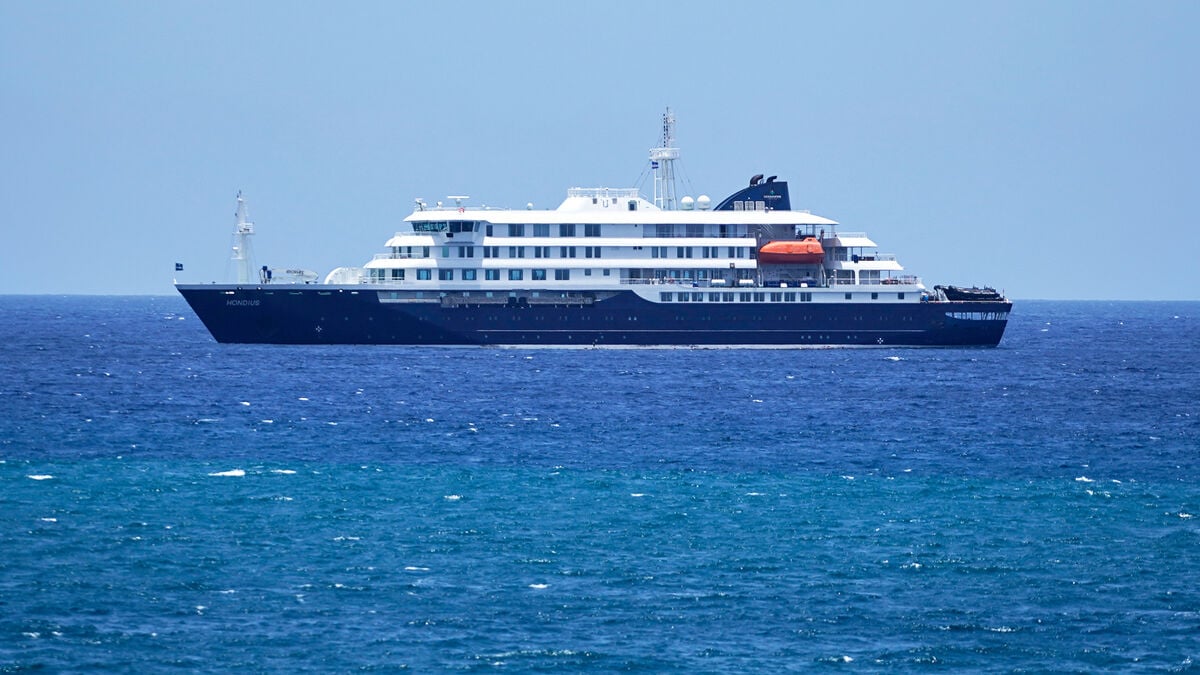
March 20: 149 people board the ship in Ushuaia, Argentina. There are 28 different nationalities among the passengers and crew. One Swede boards.
April 6: A 70-year-old man from the Netherlands falls ill with fever, headache, abdominal pain and diarrhea. On April 11, he dies at sea.
April 24: The ship reaches St. Helena, where the deceased man is disembarked with his wife. She begins the journey home to the Netherlands. At the same time, about 30 people leave the ship and travel home to their countries, among them the Swedish man. A British man who remains on board seeks treatment for a fever.
April 25: The Dutch woman flies to South Africa. She feels unwell during the journey and upon arrival in Johannesburg she faints and dies in hospital the following day.
April 27: The British man who has sought treatment becomes worse and is flown by helicopter from the ship to South Africa, where he is admitted to intensive care.
April 28: A German woman falls ill on the ship; she dies four days later at sea.
Outbreak is detected
May 3: MV Hondius reaches the waters around Cape Verde, its intended final destination. However, the passengers are not allowed to disembark because three people on board have been in close contact with the deceased German woman. At the same time, hantavirus is confirmed in two cases and officials conclude there is an outbreak.
May 6: A former passenger has contracted hantavirus and is being treated in Zurich. In South Africa, authorities confirm that tests have detected the Andes virus, the most dangerous variant of hantavirus and the only one believed to be able to transmit between humans.
May 7: People who have had contact with the deceased German woman are evacuated to the Netherlands. At the same time, reports emerge of the first suspected case of hantavirus outside the ship. A flight attendant, who had contact with the Dutch woman who died of the virus on April 26, is isolated in hospital with mild symptoms.
WHO states that no one on board has symptoms of infection and that the cabins are being disinfected. If anyone shows symptoms, they will be isolated.
What happens now?
Former cruise guests are being monitored and have been quarantined in several parts of the world.
The ship is en route to Tenerife, where the remaining 100 people on board will be allowed to disembark on Saturday, from where they will be flown home.
The cause of the outbreak is under investigation. Investigators in Argentina believe the virus may have originated from a garbage dump where two passengers had been birdwatching.
Facts: Hantavirus
Hantavirus infections are caused by around 35 different closely related variants of hantavirus that have been reported worldwide.
Hantavirus infection is a zoonosis, meaning a disease that can be transmitted between animals and humans. In one variant, the Andean virus, which is mainly found in South America, transmission between humans has also been demonstrated.
In Sweden, only the puumala virus variant, which causes the disease bat fever, is found.
Each hantavirus has a specific rodent species as its host. Hantavirus does not normally cause disease in rodents, but they can carry the virus for a long time. Viruses are excreted in the urine, feces, and saliva of infected rodents.
Infections can range from asymptomatic to very severe hemorrhagic fever or acute pulmonary syndrome with a high mortality rate.
Source: Public Health Agency of Sweden