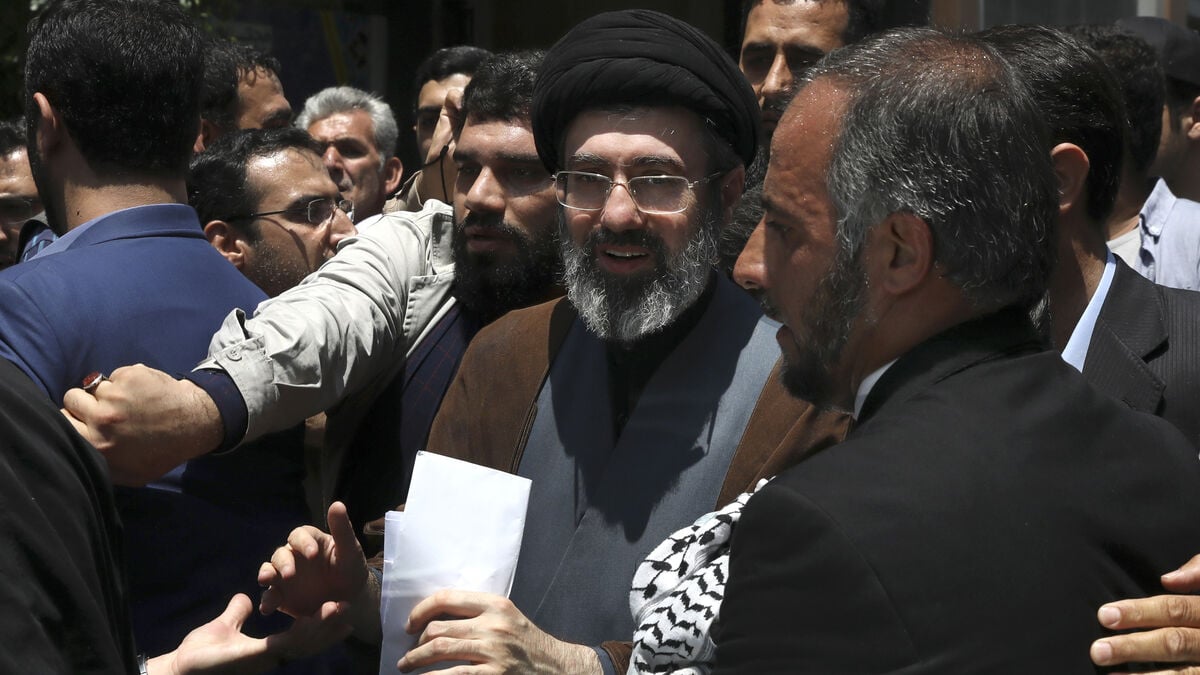
Mojtaba Khamenei, 56, has reportedly wielded significant influence behind the scenes. He has strong ties to the powerful Revolutionary Guards and his elevation to supreme leader could be seen as the country's military tightening its grip on power.
There have been several signs that the Iranian leadership has been preparing for Mojtaba to take over from his father for some time. He has begun to be called the Ayatollah in state media and has been increasingly seen in public.
Criticism of inherited power
What has worked against him, however, is that criticism of inherited power was a major factor in the 1979 revolution, when the widely despised monarchy was overthrown. Mojtaba Khamenei has not held a high position within the country's clergy and lacks an official role in the regime.
His father, Ali Khamenei, is believed to have six children, but only Mojtaba has been given a prominent public role.
The US imposed sanctions on him in 2019, citing that he was allowed to act as a representative of the supreme leader "despite never being elected or appointed to any governing position". According to the US, Ali Khamenei delegated some of his power to the son, who is said to have had close cooperation with the notorious Basij militia and the Revolutionary Guard's Quds Force, which is responsible for operations abroad.
Appointed for life
According to the constitution, the country's supreme leader must be male, belong to the clergy and be considered to possess both political competence and moral authority.
The 88-member Council of Experts tasked with appointing a new supreme leader has only had to make such an election once before since the Islamist regime took power in 1979: when Mojtaba's father was appointed to succeed Ayatollah Ruhollah Khomeini in 1989.
The supreme leader is appointed for life.
Power in Iran stems from the supreme leader, who is seen as a representative of the twelfth imam who, according to Shiite Islam, disappeared in the 9th century and is expected to return one day.
The Supreme Leader is elected by the so-called Council of Experts, which can also formally remove him. The Council of Experts consists of 88 clerics who are elected in general elections every eight years – but all candidates must first be approved by the so-called Guardian Council, of which six out of twelve members are appointed by the Supreme Leader himself.
The rest of the Guardian Council is appointed by Iran's chief prosecutor (who is chosen by the Supreme Leader) and then approved by parliament. However, all candidates for parliament and the presidency must be approved by the Guardian Council.
The Supreme Leader is the commander-in-chief and appoints all senior positions in the judiciary, state media, and the so-called Mediation Council, which mediates disputes between parliament and the Guardian Council. He also has veto power over all important decisions made in the country.
Sources: Landguiden/UI, Uppsala University