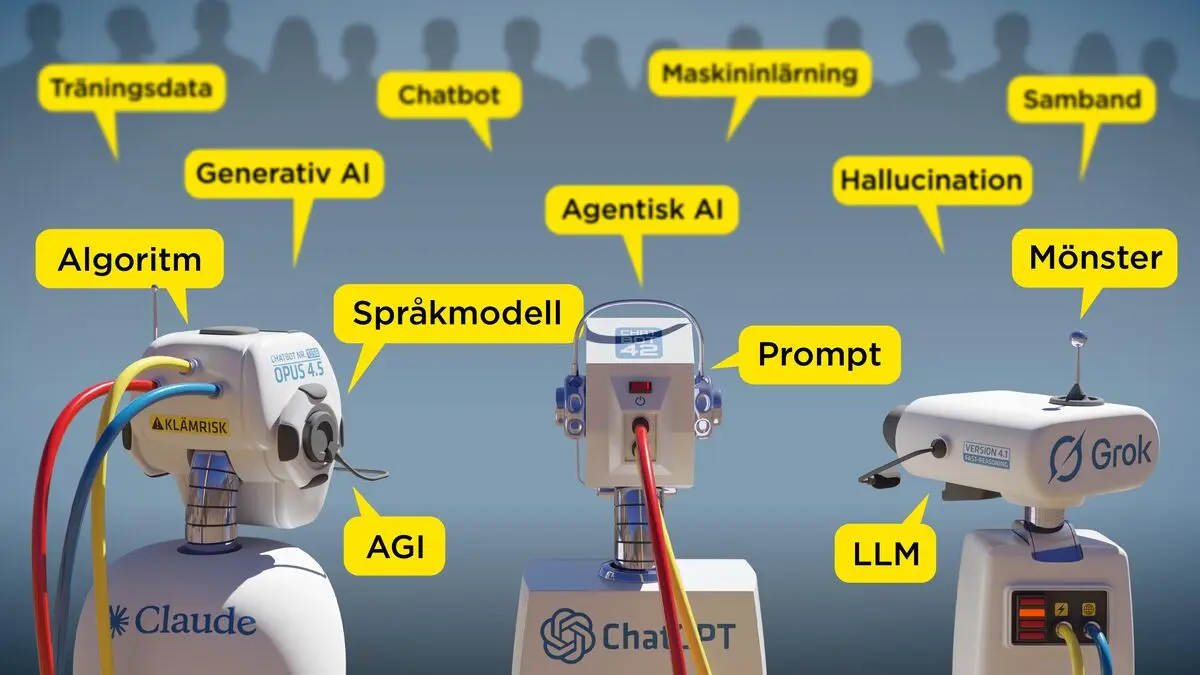
Algorithm:
An algorithm is a set of instructions. Algorithms solve problems and perform calculations. Multiple interconnected algorithms solve more complex problems. Humans have written many of the algorithms that control various AI services, but it is becoming more common for AI services to write algorithms for other AI services.
Generative AI:
AI that can create or generate content. It can be, for example, text, images, sound or video. ChatGPT, Claude, Grok, Midjourney and Sora are examples of generative AI services.
Training data:
In a broad sense, training data is the information that an AI is built on. In a somewhat simplified way, it can be said that, for example, ChatGPT has "learned" from large amounts of images and text on the internet and can then generate its own images that "copy" the style the user wants.
Machine learning:
A basic concept behind much of the AI that has become popular in recent years. Machine learning allows the computer to find patterns and relationships from a huge amount of data, rather than giving instructions from the outset about how to do something. It is especially important that the training data is correct so that the AI service does not become biased.
Chatbot:
A program that can "talk" to a user. Early versions were used, for example, in customer service to answer specific questions. Today’s variants are essentially synonymous with the most popular AI services like ChatGPT, Gemini, and Claude - programs that can "talk" to a user with broad conversational ability and provide answers to questions about anything.
LLM:
Stands for large language model - refers to the underlying "engine" that powers, for example, Gemini and ChatGPT. By training the model on enormous amounts of text, the model can predict the next word.
Prompt:
The instruction a user gives to an AI service. For example, "write a haiku poem about cats" or "check my calendar for a two-hour slot for a moderate workout next week."
Hallucination:
A hallucination occurs when an AI service makes up facts, such as inventing who the prime minister of the United Kingdom is or how many goals Sweden scored in a past World Cup match. AI has no consciousness or intelligence in the human sense and sometimes fills in missing information with something that "sounds right" based on the training data the model or service has.
Agentic AI:
Collective term for AI that performs actions that were previously only performed by humans and sets its own goals. This can be writing code, booking meetings or trading. An individual AI agent is often a more specific "service" such as booking a meeting. Agentic AI as a concept involves a more independent "thinking" system.
AGI:
AGI stands for artificial general intelligence and is a hitherto theoretical level of AI that can do more than it has been trained to do - basically everything a human can do. Although Gemini, for example, can do a lot, it is trained for specific purposes and areas of use. AGI, depending on who you ask, would be the next level of AI - AI that is like the smartest human in every field, or smarter.