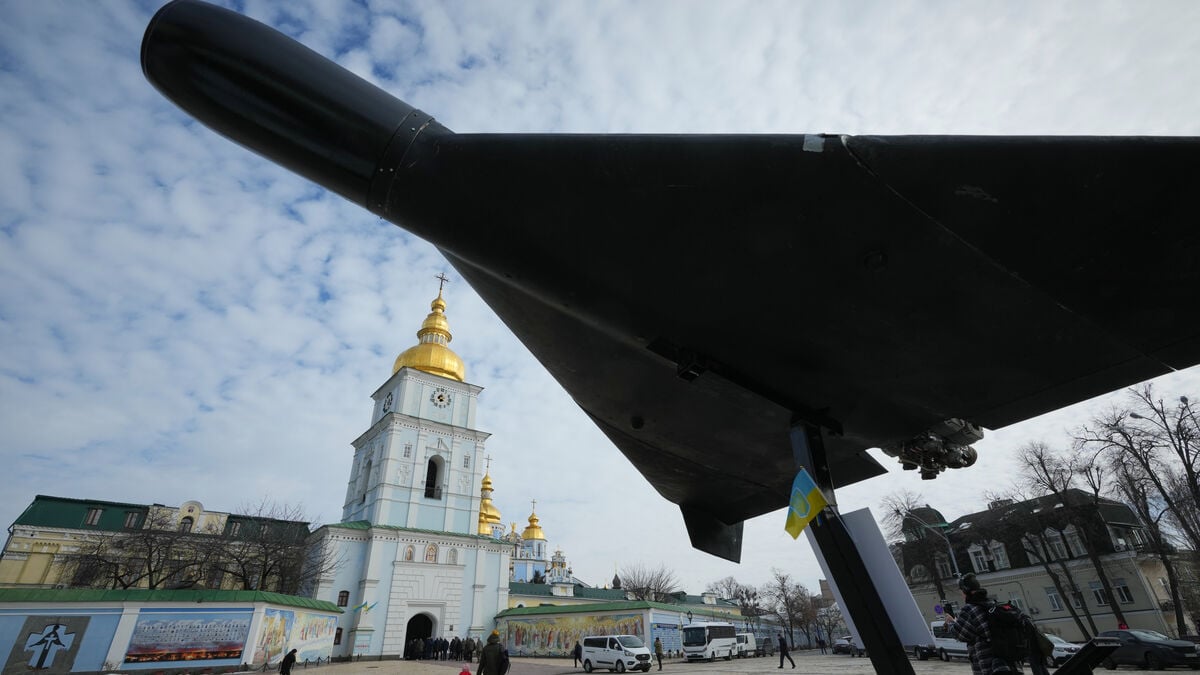
The change came a week or so ago. From attacking mostly at night, Russia now sends drone bombers around the clock. And the new Geran-4 model is jet-powered, meaning it flies at 500 kilometers per hour - too fast for many of Ukraine's defence systems.
I've lived here for a year and a half now, and it's kind of a different... feeling, I should say, says Daniel Wallinder, head of the Swedish Red Cross in Ukraine.
Many here have started to develop more stress reactions. My Ukrainian teacher, for example, has an eight-year-old son. For the first time since the war began, this boy cried during an attack.
It was the same explosions, the same sounds they had heard so many times before. But this time, emotionally, it was simply too much.
More warning earlier
Wallinder also travels to cities closer to the front, such as Sumy and Kharkiv, where schools have already moved much of their operations underground. But in the multi-million city of Kyiv, most schools have not had time to plan for the new situation. When the fall semester begins this week, they will have to deal with the air raid sirens like everyone else.
I'm thinking of preschools, for example, they might have a group of 40 small children that the teachers need to dress, go outside and then go down to a shelter or the subway.
With the jet-powered drones, the time you have to react has also become shorter.
It might be 3-5 minutes. In the past, we had longer notice.
A new everyday life?
Adding to the fear is the possibility of ballistic missiles. They are rarer - because they are much more advanced and more expensive for Russia to use - but an even worse threat.
"When it comes to ballistic missiles, there's maybe one or two minutes' warning. If any at all," says Wallinder.
Sometimes you hear the bangs before the air raid sirens go off.
The question is whether the latest attack patterns are temporary, or a new normal.
It is a big adjustment to have to think about whether we need to build underground schools in Kyiv too or how to change the situation.
A quick fix is for children to be able to stay home and be taught digitally, but that also has its downsides.
It's tricky, many children are forced to stay home alone, perhaps for an entire school day, because their parents are working, says Daniel Wallinder.
Early in its full-scale offensive war against Ukraine, in 2022, Russia gained access to Iran's Shahed-136 attack drone model, which the Russian military has dubbed the Geran-2. It is powered by a small gasoline engine, originally of German design, and has an explosive charge of around 50 kilograms that detonates on impact. The Geran-2 flies at just under 200 km/h. Ukraine has now learned to largely jam or shoot them down.
A jet-powered variant, the Shahed-238/Geran-3, was introduced in 2023, which was much faster. Russia has since developed the design into the Geran-4 and Geran-5 variants, which have increasingly longer range and better protection against being shot down - partly with the help of technical components from China and the US, among others, according to Ukraine.