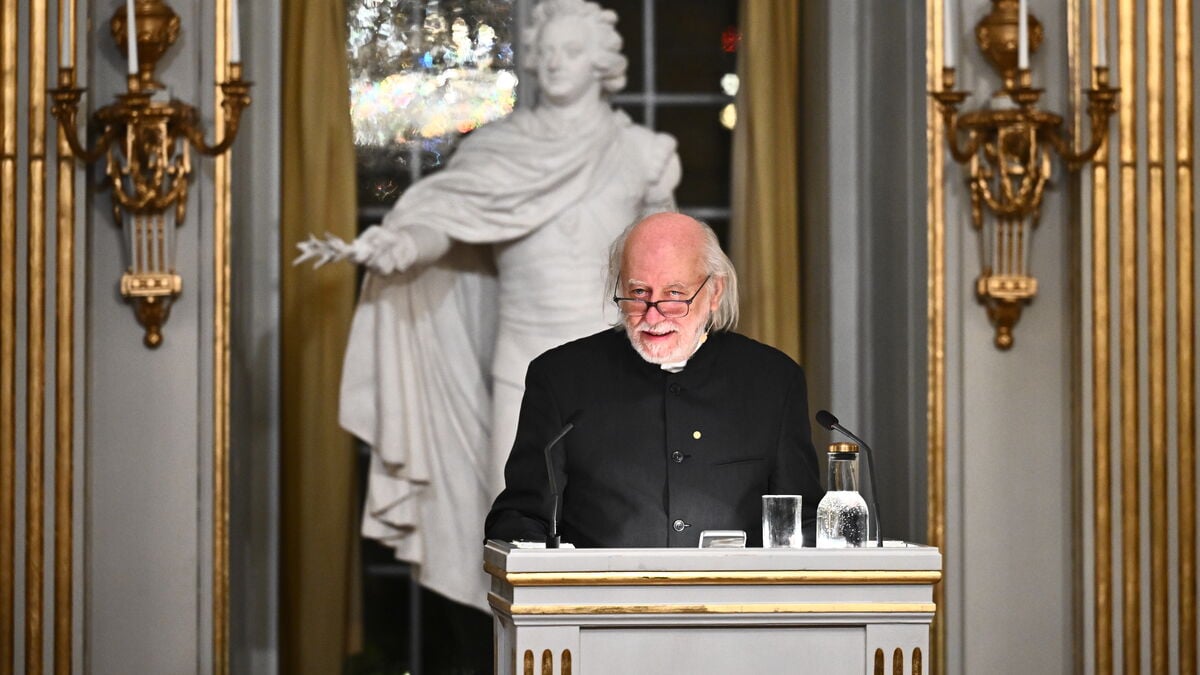
"Don't believe your eyes," Krasznahorkai tells the audience in the packed Stock Exchange Building in Old Town, Stockholm.
This year's Nobel Prize winner finds himself pacing back and forth, not in the Stock Exchange Building but in his study in an unheated tower built of cheap red spruce planks.
The study is not in an ivory tower, he emphasizes, and the tower design itself is due to a sloping plot. He needed to build at a height to accommodate all his books.
Few sentences
The lecture is written in his characteristic way with multi-page sentences and a few bullet points. Instead of reflecting on hope, Krasznahorkai talks about a new kind of angels in everyday clothes who walk silently around the earth and are “actually” easy to spot.
They step into our lives at a different pace, at a different beat, to a different melody, than the pace we walk at, where we struggle and wander around in the dust down here, he says.
The angels look at the human being in prayer, hoping for a message they don't receive. Instead, they find themselves, defenseless, in a place with "Elon Musk and their crazy designs."
Man, in turn, has plundered everything he could, and "in step with all the sciences and historical strides" has suddenly stopped believing in "anything at all," according to this year's Nobel Prize winner.
Should humans sink into a flooded swamp or move to Mars? The tools they have created have destroyed imagination and made memory very short-term.
So you abandoned the noble and common domains of knowledge and beauty and morality, he says.
Pee drops
How is that going to work? Krasznahorkai concludes with the insight into a possible uprising. In the Berlin subway in the early 1990s, he witnessed a heated police chase after a tormented vagrant who, in great pain, tried to urinate a few drops in an unauthorized place near the tracks.
“Like lightning,” Krasznahorkai was struck by the question of whether and when this “clochard and all the other pariahs will rise up.”
My feeling is that I have thought just about everything and said just about everything I think about the rebellion, about human dignity, about the angels, and yes, maybe just about everything – even about hope.
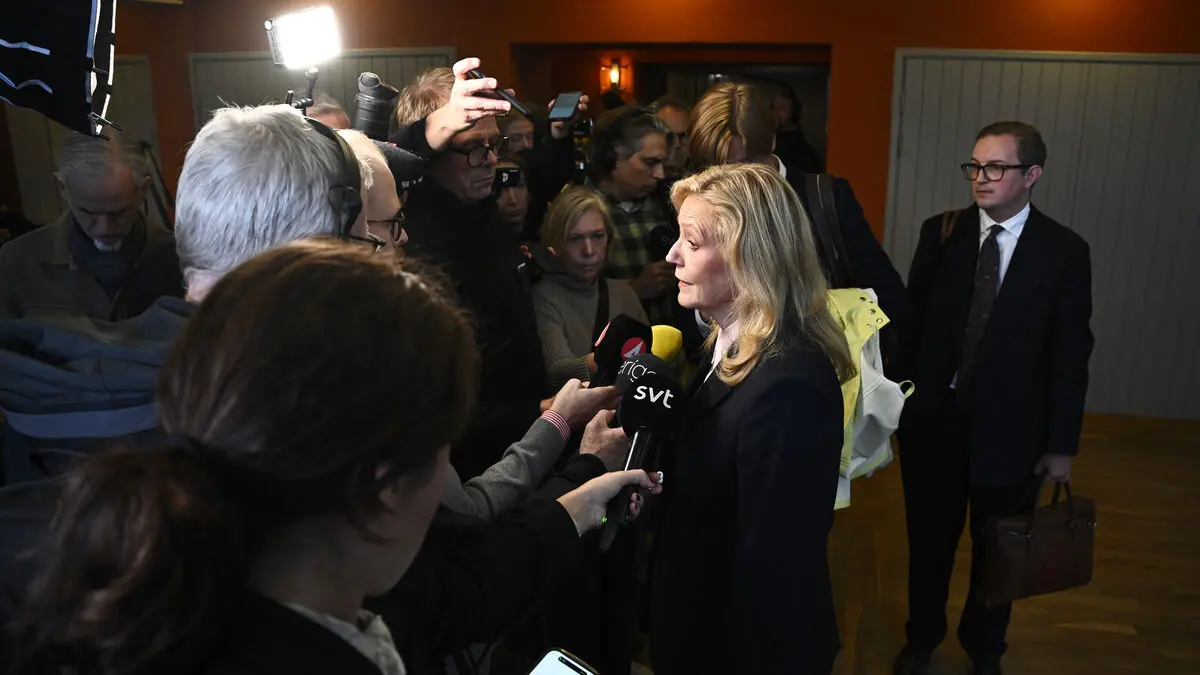
After the lecture, Krasznahorkai was presented with flowers by the Academy's permanent secretary, Mats Malm. Actress Melinda Kinnaman then recited passages from the English translation of the novel "Seiobo där nere" and from the short story collection "The world goes on".
Facts: Laszlo Krasznahorkai
Born: 1954 in Gyula, Hungary.
Lives: Szentendre (Hungary), Vienna (Austria) and Trieste (Italy).
Background: Studied law, Hungarian and literature at university. Debuted as a writer in 1985 with "Satantango" which was a great success. Quickly became known for his uncompromising style. Left his homeland in 1987 and has since lived in several other countries.
For his "visionary and powerful writing that, amidst the horror of doom, maintains faith in the possibilities of art," he is awarded this year's Nobel Prize in Literature.