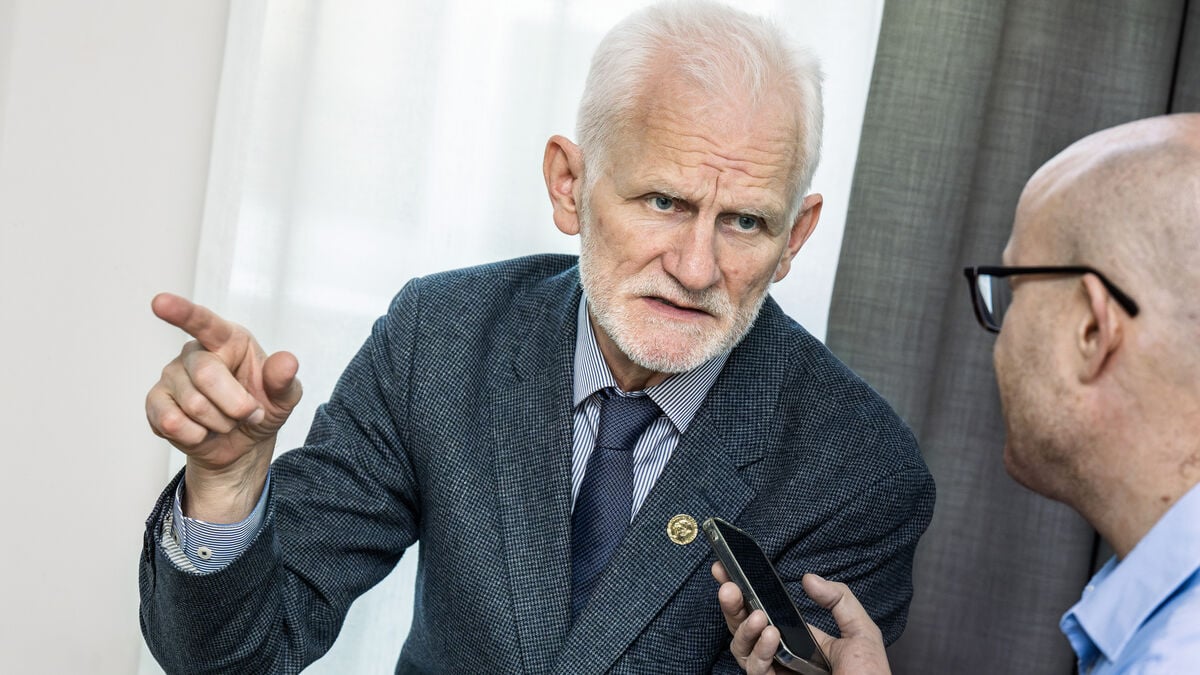
Ales Byalyatski was sitting in a detention cell in Minsk when he heard the news from his lawyer: He had been awarded the Nobel Peace Prize.
"I screamed like I was stung by a bee. I couldn't believe it was true," he says of the 2022 announcement.
He never received any official congratulations. However, the Belarusian tax authorities did contact him and asked if he intended to pay taxes on the prize money.
Nobel Prize provided protection
Three years ago, Byalyatski, Belarus' most famous human rights defender, was sentenced to ten years in prison.
The 63-year-old does not regret not leaving Belarus before he was arrested. At that time, several others in Vyasna, the organization he founded, were already in prison.
"It was a conscious decision to stay. There was so much repression and we were working to help the victims and their families, so our place was there," he says.
His status as a Nobel laureate gave him a certain amount of protection in prison, he says.
"Other prisoners were beaten, but they didn't touch me."
Released after plea bargain
Byalyatski was arrested after the major protests that broke out against dictator Aleksandr Lukashenko in connection with the 2020 presidential election.
In December 2025, he was released and deported along with a large number of other political prisoners after a deal with the US. In exchange, the totalitarian regime in Minsk received relief from sanctions.
Today, Vyasna continues to document the regime's human rights abuses in exile. Many political prisoners are still locked up.
"Active resistance in Belarus is impossible today. People are afraid of losing their jobs or being arrested," says Byalyatski.
"Don't forget Belarus"
It was in prison that he learned that Russia, with the support of Belarus, had launched a full-scale invasion of Ukraine. According to Byalyatski, the future of Belarus depends on how things go in Ukraine, since a weakened Putin means a weaker Lukashenko.
Lukashenko understands that the war has reached a dead end and that they cannot achieve what they hoped for, to join Ukraine to the Russian Empire. That is why he started negotiating with the Americans.
Ales Byalyatski has a clear message to Sweden and the EU:
Don't forget Belarus, even though crisis after crisis follows crisis. The regime has very little support and there is widespread discontent. That is why the repression continues, because they know that otherwise they will lose power.
Alyaksandr "Ales" Byalyatski was born in Värtsilä (Vjartsilja in Russian) in Russian Karelia in 1962.
He is a trained teacher and linguist and was involved in human rights work in then-Soviet Belarus as early as the 1980s.
In 1996, he founded the human rights organization Vyasna (Spring), which was banned in 2003, but has nevertheless continued to operate.
In November 2011, Byalyatski was sentenced to 4.5 years in prison for "large-scale evasion of income". He was released early in 2014, but was arrested again in 2021 and sentenced first to 7 years in prison for tax evasion and then to 10 years in prison for smuggling and financing political protests.
Byalyatski has received a number of international awards for his work: the Council of Europe's Vaclav Havel Prize in 2012, the EU Parliament's Sakharov Prize and the Swedish Right Livelihood Award in 2020, as well as the Nobel Peace Prize in 2022 (shared with the Russian organization Memorial and the Ukrainian Center for Civil Liberties (CCL)).