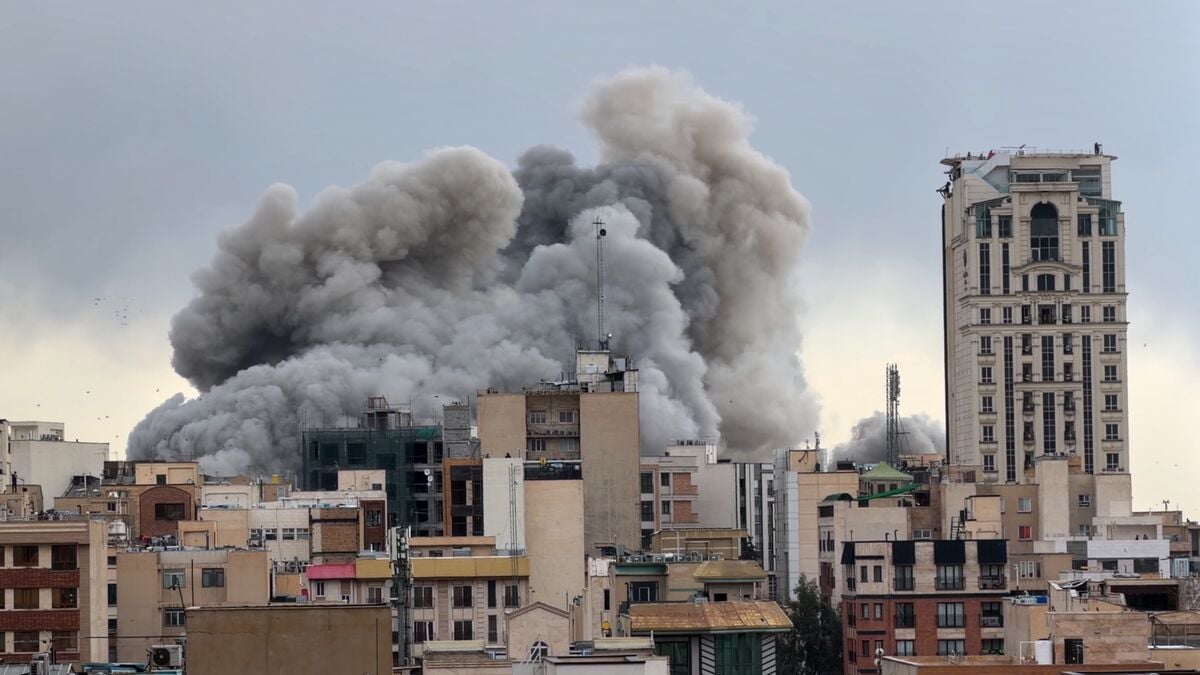
"We're beating the crap out of them. I think it's going very well," US President Donald Trump told CNN on Monday.
He has also suggested that the war, which started with Israel and the US's large-scale attacks on Iran on Saturday, could last for over a month and that the "big wave" has not yet arrived.
On Tuesday, loud explosions were reported in several waves in Tehran, where Israel first claimed to have attacked the presidential office and the Security Council. Then the building in Qom, south of the capital, where Iran's future government was to be formed, was reported destroyed.
In parallel, Iran's feared Revolutionary Guard warns that the "gates of hell" will open against the US and Israel.
Strikes back
According to US Secretary of State Marco Rubio, the primary goal of the war is to destroy Iran's ballistic missile program and the threat Tehran poses to global shipping. Israeli Prime Minister Benjamin Netanyahu claims on Fox News that the attacks were urgent because Iran was building missile and nuclear facilities that would soon be "immune" to attack.
But Iran, whose Supreme Leader Ayatollah Ali Khamenei was killed in the initial attacks, is retaliating broadly. Several countries in the Middle East, mainly those friendly to the United States or Israel, are being attacked.
During the night, explosions were heard in the Saudi Arabian capital, Riyadh, where drones caused a limited fire at the US embassy. In Kuwait, the US has closed its embassy after attacks. Ballistic missiles have been shot down in Qatar and Oman. The United Arab Emirates and Bahrain, where a US military base is said to have been destroyed, are also under attack by Iran.
For civilians and travelers, the bombardment means anxiety, canceled flights and, in some cases, evacuations.
Funeral coverage
In Iran, Israel has attacked the state television and radio building in the capital. According to Israel, the facility has been destroyed, but the broadcaster is still on the air.
As of Tuesday morning, 787 people had been killed in Iran, according to figures from the Iranian Red Crescent.
In parallel, Israel has also attacked the pro-Iranian Shiite militia Hezbollah in neighboring Lebanon, resulting in dozens of deaths.
Background: How the Iran War Started
On February 28, the United States and Israel attacked Iran, without support from the UN Security Council. The attack was described as a preemptive strike to prevent the country from developing nuclear weapons. Iran's Supreme Leader Ayatollah Ali Khamenei and several other leaders were killed in the bombings.
A year earlier, in March 2025, US President Donald Trump sent a letter to the Ayatollah to initiate new negotiations over Iran's suspected nuclear weapons program. Five meetings were held but yielded no results.
On June 22, the United States entered the then ongoing war between Israel and Iran and bombed three nuclear energy facilities.
In September, previous UN sanctions on Iran were reimposed. The economy deteriorated and popular protests erupted before the turn of the year. Trump said he was prepared to intervene on the side of the protesters when they were killed in their thousands - but that did not happen.
In early 2026, US military forces gathered in Iran's vicinity.
New negotiations with the Iranian regime began on February 3, without results.