Samuel Commey Tetteh gave half a century to the teaching profession. He was buried in a pencil case.
Frederick Teiko Ofori played guitar most of the time. So when he died, his family decided that his body would be laid to rest in a guitar.
Ghana's "fantasy stories" serve as both a celebration of the lives and livelihoods of the dead and a gateway into the afterlife. For the Ga people, a group that originated in fishing villages east of Ghana's capital Accra, death is just a stop on the road. The journey to the realm of the ancestors is preferably undertaken in a vessel that is as unique and personal as possible.
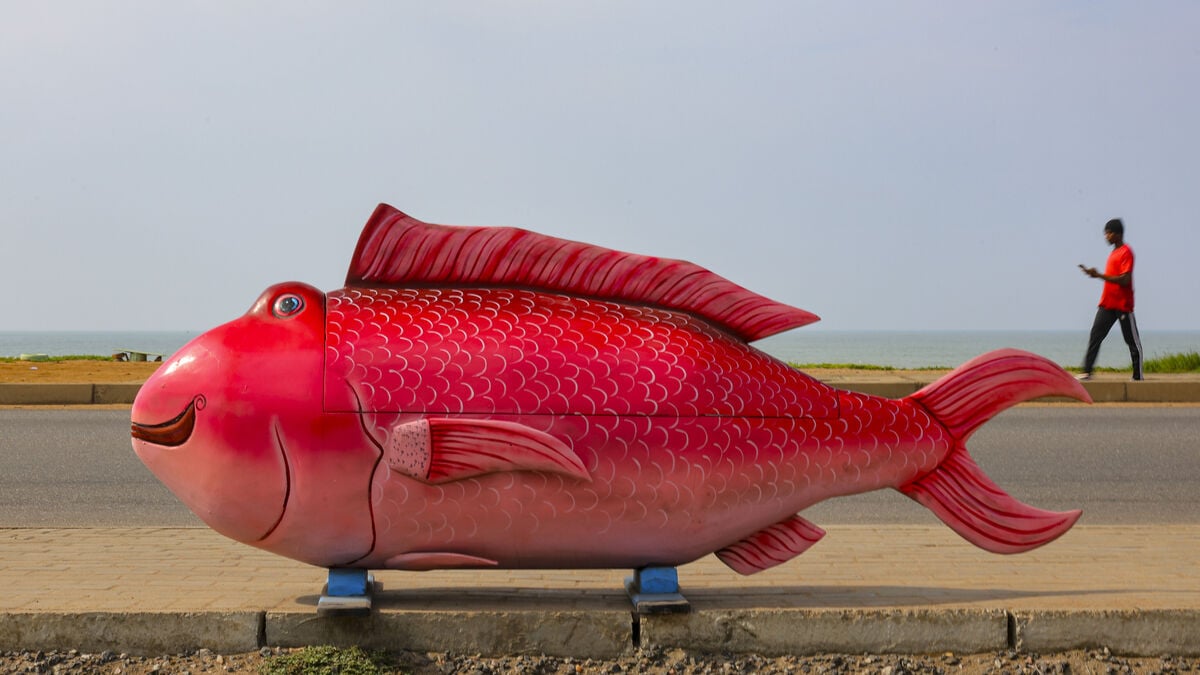
The idea is also that the coffins will serve as a presentation when the deceased meet their ancestors in the afterlife. Fishermen are buried in huge fish, farmers in cocoa pods, drivers in wooden cars. Shoemakers in elegant loafers, bar owners in giant beer bottles.
Banned during colonial times
Daniel Oblie Mensah, who sculpted both Samuel Commey Tetteh's pencil case and Frederick Teiko Ofori's guitar, has been creating personalised caskets for over three decades.
"Every time someone orders a coffin from me that reflects the deceased's profession, I get enthusiastic," the 54-year-old told the AFP news agency.
It allows me to truly honor the deceased and their family.
The tradition emerged in the first half of the 20th century. At that time - during the British colonial period - large traditional funeral ceremonies were discouraged or even banned in Ghana. The Ga people developed a symbolic solution with rituals held in secret, often at night, with coffins identical to the ceremonial palanquins used by traditional chiefs.
Contests for gifts
Today, fantasy coffins have become a phenomenon and a business. Coffins made just for the sake of being admired are displayed in museums around the world, and in Ghana, tourists and influencers pay to attend private mourning ceremonies.
The coffins are expensive. It is not uncommon for the family to go into debt to arrange the most spectacular funeral possible, Swiss social anthropologist Regula Tschumi, who has researched Ghanaian funeral culture, tells the magazine Domus.
Funerals compete to attract visitors and donations - if they are not lively enough, there is a high risk that people will simply not donate money, she says.
At the same time, the eye-catching coffins can provide a much-needed break from grief, coffin sculptor Eric Kpakpo Adotey told the AP news agency.
People forget for a moment what's inside. They admire the coffin and the mood changes.
West African Ghana came under British rule in 1821. The entire area became a British colony in 1901, then under the name Gold Coast.
Before that, the country had long been a centre for the gold and slave trade. Sweden also had trading interests in what is now Ghana, and in the 1650s built the fort of Carolusburg at Cape Coast from where they traded gold, ivory and people.
After Ghana's independence in 1957, its economy was impoverished by military coups and unstable regimes. However, Ghana is now considered one of Africa's most developed and stable democracies.
Ghana is located on the Gulf of Guinea and has a population of over 34 million people divided into up to a hundred different ethnic groups. The capital is Accra. Current President John Dramani Mahama came to power in 2025, after also governing the country from 2012–2017.
Gold, cocoa, oil and gas are important export industries and China is an important trading partner. Tourism is a growing industry.