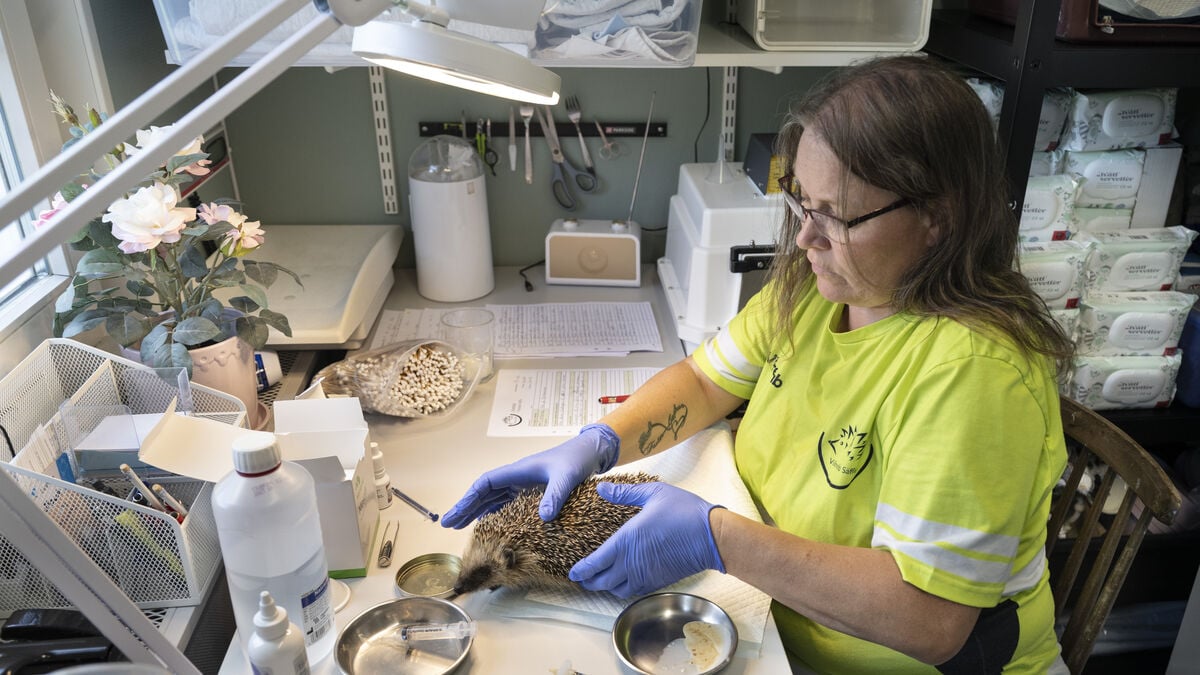
Two baby hedgehogs from Västra Frölunda recently arrived by animal ambulance at Säffle's wildlife rehabilitation centre in southwest Värmland.
They only weighed between 70 and 100 grams. Since they were so small, they had probably never been outside the nest before. Something had probably happened to the mother, and after a few days, when the young started to starve, they found their way out, says Angelica Magnusson, who has been running Säffle Wildlife Rehabilitation on a voluntary basis for the past three years with her partner Mats Johansson.
The following day, four more young were left with Angelica Magnusson. They, like their two siblings, had been found on a large lawn between two apartment buildings in Västra Frölunda.
Killed immediately
The four young that arrived last seemed lively, but when Angelica Magnusson began examining them, she immediately discovered crawling fly larvae in the young's eyes and in wounds on various parts of their bodies.
Fly larvae are the worst thing that can happen to a hedgehog. If it's just fly eggs, they can survive. The eggs, which look like small grains of rice, are clustered in the fur and can be removed with tweezers. But the fly larvae usually hatch quickly - in just a few hours. It's painful for the hedgehog because the larvae eat into the tissue, says Angelica Magnusson.
The four young in which fly larvae had already begun to eat into their bodies were euthanized immediately.
"Being forced to euthanize animals is the absolute worst thing about running a wildlife rehabilitation centre. We want to protect the animals. But the most important mission we have is actually to be able to shorten the animals' suffering when necessary," says Angelica Magnusson.
Starting this autumn, the hedgehog will be protected as a species for the first time. It is classified as vulnerable on the Red List and its population is estimated to have halved in 15 years.
Biggest threats
Robotic lawnmowers are among the hedgehogs' biggest threats. They are most often operated during the nights and early mornings - the exact time of day when hedgehogs are most active.
Veterinarian Therese Hård often sees injuries from robotic lawnmowers on hedgehogs' legs and large infected wounds with crawling fly larvae on hedgehogs that are brought in for rehabilitation.
She works as a veterinarian at the Norden Ark Foundation's zoo in Hunnebostrand, which has been accepting hedgehogs for rehabilitation since this year. The zoo also helps nearby Kottecentralen in Ed municipality with hedgehog rehabilitation.
A typical injury is a large, ugly and difficult-to-heal wound where fly larvae are eating away at the tissue. You can see it moving under the skin, says Therese Hård.
On average, she has to care for 10-15 injured hedgehogs per season. Most come in during the summer months - especially in July, when it is hottest and many hedgehogs become dehydrated.
Released back into the wild
On average, hedgehogs are rehabilitated for 1-2 weeks before being released back into the wild. A baby hedgehog stays for a few months; it must reach a weight of about half a kilogram before it can be returned to the wild.
Wild animals should not be out of the wild longer than necessary, they should be returned to where they belong. Every time they are taken into care, there is enormous stress for the animals, points out Therese Hård.
Säffle Wildlife Rehabilitation is currently taking care of 15 hedgehogs and a hare. Five squirrels were recently released back into the wild after successful rehabilitation.
One of the hedgehogs came in with a fresh wound on its back where most of the skin had been peeled off - probably by a grass trimmer or robotic lawnmower. It requires a lot of pain relief and wound care.
Both Angelica Magnusson and her partner work full-time in addition to running the wildlife rehabilitation centre, which is financed by their salaries and voluntary donations.
If there are several vet visits, it can be expensive. Likewise if we have many young inside; they need puppy milk replacement. Regular milk will make a hedgehog sick. Adult hedgehogs can only drink water.
Hedgehogs often seek out gardens where they build nests of leaves, moss and dry grass in shady and sheltered places, such as under bushes and wood sheds. They hibernate - but when this happens depends on the weather and the availability of food. Hibernation usually lasts from October-November to March-April.
Found in snowdrift
Normally, the first hedgehogs start arriving at the wildlife rehabilitation centre after hibernation. The hedgehogs that need help at that time are usually emaciated after losing a lot of weight.
This year, the first one came to us already in January. It was found in a snowdrift and had both lungworm and pneumonia. Lungworm is a common parasite in hedgehogs and causes severe coughing. It was cured with deworming and antibiotics, says Angelica Magnusson.
In July and August, there is high pressure on wildlife rehabilitation. That's when many people are mowing grass and driving. If the hedgehog mothers die in traffic, the babies will survive.
What type of injury is the worst?
The most frustrating thing is animal abuse, like when someone plays soccer with hedgehogs or sprays them with paint. We recently had two hedgehogs that were sprayed with some kind of red and green graffiti paint that wouldn't wash off. One of them was a lactating female. She glows like a stop sign with the paint and when she goes out with her babies, they become easy prey.
How long the animals stay in rehab varies.
But there is a rule. If we don't think we can complete the rehabilitation within three months, the animals should be put down because it will be too stressful for them, says Angelica Magnusson.
The hedgehog is declining in numbers, mainly in the southern part of the country, according to the SLU Species Database. The hedgehog is now on the International Union for Conservation of Nature's Red List and has been protected since this autumn.
The major threats to hedgehogs are badgers, foxes, large birds of prey, as well as robotic lawnmowers and traffic.
For the third year in a row, a hedgehog count is being organised in Sweden during Hedgehog Week week 33. During the period 10-16 August, everyone is encouraged to report on the World Wide Fund for Nature's (WWF) website if they see a hedgehog - but also if they don't see one.
The hedgehog count is initiated by WWF in collaboration with the non-profit foundation Nordens Ark, which works to preserve endangered animals and biodiversity. It is carried out with funding from the Swedish Postcode Lottery.
All observations are sent to the SLU Species Data Bank and become available for analysis. So far, in the first two years, over 105,000 observations have been registered.
Today, there are approximately 30,000 hedgehogs in Sweden.
(Source: World Wildlife Fund WWF)
The Swedish Environmental Protection Agency allows private individuals to take care of an injured wild animal for up to 48 hours. During that time, the animal must be contacted and handed over to an approved wildlife rehabilitator or released back into the wild.
Wild animals taken into care for rehabilitation are covered by the Animal Welfare Act.
When you find a wild animal, you can contact Disaster Relief - Birds and Wildlife (KFV) for advice. KFV Riks is Sweden's association for wildlife rehabilitators.
Contact information for wildlife rehabilitators across the country can be found at www.viltakuten.se.