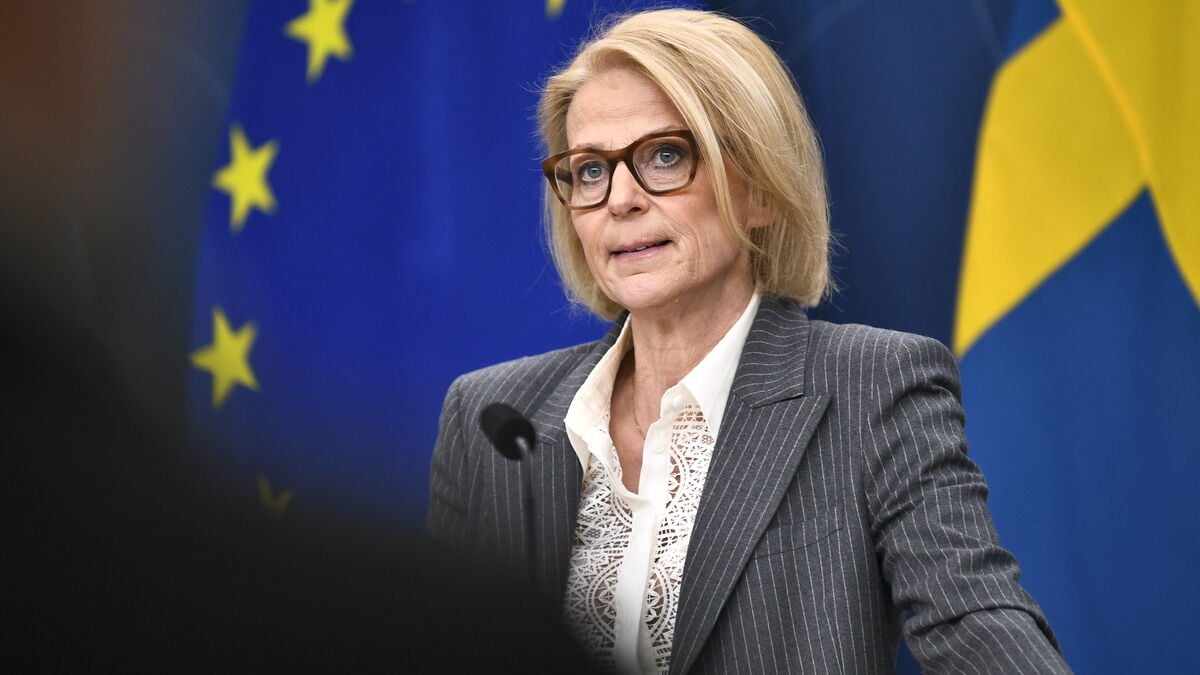
Svantesson presents the government's new economic forecast based on its base scenario. This means that the war in Iran will end in a couple of weeks and thus only have a limited effect on the Swedish economy.
However, she warns that the forecasts are uncertain.
"It's safe to say that we live in uncertain times," she says.
Overplayed
The government's milder scenario, which was presented last week, is already overplayed, Svantesson notes. It assumed that the war would be over in a few days.
The more serious scenario, however, remains: it involves an escalated regional conflict and oil prices rising to $120 per barrel for a prolonged period.
"It can be assumed the war could be prolonged and have effects on the Swedish economy," says Svantesson.
By that, Svantesson means "a few months", which would, among other things, lead to increased inflation and higher electricity prices.
Svantesson finds developments in the Strait of Hormuz worrying because they disrupt key gas and oil shipments.
If the problems continue there, prices will rise, she says.
However, the Ministry of Finance assesses that the probability of the base scenario occurring is somewhat greater than for the severe scenario.
Households are worried
In its forecast, the government still expects the economic recovery to continue in 2026 and expects Sweden to emerge from the prolonged recession in 2027.
However, Svantesson is concerned that households' concerns will cause them to hold onto their wallets and that the recovery will thus falter.
Many small business owners are dependent on increasing demand, she says.
The war in Iran has caused gasoline and diesel prices to rise. Electricity prices are also being affected. At the same time, the stock market is shaky.
The government and the SD are currently negotiating the content of the spring amendment budget to be presented on April 13. In these negotiations, possible temporary measures to support households are being discussed. For example, lowering taxes on gasoline and making electricity price support more generous.
Since day one of this job, a lot has happened in the outside world. We can handle and parry it because we have strong finances.
Svantesson does not want to go into how much money the government might consider spending on temporary investments.
The government expects growth in 2026 to be 2.8 percent of GDP, compared with 3 percent in the December forecast. For 2027, growth is expected to be 2.5 percent.
The unemployment forecast is left unchanged at 8.4 percent for 2026 and 7.8 percent in 2027.
The CPIF inflation forecast is raised to 1.2 percent this year, from 1.1 percent previously. For 2027, CPIF inflation is lowered to 1.6 percent, from 1.8 percent previously.