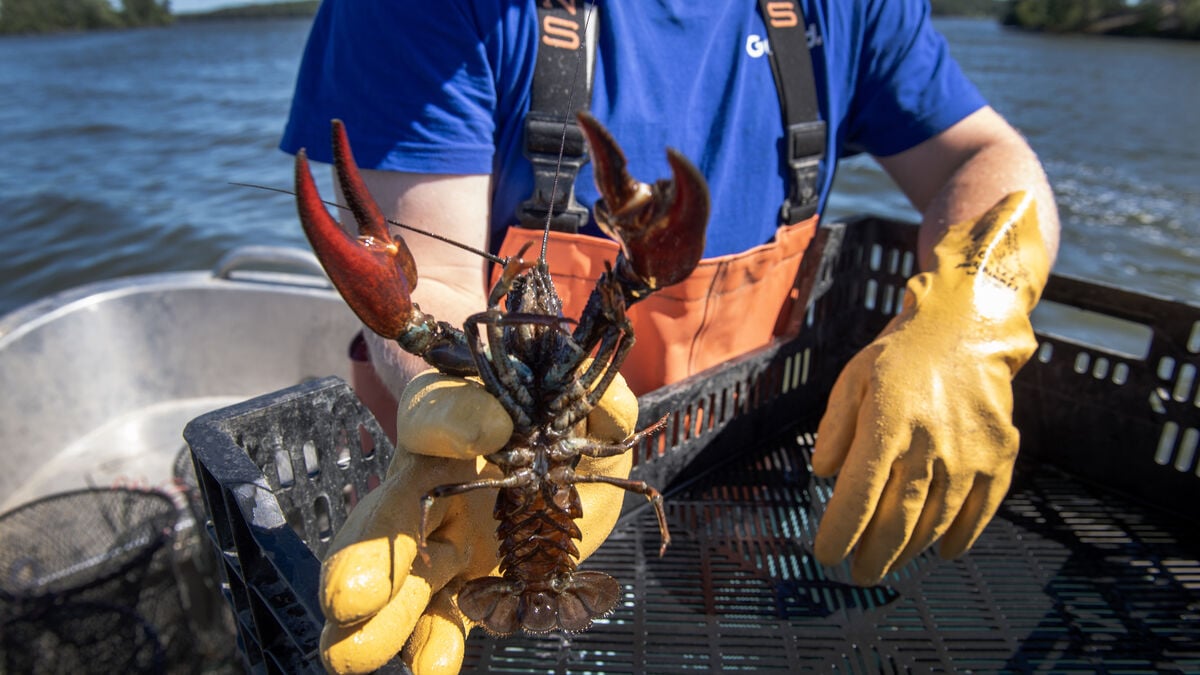
"I think it could be a pretty good year for crayfish. We've had a relatively warm spring and a pretty pleasant summer, from a crayfish's perspective. That means they shed their shells as they should and eat well," says Martin Karlsson, investigator at the Swedish Agency for Marine and Water Management.
If the summer is too cool, it may take longer for the crayfish to molt. It is when they molt that crayfish grow, but during the molting process they do not enter the crayfish cages.
In Sweden, there are two species of freshwater crayfish, the native crayfish and the signal crayfish. The signal crayfish was introduced during the 1960s and 1970s to compensate for the decline in crayfish, which was severely affected by crayfish plague. However, it turned out that the signal crayfish itself carries the infection without getting sick, which has contributed to the continued decline of the crayfish. The signal crayfish is included in the EU's Invasive Species Regulation.
It can be seen as a bit of a disaster that we introduced the signal crayfish as it accelerated the disappearance of the river crayfish. But the big problem today is that the signal crayfish is still spreading through illegal releases. It is these releases that continue to threaten the remaining populations of river crayfish, says Patrik Bohman, environmental analyst at the Swedish University of Agricultural Sciences, SLU.
Good for crayfish fishing
But there is a risk that the native crayfish will gradually disappear, believes Patrik Bohman. It is considered critically endangered, according to the Swedish Species Data Bank's red list.
There are over 10,000 stocks of signal crayfish. For the river crayfish, fewer than 800 stocks remain, says Patrik Bohman.
The crayfish is highly protected and fishing for the species is regulated. The rules are in place to protect the stocks and reduce the spread of crayfish plague.
At the same time, SLU recommends that people continue to eat and fish crayfish sustainably in healthy stocks to preserve them.
If we are to succeed in preserving the crayfish, we must also preserve the tradition of fishing and eating it. As long as the species has a clear place on the crayfish platter, there is also a strong commitment to protecting and re-establishing it, says Patrik Bohman.
“It’s important to take the opportunity to work”
Even professional fisherman Martin Karlsson agrees that it seems to be a good crayfish year this year.
But it comes in waves. It's always exciting to see what it looks like each year. If there are plenty of crayfish at the beginning, there usually will be later too. But some years there are hardly any larger crayfish to catch.
During the crayfish season, it is a busy day for Martin Karlsson, who fishes for crayfish in Hjälmaren and runs Nackhällsfisk. The crayfish fishing season runs from midsummer to the end of September. He goes out in the morning at seven and stays out until around 1 pm to catch the crayfish. From the end of July onwards, he works every day for a period.
There is no problem getting rid of crayfish. It is a good economic season for us professional fishermen, it is important to take the opportunity to work.
But even though crayfish fishing is profitable, it is not the most fun kind of fishing, according to Martin Karlsson.
It's not very advanced, it can get very monotonous to pull up crayfish from 7 a.m., sort them, and then throw them back into the cages.
The most fun thing is fishing from the ice on a nice, sunny winter day.
Can be experienced as a brutal meal
But even if this year's crayfish season looks promising, it is not certain that future Swedes will gather around crayfish platters so often, believes Richard Tellström, associate professor of culinary arts and ethnology at Stockholm University.
The crayfish platter can be influenced by the vegetarian and vegan trends in youth circles. It can get messy with these parties where you decide to eat something that is difficult to replace.
In addition, many people today want individual meals with more choice, believes Richard Tellström.
It suggests that it is slowly dying out and may be gone in two generations. It still lives on in the older generation. I think it has become too trivial and too simple.
Our relationship to eating whole animals has also changed, says Richard Tellström. Sucking the meat out of the crayfish's claws and eating it with your hands can be experienced as a brutal meal.
At the same time, sales figures indicate that crayfish are still popular. Sales of fresh crayfish and shellfish had increased by eleven percent in 2024 since 2016, according to Statistics Sweden.
"It's a fantastic autumn festival, I think. It announces that summer is over and autumn is beginning. The autumn darkness becomes part of the decor," says Richard Tellström.
Crayfish Day is usually celebrated in August due to an old ban on crayfish fishing between November and early August. Although the ban was lifted in 1994, many people still celebrate it at this time.
The crayfish feast originated in the 19th century and first became established in a bourgeois social class. During the 20th century, the tradition spread and became established in all walks of life.
Before crayfish platters, crayfish were usually eaten as a snack with beer, for example. Or they were used as an ingredient in cooking.
During the interwar period, decorations were added, such as the characteristic crayfish lanterns, hats and colorful bibs.
Common accompaniments are bread, Västerbotten pie, cheese and schnapps.
Source: Richard Tellström, Nordic Museum.
The crayfish is Sweden's only native crayfish species. It lives in waterways, lakes and rivers and thrives in clean, oxygen-rich water. The crayfish has long, almond-shaped claws and a dark, brown-green color. The crayfish is sensitive to crayfish plague and is classified as critically endangered according to the Swedish Species Data Bank's red list.
The signal crayfish originally comes from North America and was introduced in Sweden in the 1960s and 1970s. It thrives on rocky bottoms in ponds, streams and lakes and is recognizable by its reddish-brown color and broad claws. The signal crayfish itself carries crayfish plague but does not get sick itself. It is classified as invasive according to the EU's Invasive Species Regulation.
Both the signal crayfish and the river crayfish grow by shedding their shells, which they do several times during their lives. They are omnivores and eat insects, algae, snails and plants, among other things. Both Swedish varieties are nocturnal and hide under, for example, roots and rocks during the day.
Source: Swedish Agency for Marine and Water Management, WWF.