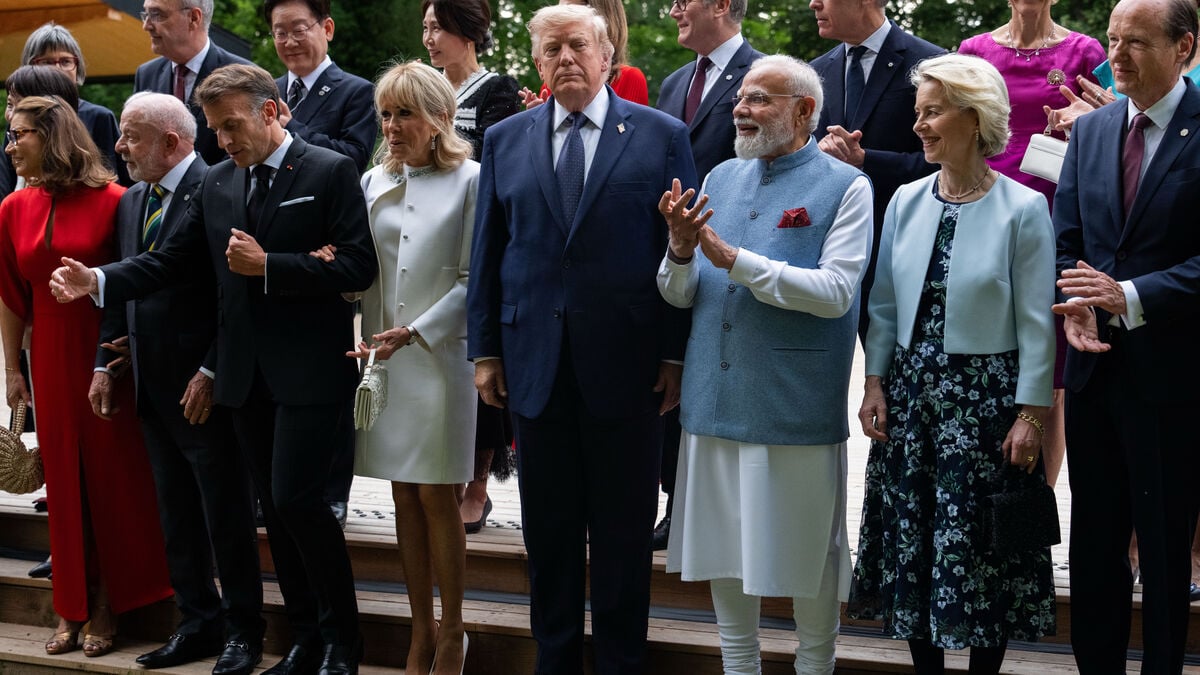
"We, the leaders of the G7, stand united in our unwavering support for Ukraine to defend its freedom, sovereignty and territorial integrity," the statement says in connection with the meeting in Évian-les-Bains, France.
To further support the country's "progress on the battlefield" and "new momentum" in recent months, the countries have agreed, among other things, to increase deliveries of various air defense systems and support to "help the country through next winter."
New sanctions
According to the G7, now is also an appropriate time to impose new sanctions against Russia. These will, among other things, target the country's oil and gas sector, as the US and Iran have reached an agreement that will see the Strait of Hormuz reopened.
Macron said at a press conference on Wednesday that the G7 meeting had been a success after months “characterized by fragmentation, division and disagreement.”
Macron also praised a "remobilization" of the G7 countries' willingness to increase pressure on Russia to reach peace in Ukraine. The president said at the same time that he saw no honest intention from Russia to seek peace.
Zelenskyy on site
The informal G7 group consists of seven of the world's leading industrialized countries that are also considered democracies: France, Italy, Japan, Canada, the United Kingdom, Germany and the United States. Ukrainian President Volodymyr Zelenskyy also attended the meeting.
After the meeting, Zelenskyy announced that he had spoken to both Macron and US President Donald Trump about the meeting.
"It was an important, coordinating conversation that could mean significant changes," Zelenskyy wrote on X late Wednesday.
The talks between Macron and Trump continued during the evening when the American president was received for dinner in the Hall of Mirrors in Versailles.
On Wednesday, the office of the President of the European Council, António Costa, said that brief diplomatic contact had been exchanged with the Kremlin.
In recent weeks, diplomatic-level contact has taken place to open communication channels, but nothing of further substance has been discussed, an EU official said on condition of anonymity.