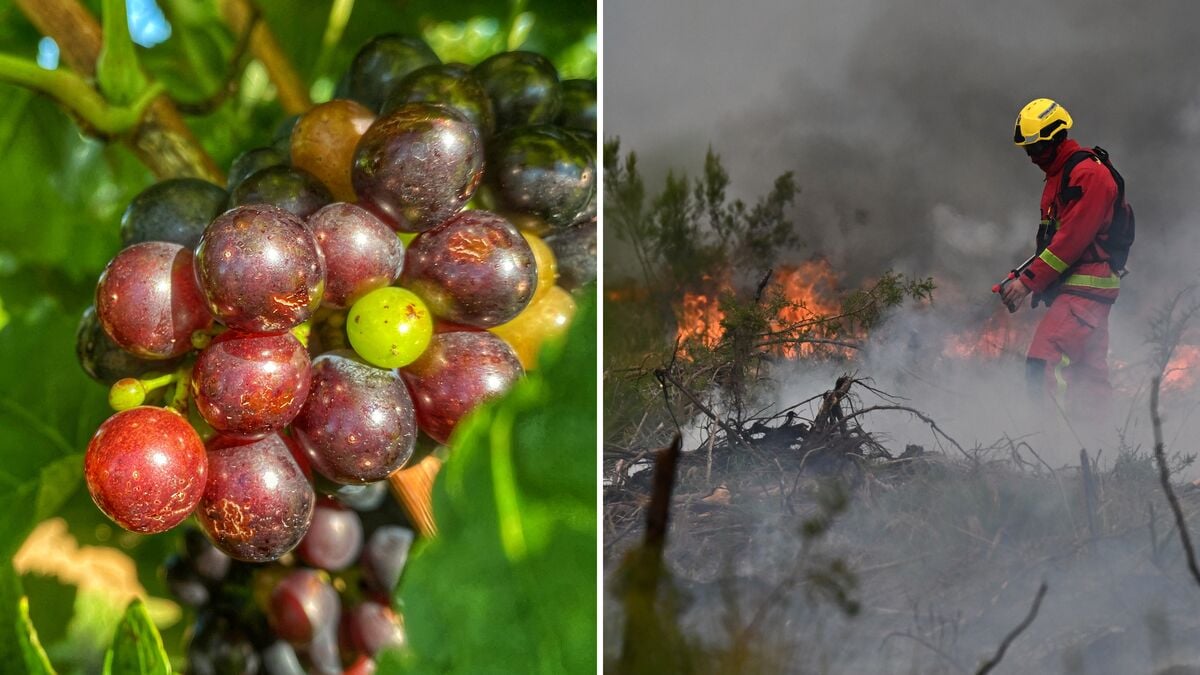
Since last week, violent forest fires have raged in southwestern France, including in Pyrénées-Orientales, an area with many vineyards.
While vineyards can help prevent the spread by acting as moisture-giving firebreaks, many have succumbed to the flames.
A full 90 percent of Gilles Trouiller's nine-hectare vineyard on the Montalba-le-Château plateau has burned down, writes Le Figaro.
These are vines that we have been using for 30 years and that cannot be replaced, Trouiller tells the newspaper.
Indirectly affected
Firefighters are battling a forest fire west of the city of Bordeaux, the heart of the famous French wine region of the same name. Most of the region's vineyards are located north and east of the city.
But many vineyards risk being indirectly affected. This is because smoke from forest fires easily penetrates the skin of the grapes and gives the wine a smoky flavor.
It doesn't taste pleasant at all. In California and Australia, people have struggled to find ways through different fermentation methods, but it can't be eliminated, says Fredrik Schelin.
Other winegrowers in Pyrénées-Orientales tell Le Figaro that they have not yet had time to get an overview of the consequences because their vineyards are located inside the security fences.
Fredrik Schelin believes that the economic consequences could be significant.
"It will affect many things and it's terrible. This is the only income these farmers have," he says.
Wine growing is being strongly affected by a warmer climate. Researchers at the Université de Bordeaux concluded in a study a few years ago that around 90 percent of all wine production in low-lying areas in countries such as Spain, Italy and Greece is at risk of disappearing by the end of this century.
A higher average temperature makes wines both sweeter and higher in alcohol content.
Sweden can benefit
The risk is that they will not be able to make wines of the same quality in the future, says Lotta Nordmark, who researches fruit and wine production at the Swedish University of Agricultural Sciences.
In Italy, vineyards are now being moved higher up into the mountains where it is cooler, according to Nordmark. She predicts that climate change will benefit Sweden as a wine country.
You could probably see vineyards up in northern Sweden in the fairly near future, she says.
She emphasizes that a prerequisite for this is proximity to bodies of water that store heat.