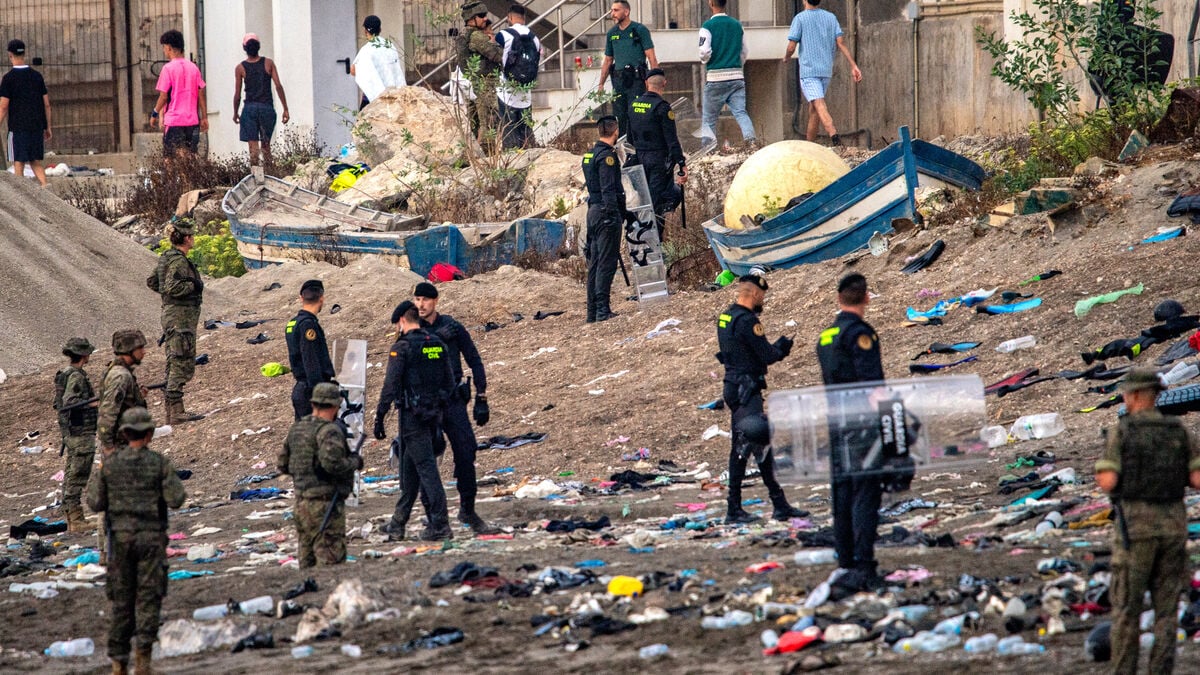
More than 50,000 people made their way from Morocco to the small Spanish exclave of Ceuta on the North African Mediterranean coast in just a few days. The incident has sparked strong reactions within the EU - but the crisis may have been triggered by Morocco for political reasons.
They want to show that European countries are vulnerable and that their interests must be taken into account, says former UN Deputy Secretary-General and Sweden's former Foreign Minister Jan Eliasson (S).
The guards look away
Eliasson links the migration chaos, among other things, to the fact that Spanish Prime Minister Pedro Sánchez made a controversial visit to Morocco's neighbour and archenemy Algeria the other week.
Everything related to the relationship between Algeria and Morocco is sensitive and Morocco wanted to show that they had a card, says Eliasson.
The assessment is shared by Jan-Paul Brekke, an expert on migration at the Institute for Social Research in Norway.
What is clear is that it can happen because the guards on the Moroccan side of the fence are looking away and are absent, Brekke tells NRK.
According to Brekke, the incident is reminiscent of a similar incident in 2021 when the Moroccan government relaxed border controls and allowed several thousand people to enter Ceuta over two days.
“Go to Ceuta”
Dagens Nyheter has spoken to one of the migrants on site in Ceuta who confirms that many were encouraged to try to cross the border.
People came and knocked on our door and shouted "go to Ceuta," Ayoub Elharous tells DN.
According to Carl Bildt (M), former Minister of Foreign Affairs, it appears that Morocco has controlled the process.
There is much to suggest that the Moroccan authorities have transported people to the border and that the Moroccan border guards have removed parts of the border barriers, Bildt tells Ekot, saying that it may be a mark on the part of Morocco.
Countries use migration pressure for political purposes.