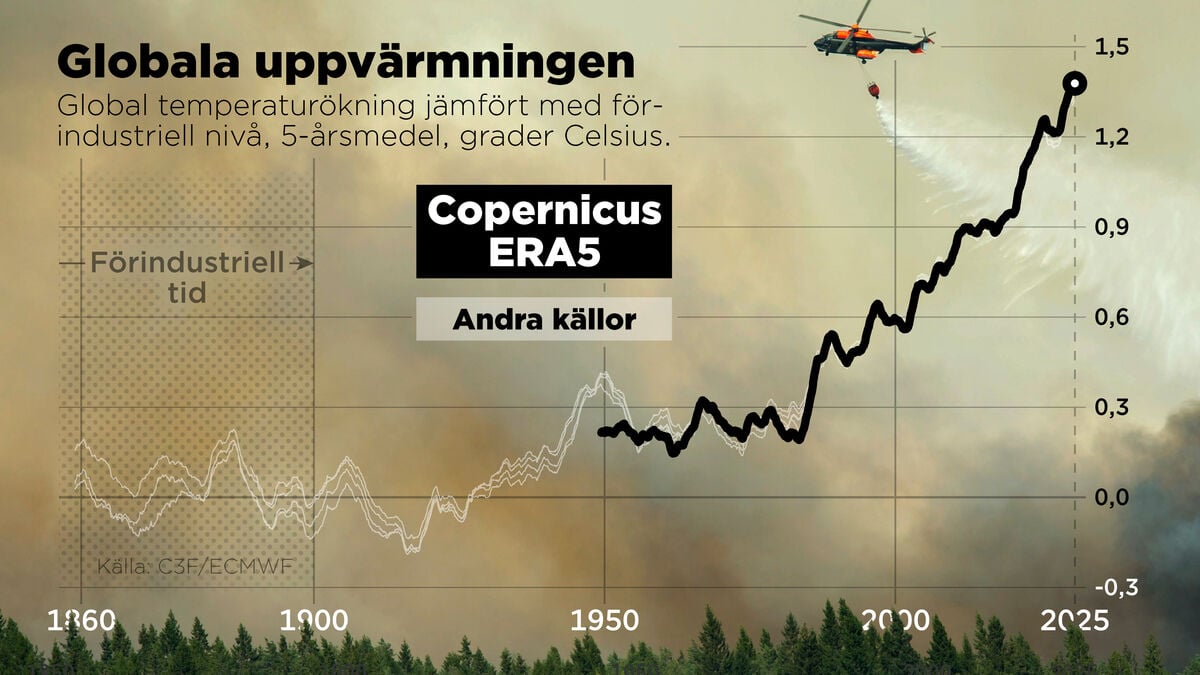
2025 was only 0.13 degrees Celsius cooler than the record year 2024 and 0.01 degrees Celsius cooler than 2023.
"These three years stand out compared to all previous years," says Copernicus climate manager Samantha Burgess at a press conference.
Over the past three years, global temperatures have averaged more than 1.5 degrees above pre-industrial levels - the first time that limit has been exceeded over a three-year period.
It is a challenge to talk about global warming at a time when large parts of Europe are experiencing snow and cold beyond the norm, admits Carlo Buontempo, director of Copernicus, who has not been able to cycle to work due to snow and ice.
If you look very locally, it's cold, but if you zoom out and see the bigger picture, it becomes very clear. If you zoom out to the whole year, you see that we just experienced one of the warmest years on record.
The main reason for the recent warming is the build-up of greenhouse gases in the atmosphere from emissions from fossil fuels such as gasoline and diesel. Sea surface temperatures also reached unusually high levels, linked in part to the El Niño phenomenon.
Limit reached
Based on the current rate of warming, the Paris Agreement's 1.5-degree limit for long-term global warming could be reached as early as the end of this decade, more than a decade earlier than estimated when the agreement was signed in 2015.
This does not mean that the Paris Agreement is dead, but Carlo Buontempo emphasizes that the challenge now is how to deal with the fact that the limit has already been exceeded.
Our decision will change the scale of the exceedance and the type of risk we will face in the coming decades.
Extreme weather
The forecast for 2026 is that it will also be one of the warmest years on record. It may not be as warm as 2024, but, like last year, not far off. With rising temperatures, we can also expect more and more intense extreme weather events, explains Samantha Burgess.
A warmer atmosphere contains more moisture, which means that when it rains, it is more intense. There is more energy in storms and when we get heat waves, they are also more intense. It is not so much the long-term climate changes that have consequences for people and nature, but the extreme weather events.
Facts: 1.5 degrees
The goal of the Paris Agreement is to limit global warming to well below 2 degrees, preferably 1.5 degrees, compared with pre-industrial levels.
The goal is set to mitigate the most devastating effects of climate change, which worsens with every tenth of a degree the Earth warms.
At 1.5 degrees Celsius, more intense storms and heat waves and an increased risk of mass coral die-offs await. At 2 degrees Celsius, a larger proportion of the population is exposed to deadly extreme weather and the likelihood of irreversible climate tipping points increases.
More and more people are now convinced that the 1.5-degree target is impossible and many scientists believe that the planet is on its way to 2.5 degrees of warming.