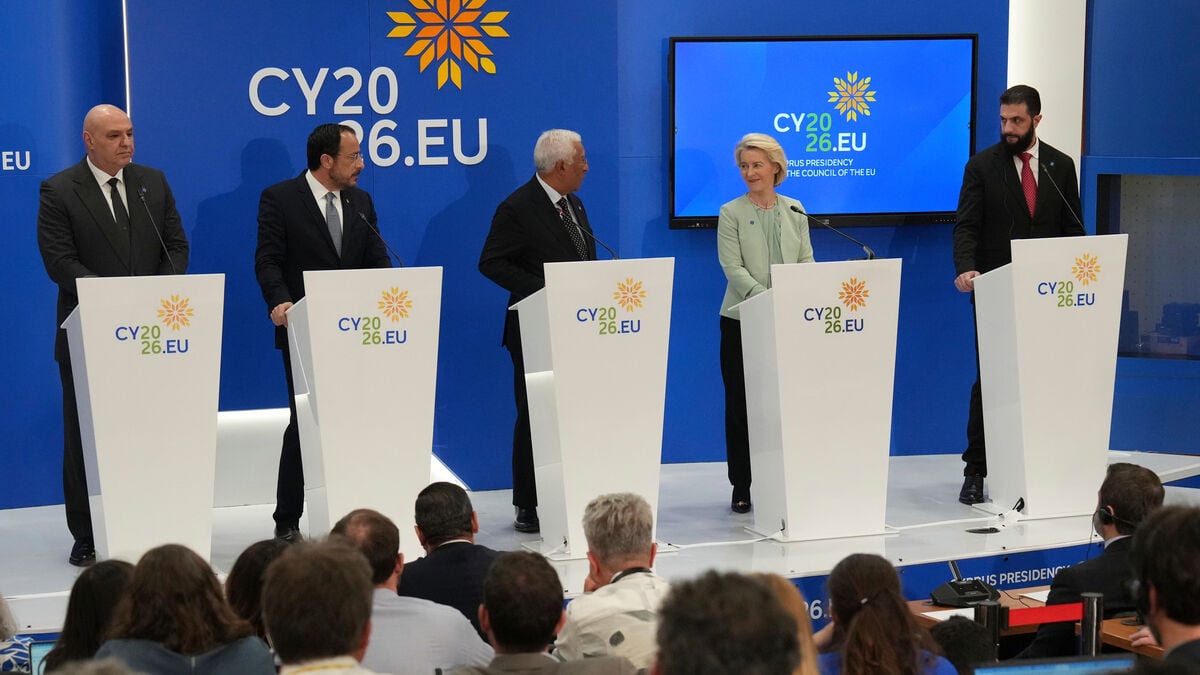
The situation in Lebanon and tensions around the Strait of Hormuz were two of the major issues discussed by EU countries and regional leaders in Nicosia on Friday.
“We call for respect for Lebanon's sovereignty,” Commission President Ursula von der Leyen said, taking the opportunity to emphasize how closely everything is connected - not least economically.
A threat to a merchant ship in Hormuz is also a threat to a factory worker in Belgium, von der Leyen said.
However, the summit was attended only by countries affected by the conflict - not those directly involved such as Iran, Israel or the US. And the countries on the Arabian Peninsula were only represented by the secretary-general of the Gulf Cooperation Council.
Concerns about Iran
EU foreign policy chief Kaja Kallas still sees a point in bringing the EU together with countries such as Egypt, Lebanon, Jordan and Syria. Not least to emphasize that not only Iran's possible nuclear weapons, but also Iran's support for proxies elsewhere and hybrid attacks in Europe must be addressed in talks between the US and Iran.
"We risk ending up with an even more dangerous Iran. We must be clear, together with regional actors, that these issues must be addressed and that we can help in the negotiations," Kallas said in Nicosia.
Both she and EU Council President António Costa have traveled extensively in the area recently.
Spanish discontent
The EU is an economically important player in the region, with significant humanitarian support to, for example, the Palestinians.
Politically, however, the influence is limited, not least due to the fact that different EU countries have different opinions when it comes to Israel.
Spanish Prime Minister Pedro Sánchez has been the most critical of both Israel and the US. He is deeply unhappy that it is not possible to agree to suspend the EU's association agreement with Israel.
There is no consensus on this issue and the result is that the EU's position is weakened, Sánchez said in Nicosia.
Facts: Middle Eastern leaders at EU meeting
The heads of state and government of the EU countries are having a working lunch with representatives from the Middle East during the summit in Cyprus.
The following leaders are involved:
Egyptian President Abdel-Fattah al-Sisi
Syrian President Ahmed al-Sharaa
Lebanese President Joseph Aoun
Jordan's Crown Prince Hussein
Secretary-General of the Gulf Cooperation Council (GCC), Jasem Mohamed al-Budaiwi
Source: European Council