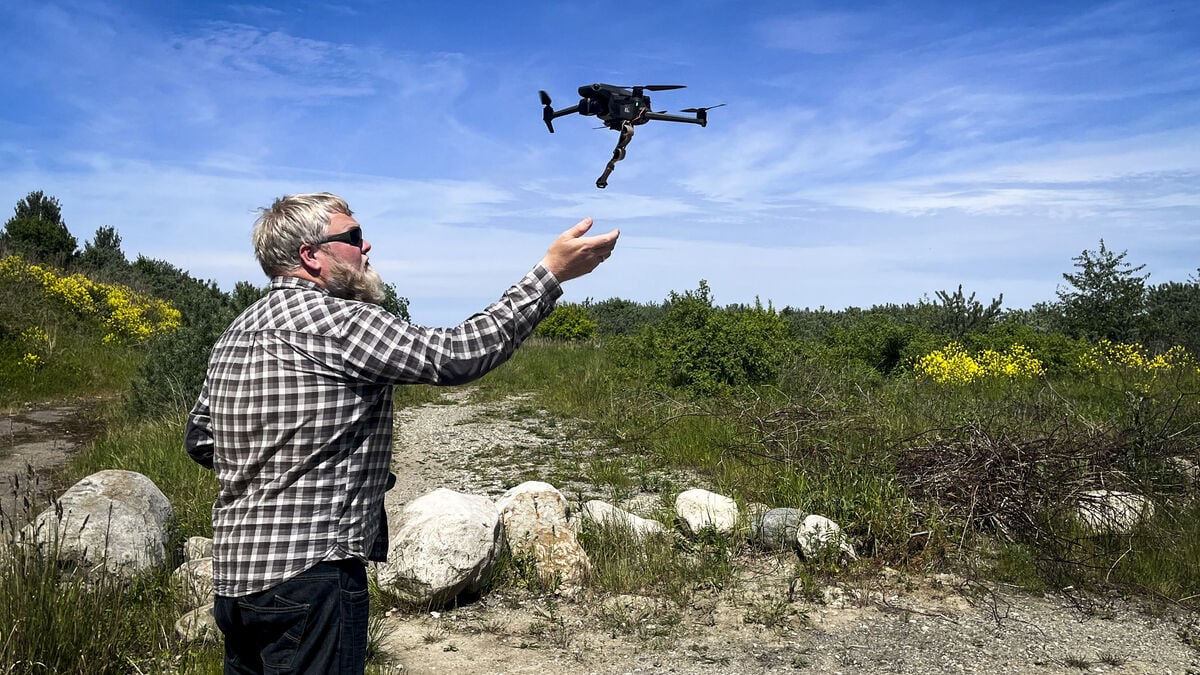
There is great interest in taking drone courses to strengthen Estonia's defence capabilities. Many citizens take the threat from Russia seriously and want to do what they can to be ready if war comes.
The initiator of the courses is entrepreneur Taavi Kotka, who runs the business in collaboration with the Ministry of Defence and the voluntary defence association Kaitseliit, a few kilometres outside the capital Tallinn.
There, participants can practise with simulators and real drones. Kotka himself gives instructions before the simulator exercise:
The task is to find infantry and kill them. So we have to find some Russians running around here. They will shoot at you if you get close. You don't have to hit them directly, but within a five-metre radius," says Taavi Kotka as a small group sits down at computers with drone simulators.
Tens of thousands
There are five courses available within the framework of the Kuri kotkas (Angry Eagle) project, from basic to advanced. The goal is that eventually there will be tens of thousands of people in the country who can build drones or use them for reconnaissance, bombing and other purposes.
Taavi Kotka repeatedly points out that Estonia is a small country where drone knowledge among civilian volunteers would make a difference in a critical situation.
Instructor Andres Lilleste has a civilian job on weekdays, but on weekends he usually wears green clothes, he says, referring to his involvement in Kaitseliit.
We talk about this as drone training with a slight military touch, because the instructors have a background in police or defence, he says.
Our aim is to ensure that we have more people willing to defend Estonia.
People on the ground
Drones are important in warfare today, but will hardly reduce the need for soldiers at the front, says Taavi Kotka.
You can't occupy a country with a drone. You can attack with a drone, you can destroy infrastructure, but you can't occupy. To occupy a country, you need people on the ground.
The youngest course participants have been 16 years old, the oldest 73, he says. Around 20 percent of them have been women or girls.
We also sometimes have women-only days. They are extremely popular because if you take the men away, the women become more interested.
The border between Estonia and Russia is almost 300 kilometres long and forms part of NATO's and the EU's external border.
Estonia became independent from the Soviet Union in 1991. Since then, Estonia has wanted to conclude a border agreement with Russia. One was concluded in 2005 but was then torn up. A new attempt was made in the spring of 2014 but was never ratified due to Russia's invasion of the Crimean peninsula in Ukraine.
Russia has conducted military manoeuvres near the Baltics and repeatedly violated Estonian airspace.
Estonia sees its NATO membership as its main security guarantee. NATO has strengthened its military presence in the country, and Estonia has increased its defence spending significantly - from 2.9 percent of GDP in 2023 to a planned 5 percent from 2026.
Source: Country Guide/UI