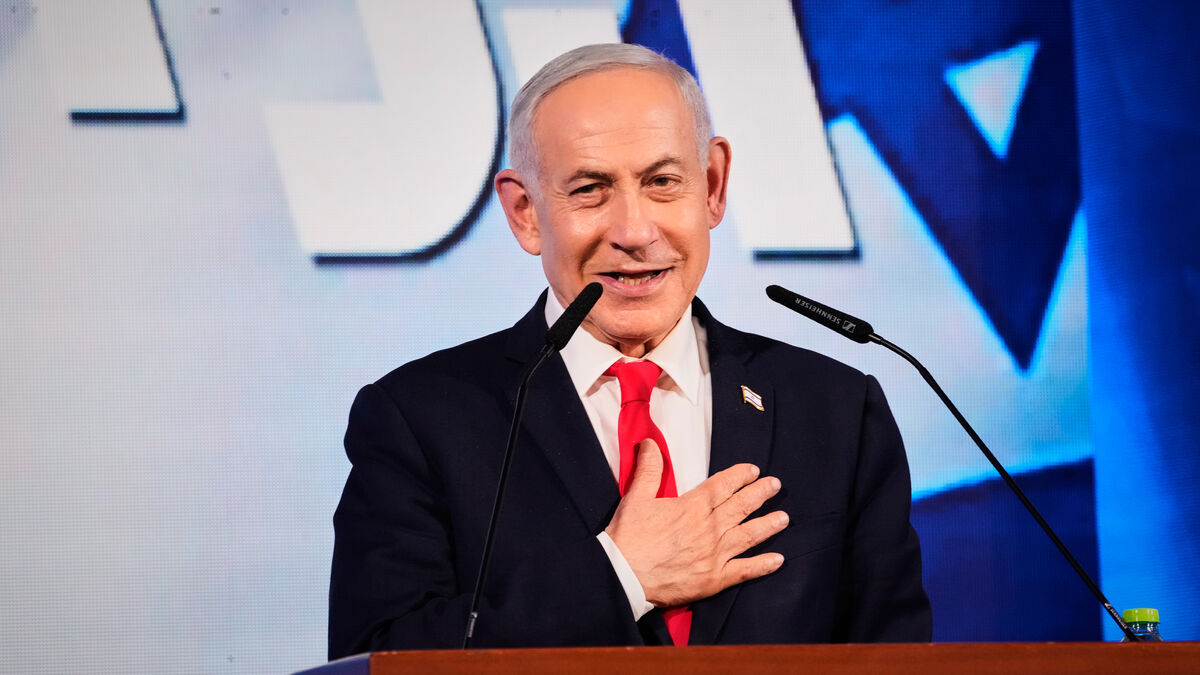
With more than 80 percent of the votes counted, longtime Prime Minister Netanyahu’s bloc is leading. But it is doubtful that this can be called a victory.
Netanyahu’s Likud party is on track to win the most seats in the Knesset. Together with its nationalist and ultra-Orthodox coalition partners, the bloc is expected to win about 54 of the 120 seats in parliament, according to Israeli media estimates.
The other large bloc, led by opposition leader Gadi Eisenkot’s Yashar party, is expected to receive just under 50 seats.
In that case, neither side will have a majority on its own, and thorny negotiations lie ahead.
President Isaac Herzog is calling on all parties to cooperate on Wednesday afternoon to avoid a snap election.
"We must do everything we can, especially after yesterday, to avoid another election. That’s why I expect to come here with an open mind," Herzog said at his residence in Jerusalem.
“Zionist government”
Gadi Eisenkot proclaimed on election night that Israelis had voted for change. He called on Netanyahu to leave politics.
To the millions who have voted for conscription for all, for new leadership: I promise that I will do everything in my power to form a Zionist government, said the opposition leader.
The prime minister appeared later on election night and opened the door to new agreements, saying that “the Zionist majority” needed to come together to keep Israel safe.
If the seat distribution holds, Eisenkot and Netanyahu will either have to negotiate with each other or turn to the third bloc.
Possible kingmakers
Both sides have so far kept the Arab-Israeli parties at arm’s length. But those parties have now won almost twice as many seats as before, giving them a pivotal role.
Netanyahu has ruled out any contact with them and consistently described them as a threat. Gadi Eisenkot has indicated that he is open to their passive support, but the issue divides the other parties in his coalition.
Yousef Jabareen, who leads the Arab-Israeli Joint List coalition, is proposing a “Jewish-Arab partnership,” according to Israeli media:
Anyone who wants to offer a concrete alternative to Netanyahu’s blood-stained government will need to talk to us.
A preliminary election result is expected on Wednesday evening. In the next step, President Herzog will ask all party leaders who they believe has the best chance of forming a government.
Facts: The parties in Israel
The parties in Israel’s parliament, the Knesset, are divided into two main blocs. Before the October 27 election, Prime Minister Benjamin Netanyahu ruled with a narrow majority.
Netanyahu’s bloc has included Likud (Netanyahu’s right-wing conservative party), Shas (an ultra-Orthodox religious party), the Torah Party (also an ultra-Orthodox right-wing party), Jewish Power (Otzma Yehudit, a far-right, ultra-nationalist party led by Security Minister Itamar Ben-Gvir), Religious Zionism (a right-wing nationalist party led by Finance Minister Bezalel Smotrich), and Noam (a small, ultra-conservative religious party).
The opposition “change bloc” includes Yashar (a newly formed centrist party led by former commander-in-chief Gadi Eisenkot), Beyahad (“Together,” a centrist party formed through a merger of Yair Lapid’s Yesh Atid and former Prime Minister Naftali Bennett’s party), the Democrats (a left-wing party led by Yair Golan), and Yisrael Beiteinu (a secular right-wing party).
Outside the two blocs, there are two Arab parties (the Joint List and Ra’am) that cooperate.




What do you think?