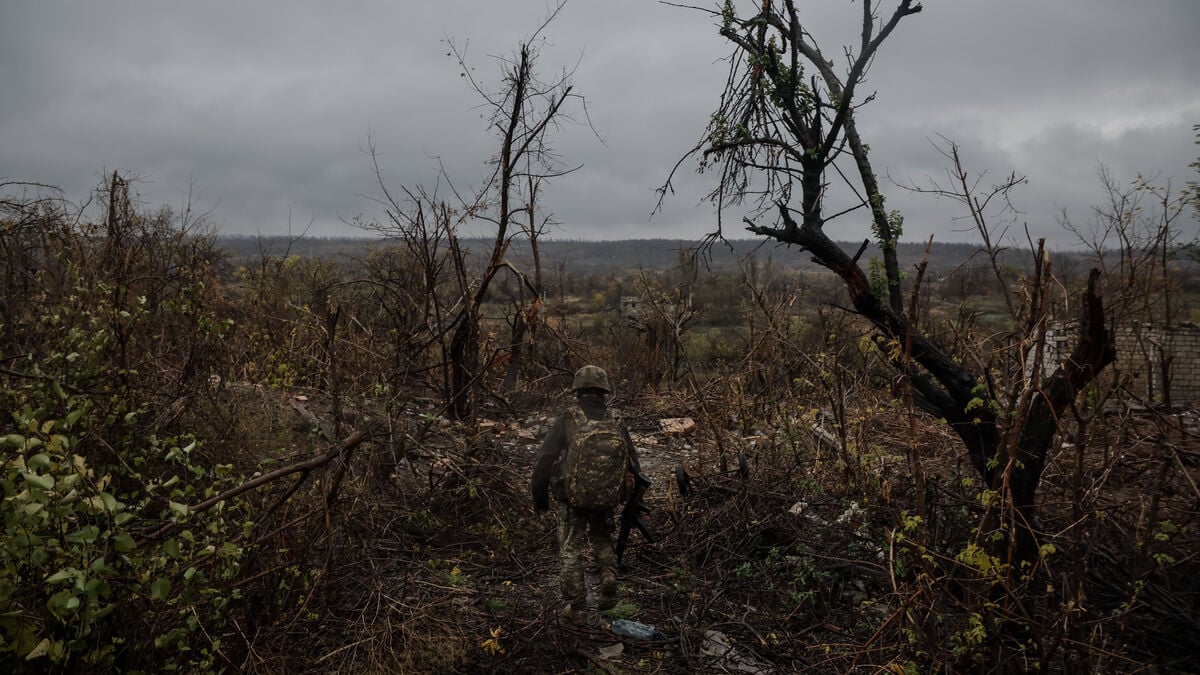
The Russian invasion forces are slowly advancing in the bloody battles on the front in eastern Ukraine, but Ukraine is still holding out behind a heavily fortified defense line.
In talks for a peace settlement, Russian leader Vladimir Putin is insisting that the Ukrainian defense forces take a step back. His main condition is reportedly that Russia gets the entire Donbas region – including the parts that his forces have not taken militarily.
Treasures in the ground
Donbass has been economically important for centuries. Large coal mines began to be mined there in the late 19th century. With large immigration, the region became the largest industrial hub in the Russian Empire, the Soviet Union, and then Ukraine. It contains rare lithium, cobalt, and titanium, the demand for which is expected to remain.
The area has been disputed and divided since 2014. Even before the major outbreak of war in 2022, thousands of people had been killed and hundreds of thousands displaced.
In 2022, the invading forces seized a strip of land that stretches along the coast of the annexed Crimean Peninsula.
Crimea, the coastal area and Donbass hold historical symbolic value for Putin, who began referring to the areas as “Novorossiya”, New Russia, as early as 2014. That name was given to the larger region when it was taken over by the Russian Empire in the 18th century.
Language and identity
From the Russian side, the invasion has been justified as an intervention for Russian speakers, but in Ukraine the Russian language has not been synonymous with Russian identity or sympathies. Before the war, surveys showed that a clear majority of Russian speakers identified themselves as Ukrainians, even in Donbass.
US President Donald Trump is reportedly putting pressure on Ukraine to relinquish control of the regions of Donbass. Most people there speak Russian, negotiator Steven Witkoff reportedly wanted to point out in a meeting.
Open door?
The peace proposal put forward by the US would allow Russia to take over all of Luhansk and Donetsk, including the parts that the invasion forces have not been able to take over. The area is about the size of Luxembourg.
Ukraine has established a strong defense belt there, running from Sloviansk in the north via Kramatorsk to Kostiantynivka in the south.
Behind it lie vast fields where there are currently no defense lines. Surrendering Donbass is therefore feared to leave the door to central Ukraine wide open for new Russian attacks.
Donbass, also known as the Donets Basin in Swedish, primarily encompasses the two regions of Donetsk and Luhansk in eastern Ukraine.
The name comes from the Donets River, which flows through the region as a tributary of the Don. The largest city, Donetsk, is usually considered the regional center.
In the late 19th century, large coal deposits began to be mined in the region, whereupon it emerged as a strong industrial hub.
In 2014, Russian-backed armed groups took over areas of eastern Ukraine and proclaimed two people's republics in Donetsk and Luhansk. When Russia began its major war of aggression in 2022, it recognized the two people's republics. That same fall, Russia said it would annex them along with two other regions of Ukraine.
In November 2025, Russian forces controlled about nine-tenths of Donbass.
Donbass sometimes also includes areas to the west in Ukraine and in the Russian Rostov region on the other side of the border in the east.