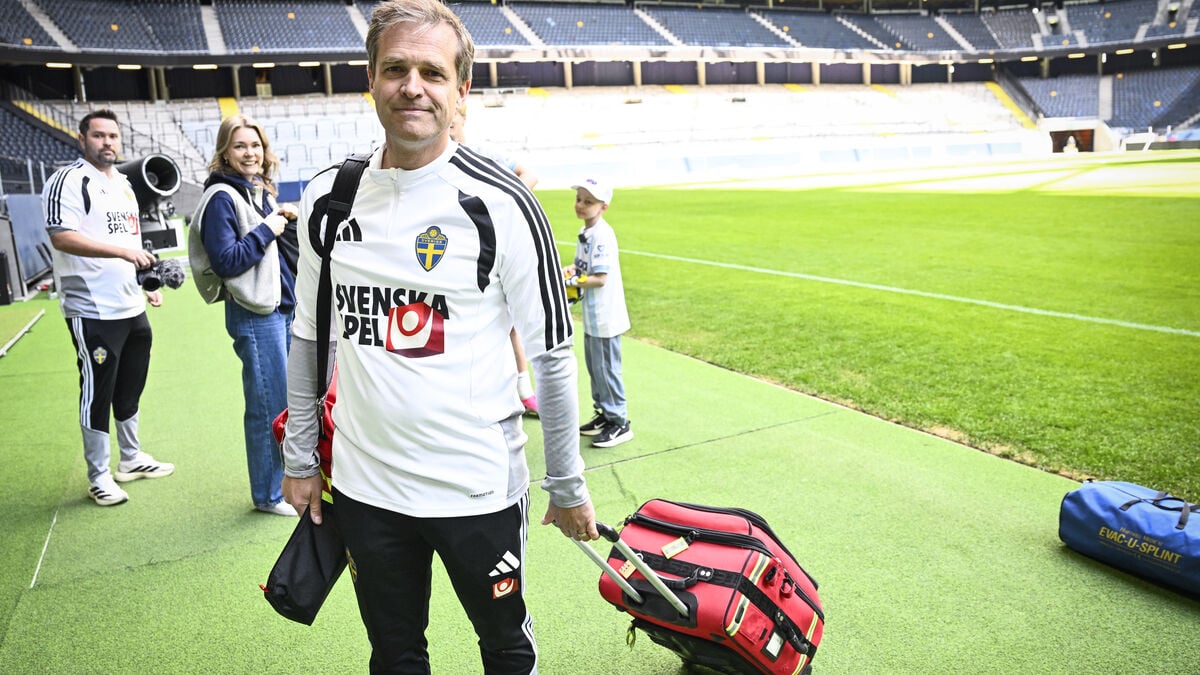
Last week's early summer heat disappeared just in time for the World Cup camp. It's only around 15 degrees while the national team is training.
In Dallas, where the national team is based in Frisco, it will be significantly hotter, around 35 degrees on the hottest days. Therefore, the players are being prepared immediately - and in several different ways. The aim is to get their bodies used to the temperature increase that awaits them.
Information and education are an important part so that you feel prepared. The second thing is that if you are going to acclimatize to heat, you actually need to train in that environment for two weeks. We don't have the opportunity to do that. The heat is a challenge, but you can also see it as an opportunity to prepare for it and try to reduce its effect, says Jonas Werner.
Checking carefully
The medical team carefully records how much fluid the players lose. Saliva, sweat and weight are checked.
The goal of acclimatization is to ensure that you sweat a little more and lose a little less of certain salts. In simple terms, you can keep more blood centrally instead of it moving out to the skin to get rid of heat.
The national team will have its first training session in Frisco on June 7. Initially, training sessions will be held in the evening. It is also about getting over jet lag. Then training will start around 10 a.m.
Heat stress is at its highest in Dallas between noon and 6 p.m. That's why we try to schedule training as early as possible, but still allow you to sleep in and so on.
A package of measures can be taken to cool down the players.
It's everything from ice in water bottles to slush, cold or iced towels, spray bottles. We're looking at the possibility of using ice vests and ice packs.
Muscles feel good
Training and playing in scorching heat is not only physiologically negative, points out Jonas Werner.
Muscles can work better, you can become more explosive and a little faster, for example, but you can expect overall performance to be affected. You don't do as many high-speed runs and they aren't as long. It will become clearer at the end of the match that you don't have quite as much stamina.
In Houston and Dallas, the games are played indoors.
I see those as manageable from a heat perspective. The match in Monterrey will not be played until 10 p.m. It will be hot and humid, but not as hot as during the day. The locations we are playing in are in the top four of those that have the potential to be the hottest and most humid.
Monterrey offers a different challenge.
The arena is located at an altitude of 495 meters. Players' pulse will be a few beats per minute higher and the ball may behave a little differently.
Nine specialists in the fields of medicine, performance and sports psychology are part of the Swedish World Cup squad. The group is led by Jonas Werner, an orthopedist at Vrinnevis Hospital in Norrköping who has been associated with the national team since 2020.
Doctors: Jonas Werner and Peter Cratz.
Physiotherapists: Fredrik Larsson and Carl Persson.
Naprapaths: Christian Andersson and Henrik Nyhus.
Performance: Niklas Egnell, Olle Ekberg and football psychological advisor Daniel Ekvall.