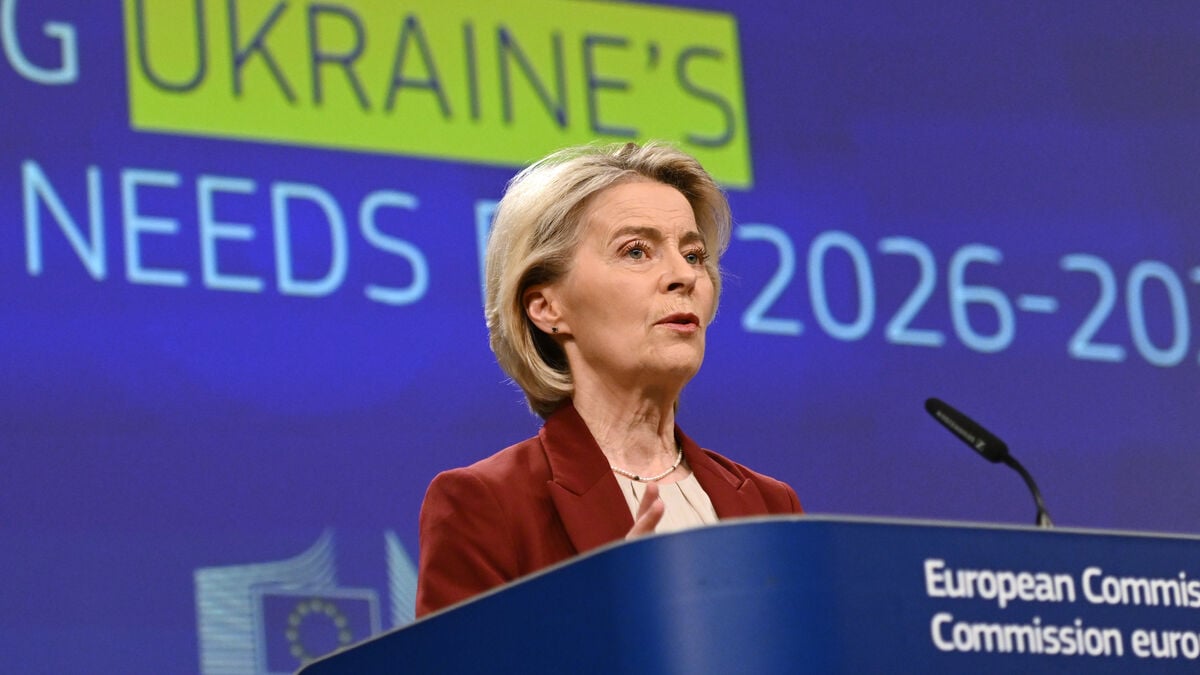
Rarely have the cracks looked so deep ahead of a summit as when the heads of state and government of the EU countries gather in Brussels.
Support for Ukraine is hanging by a thread when Belgium, with support from Italy, among others, refuses to open up the use of frozen Russian state assets.
The long-discussed trade agreement with the countries of Latin America looks uncertain after resistance from France in particular.
The US is portraying European leaders as weak, on a continent that is heading towards its own demise. And to top it all off, the streets of Brussels are also filled with honking tractors demanding that the EU budget continue to go primarily to agriculture.
Torn to pieces?
There are plenty of negative headlines and criticism, not least directed at the President of the European Commission, Ursula von der Leyen.
"You are not defending our way of life. You are undermining it and torpedoing it," scolds Marc Botenga from the Belgian left-wing party PTB in a debate in the EU Parliament.
"You are making Europe weak, Mrs von der Leyen. Please resign!" his colleague Tomasz Froelich from the German far-right AfD party hisses.
“Is this the week the EU tears itself apart?” asks the news site Euractiv.
Long meeting?
Yet it is not the EU that is primarily facing a fateful moment at the summit. The situation is much worse for Ukraine, which urgently needs the financial support that the EU countries are discussing.
Perhaps that fact will be decisive in ensuring that the heads of state and government still agree on a solution, regardless of whether it is with the help of Russian assets or in some other way.
If there is no money at all, Ukraine risks going under – for which very few EU leaders want to be responsible.
EU Council President António Costa has promised to keep the leaders at the summit for as long as necessary.
The president is fully committed to using all the means at his disposal to achieve a result, says an EU diplomat at a press briefing.
Happy Orbán
However, the disagreement and cracks do not seem to worry Hungary, which has long stood aside when it comes to all EU support for Ukraine.
Prime Minister Viktor Orbán is now joined by the Czech Republic's newly elected Prime Minister Andrej Babis at the summit and is looking to the future with optimism.
“This is the alliance of victorious patriots that will make Europe great again,” promises Orbán on X.
The 27 heads of state and government at the EU summit belong to politically different party groups, based on their party affiliations.
Most – twelve – come from the Christian Democratic conservative EPP, including Prime Minister Ulf Kristersson (M).
The social democrat S&D has five leaders, compared to four for the liberal RE. The far-right ECR and PFE groups each have two leaders, while another two are non-attached or independent.
At the farthest point at the table has been Hungarian Prime Minister Viktor Orbán – since he took office in May 2010. The most recent is the Czech Republic's newly appointed Prime Minister Andrej Babis, who took office last week.