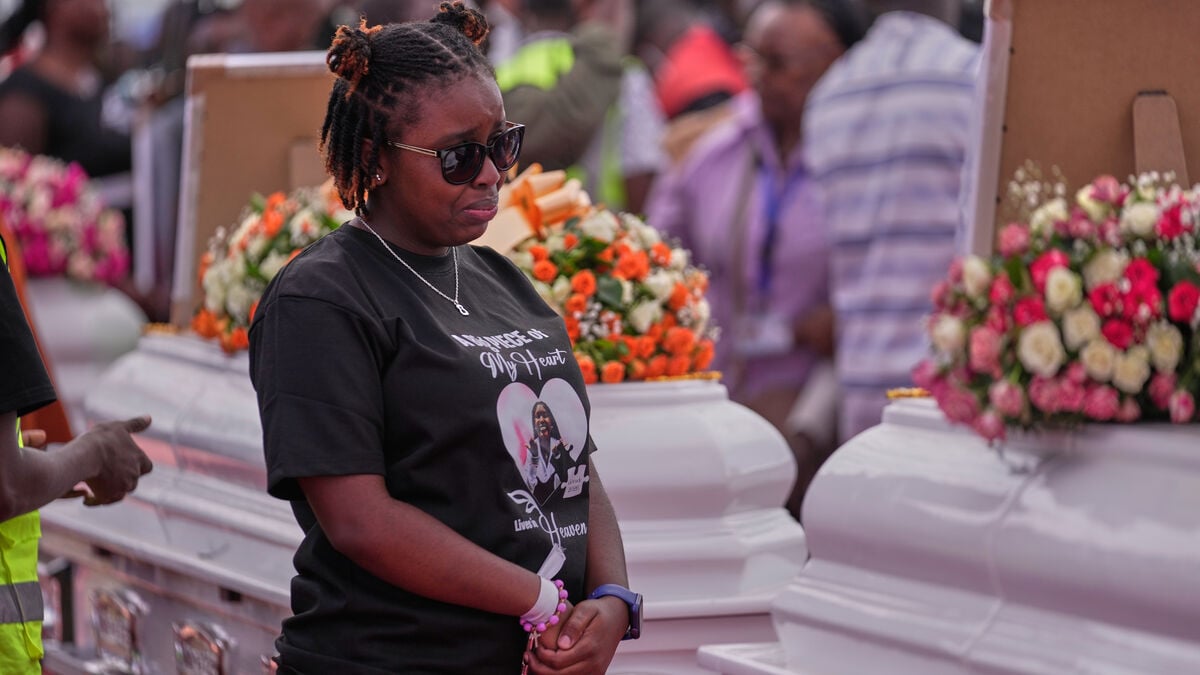
White coffins with flowers and portraits lined the streets as 16 students at Utumishi Girls Academy in the central Kenyan town of Gilgil were buried in June. Hundreds of relatives, classmates and others gathered to honour the girls.
The school is attended by girls aged 15-18. Hundreds of students were there when the fire broke out in a dormitory building in the middle of the night on May 28. 79 young people were injured.
Several students at the girls' school are suspected of arson. According to information that emerged in interrogations after the catastrophic fire, it started when a mattress was set on fire by the door of a dormitory, reports AP.
The school fire is one of many this year alone. Several fires have been deliberately started by students in protest against strict discipline and poor conditions, The Guardian reports. Many see the arsons as the result of an education system that suffers from chronic underfunding and corruption, and relatives have begun to question the safety of the schools where their children live during term time.
Overcrowding and abuse
The pressure on children to do well in school is high in Kenya, where a large proportion of the working-age population ekes out odd jobs in the informal sector. Psychologist Catherine Gachutha points out to AFP that teenagers are usually not malicious, but that they may not always understand the consequences of their actions.
"These are young people going through a school system that doesn't lead to jobs," she told AFP, adding that the fires could be a way to rebel against the government.
In Kenya, boarding schools are common, where children are away from their families for months at a time. Instead, they live in often overcrowded schools, where abuse is not uncommon.
15-year-old Tasha survived the fire at her girls' school thanks to her friends breaking open a door that was locked from the outside, in violation of fire safety regulations. According to Tasha, there had been rumours that some students were unhappy with the conditions at the school and were planning a protest.
"I didn't think they would go this far," she told AFP.
"Extortion"
A principal at a boarding school in the western part of the country, speaking to AFP on condition of anonymity, said he had sent students home because of anonymous threats against the school.
There's a lot of blackmail going on from teenagers now, he says.
He sees constant delays and shortages in government funding as a major problem. According to him, “greedy” principals take in too many students to get more money, which leads to young people often sleeping in premises that are not intended as dormitories, such as converted cafes or in corridors.
The Kenya Red Cross said on June 12 that 47 fire incidents had been reported at schools in the country so far this year. In addition, 56 schools have been closed due to student unrest, affecting thousands of students.
A survey conducted by the Ministry of Education in 2021 found that 126 cases of arson at schools in the country took place between January and November 2020, the BBC reports. According to several firefighters who spoke to AFP, there is a lack of basic safety.
Many schools simply cannot afford a proper fire safety plan, says Isaac Maina at G4S, one of the country's largest private emergency services.
Barricaded doors
The architectural organization AAK has identified 55,000 public schools with “deplorable conditions,” says the organization’s director, George Ndege.
In some schools, the windows are barred and the doors are barricaded. The reason is that some school boards believe that it is more important to ensure that students do not sneak out than to ensure security, he says.
The government will not offer any financial rescue packages for affected schools, but has promised to set up a working group to investigate the factors behind the fires.
In 2024, 21 boys died in a school fire. Following this, the Ministry of Education ordered that 348 boarding schools be converted to day schools for safety reasons. However, it is not known whether this was implemented.
Free primary education was introduced in Kenya in 2003, which has since led to almost all children being enrolled in school. Since 2017, the country has followed a curriculum of two years of pre-school, six years of primary education, and then two additional stages of three years each. School fees for the two higher stages were abolished in 2008, but there are still costs for activities, school uniforms, and school lunches. The costs mean that some children leave school early.
Some school fees are still often charged, mainly by boarding schools.
English is the dominant language of instruction, although some children are taught in local languages, at least during the first years of school.
Approximately 87 percent of students complete grades 1-6, according to Our World in Data, but not as many are expected to continue to the higher stages.
Approximately 10 percent of Kenyans continue their studies at universities, colleges or technical institutes.
School fires at boarding schools are a recurring problem. Many of the fires are set by disgruntled students.
Source: Country Guide/UI