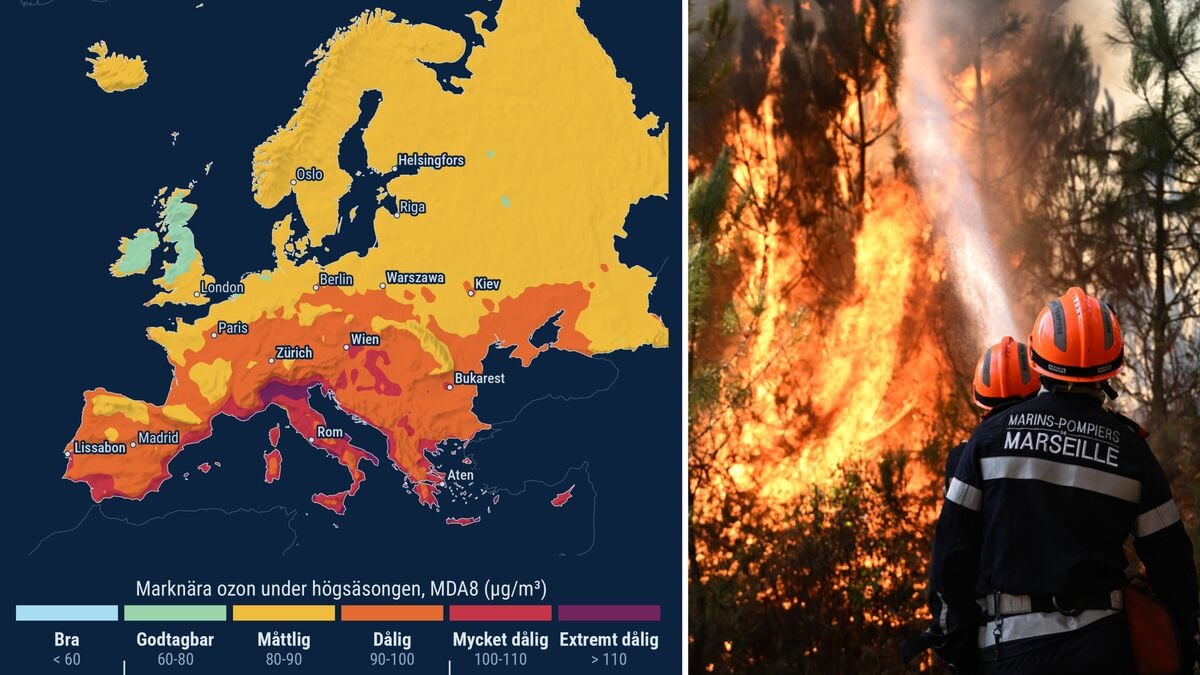
Ozone is associated with protection from the sun high in the atmosphere. However, when the same substance forms at ground level, it is hazardous to health and can lead to respiratory and cardiovascular problems.
Almost 40 percent of the world's population is exposed to extremely poor air quality due to ozone exposure, says Laurence Rouïl, head of the Copernicus atmosphere monitoring service CAMS, at a press conference where a new report on global air pollution is presented.
High levels
The Middle East, India, China and parts of Southeast Asia are the worst affected. Europe has long fought ozone pollution by reducing emissions of nitrogen oxides, among other things. But heatwaves, forest fires and the fact that ozone can be transported long distances mean that levels have not decreased and are estimated to lead to 60,000 premature deaths in Europe a year, according to the European Environment Agency EEA.
The French Riviera, northern Italy and the Adriatic coast have had more than 30 days this year with levels above the EU target, mainly due to the heat.
But these recurring heatwaves in Europe this summer are also responsible for levels being fairly similar across most of the continent, even in Scandinavia, says Rouïl.
Other particles worse
At the same time, other air pollutants are still worse, the so-called PM 2.5 particles with a diameter of 2.5 micrometres, which are caused by industry and traffic, among other things. They currently cause around 180,000 premature deaths in Europe, which is still more than halved compared to 2005.
"Those emissions are, at least in theory, easier to control. Of course we have forest fires and things like that which are difficult, but one of the biggest sources of PM 2.5 in Europe is small-scale burning of wood and coal, which we can take action against," says Ian Marnane at the EEA.
Facts: Cams
CAMS is the EU's atmosphere monitoring service under the Copernicus Earth observation programme. The CAMS atmosphere watch report provides an overview of global air quality.
This year's edition is the first and focuses on ground-level ozone, smoke from forest fires and desert dust.
The health-hazardous gas ozone consists of three oxygen atoms and is formed at the ground in sunlight and heat when nitrogen oxides, mainly from the combustion of fossil fuels, react with volatile organic compounds from industry, among other things.