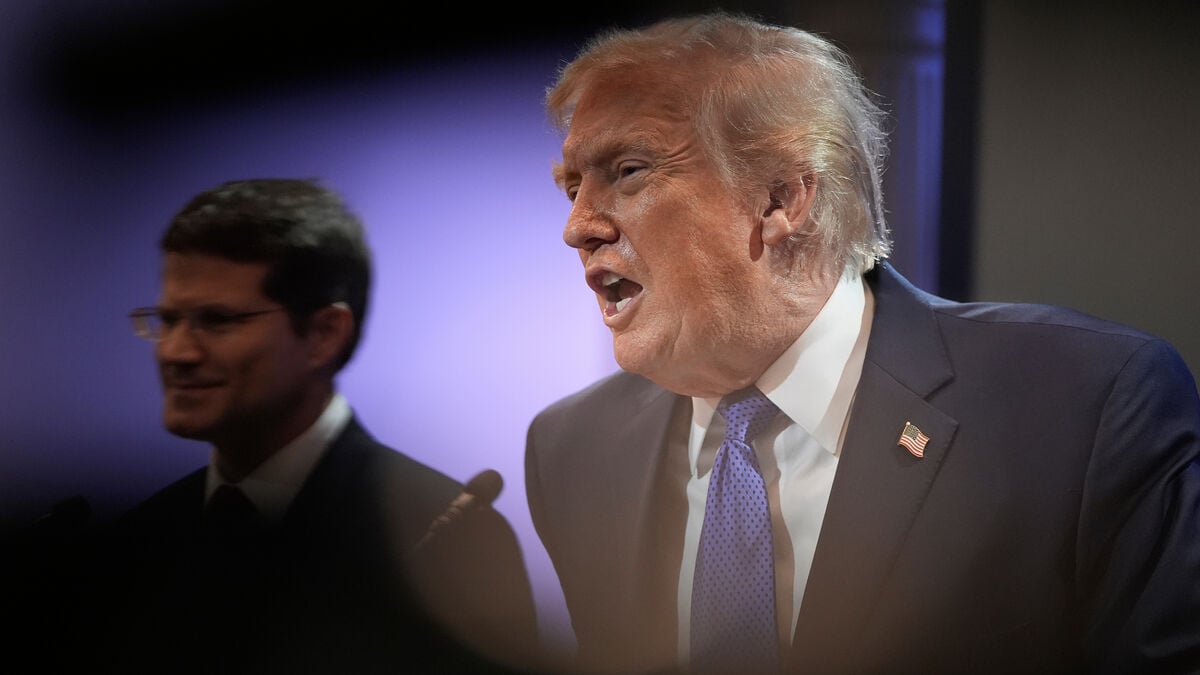
No sooner had news arrived that President Donald Trump had imposed 10 percent tariffs on the rest of the world than it was time again. On Saturday, Trump announced that he had decided to raise the tariff rate to 15 percent. Both announcements came after the Supreme Court announced on Friday that the president's previous tariff order had been invalidated.
Criticism from several quarters
Criticism of Trump is now coming from several quarters. Ahead of Monday's meeting of the European Parliament's trade committee, committee chairman Bernd Lange is coming out and wants to see countermeasures, in the form of freezing the ratification process of the trade agreement with the US until more details are received.
"Pure customs chaos. Nothing makes sense anymore - only unanswered questions," Lange writes in a comment.
Last summer, the EU and the US agreed on a trade agreement that would impose 15 percent tariffs on most goods from the US, while removing tariffs on a range of American goods.
"Clarity and legal certainty are requirements for further steps to be taken," Lange now comments.
The European Commission emphasizes that the parties have a valid agreement.
"An agreement is an agreement. As the US's largest trading partner, the EU expects the US to uphold its commitments," the Commission said in a statement.
Has tools
At the same time, French Trade Minister Nicolas Forissier says in an interview with the Financial Times that the EU has the "necessary tools" to act against the US.
One such countermeasure would be the so-called bazooka. It is an anti-coercive instrument that allows the EU to act in several ways against a country considered to be harming the EU economy.
"We can no longer be naive. We need to use all our tools and not just talk about them," Forissier says in the interview.
Other parts of the world are also now questioning Trump's new announcement.
"To be completely honest, it's a real mess," says Itsunori Onodera, former defense minister and now chairman of Japan's ruling Liberal Democratic Party (LDP) tax group.
Although the tariff increase has been presented as a global measure, it has different effects based on what agreements different countries previously had with the US. A compilation by The New York Times shows that, for example, the situation is unchanged for Japan, while Argentina, Colombia and Australia will now face a higher tariff rate.
The Australian government has announced that it is considering "all possible measures."