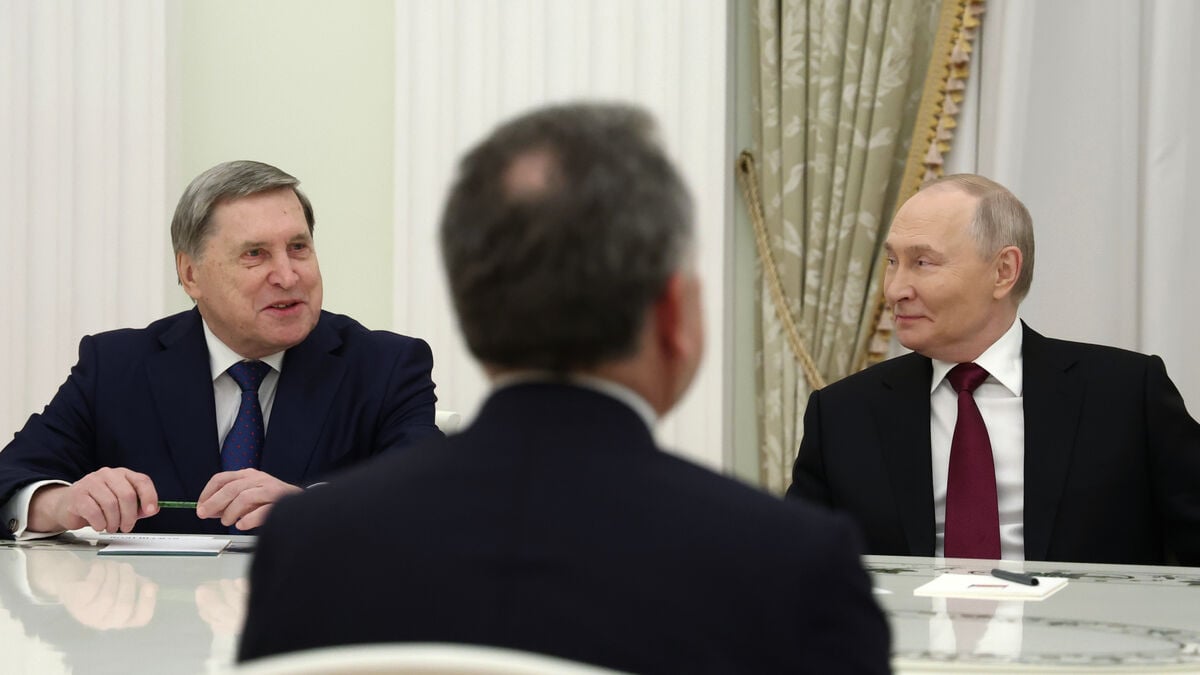
Steve Witkoff and Jared Kushner, President Donald Trump's son-in-law, met with Russian leader Putin in Moscow on Tuesday. They exchanged pleasantries in front of cameras and then began a several-hour meeting behind closed doors.
Following the meeting in Moscow, talks between American and Ukrainian negotiators are now underway in Florida.
After leading the US mediation of a ceasefire in the Gaza war, businessman Witkoff has been tasked with ending the war in Ukraine. Several leaks in recent weeks suggest that he is trying to do so in unusually confidential contacts with Russia, and that Secretary of State Marco Rubio and others involved are being informed after the fact, if at all.
The pressure is placed primarily on Ukraine.
"The White House wants to take advantage of the growing problems in Kiev – on and off the battlefield – to push through a peace agreement that is more beneficial to Russia," writes exiled Russian analyst Tatiana Stanovaya at the Carnegie think tank.
Deadlines and ultimatums
Fighting continues on the front lines. Russian invasion forces advanced somewhat faster in November, but are not considered close to any major breakthrough. In the capital, Kiev, President Volodymyr Zelensky is rocked by corruption allegations against his inner circle.
Donald Trump is expressing his positive views on the talks in Moscow and has demanded that Ukraine give up all of the partially occupied Donbass. Putin, for his part, is adamant that Ukraine hand over all of the partially occupied Donbass.
"Either we liberate these territories by force of arms, or Ukrainian forces leave these territories and stop killing people," he said in an interview this week.
What the Russian president is saying is that Ukraine and its allies must choose: whether the goals of the Russian invasion should be met militarily – or militarily with some complementary negotiations and fewer deaths, writes Carnegie analyst Aleksandr Baunov.
The pressing questions remain
Several leading heads of state and government within the EU are reported to have raised the alarm that the US may "betray" Ukraine and approach Russia in a way that makes Ukraine increasingly defenseless in the future.
Crucial issues – whether Ukraine should give up land or receive sufficient security guarantees – have not, as far as is known, been resolved in the Russian-American talks.
The US is still holding off on putting significant pressure on Russia. With Steve Witkoff's plan, the Trump administration has instead let Vladimir Putin's list of demands be the starting point for the talks, writes British-Russian Russia researcher Sergey Radchenko in the journal Foreign Affairs:
“And a so-called peace is being offered that could actually be much worse for Ukraine and the West than a continuation of the war.”
US envoy Steve Witkoff held secret talks with Russian envoy Kirill Dmitriyev in Florida in late October. The US then presented a 28-point peace plan.
According to it, Ukraine would, among other things, give up the Luhansk and Donetsk regions, limit its military, and renounce alliances. Other allies reacted forcefully to what was seen as a Ukrainian capitulation.
Ukrainian President Volodymyr Zelenskyy said in a speech to the nation that they face a difficult choice and risk losing an important partner. Donald Trump gave Ukraine a short deadline to respond, but later backed down.
US Secretary of State Marco Rubio, who was initially reported to have described the plan as a “Russian wish list,” began talks with Ukraine and European allies, presenting an “updated framework.”
The US's Witkoff traveled to Moscow on Tuesday. In a lengthy meeting, Russia was said to have objected to several "unacceptable" points. Vladimir Putin then declared that Donbass would be conquered by force if Ukraine did not give in.