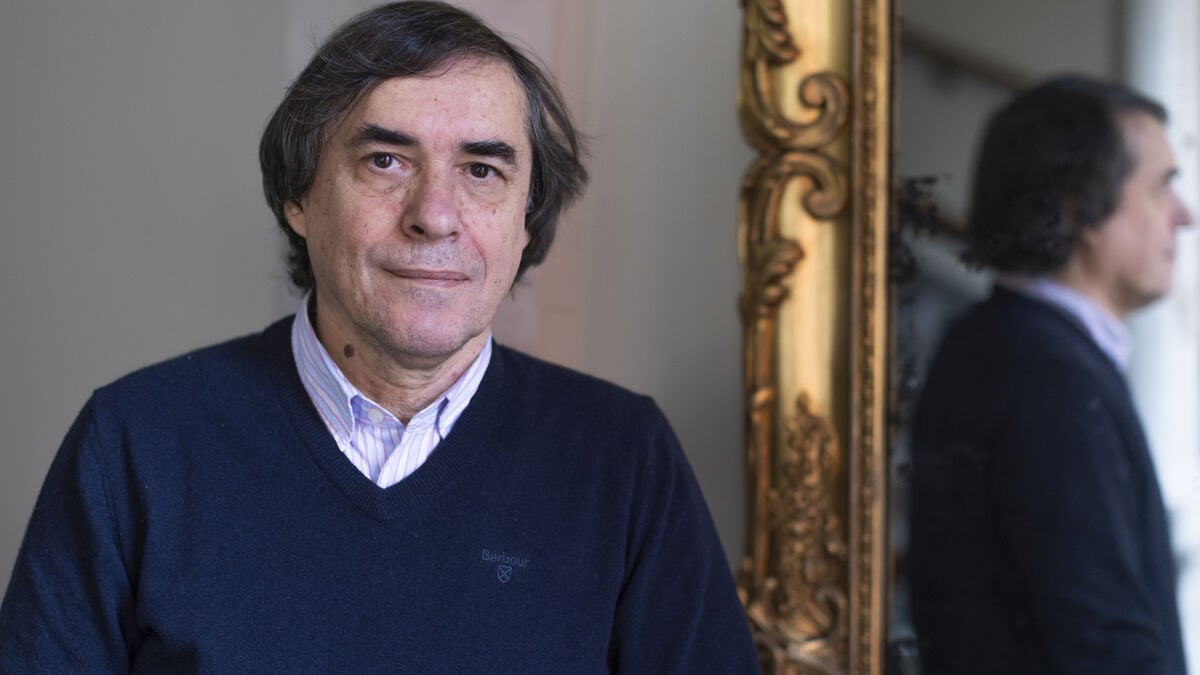
With his latest novel, he overcame a writing depression. But this year, the longtime Nobel Prize-nominated Romanian turns 70 and has decided to take it a little easier, he says.
Is it also tiring to be presented as a Nobel favorite?
I don't even know if the Academy knows me. I don't know if I've ever been on the receiving end, what I do know is that some people have written that I deserve the award and that's a great happiness for me.
He has carried "Theodoros" with him for a long time. As a young assistant at the University of Bucharest, Mircea Cartarescu taught courses that no one else wanted to teach. This was before the fall of the Wall and before he was allowed to travel abroad at the age of 34. Among the authors he was forced to read was Ion Ghica, whose letters he read.
Panting
Ghica recounted the colonial correspondence between Queen Victoria and the Ethiopian King Tewodros II. In the Ethiopian ruler's name, language, and portrait, Ghica suddenly saw his lost childhood friend, the servant's son Tudor, whose only wish had been to one day become emperor. The prospect was breathtaking.
There is no way Tudor became king, but when I discovered this letter I wrote in my diary: "This is a complete novel waiting for its author." I felt compelled to write the book about Theodoros.
Instead of a historical truth, he has written a fictional one. Cartarescu lets the archangels tell the fantastic tale, whose historical battlefields and exploitation of women sometimes bring to mind "Game of Thrones." The angelic perspective allows him to weave together "an ocean of stories," including the one about John Lennon’s family and a giraffe who comes to Paris.
I was also thrilled to write about the love story between King David and the Queen of Sheba.
Power
But the story of Theodoros, also known as the "spool worm," is fundamentally about a person with insatiable and destructive ambitions for power.
- When I wrote this book, today's madness had not yet begun; it was in its first presidential term, you could say. Now the book is similar to what is happening today with the Epstein files and everything, says Cartarescu.
The world is shaking, going downhill perhaps forever, although I still have hope. But it is difficult to live in these times, and to write literature.
Facts: Mircea Cartarescu
Born: 1956 in Bucharest.
Career: Translated into twenty languages and a constant candidate in Nobel Prize speculation. Published in Swedish in 2002 as "Nostalgia". Other well-known works are the "Orbitór" trilogy, "Travesti" and "Solenoid". "Theodoros" differs from most of his previous novels and Swedish critics are divided:
"A literary test of strength - that doesn't work," says Henrik Sahl Johansson in Svenska Dagbladet.
"As long as this kind of text exists in the world, I am prepared to forgive everything," writes Martina Montelius in Expressen.
Family: Married to the writer Ioana Nicolaie, one son and one daughter from a previous marriage. Mother, 97 years old.
Cartarescu lost his brother at the age of one and a half. The brothers had contracted pneumonia during a harsh winter. The parents took them to the hospital, but when they returned, they were told that one of the children had died. However, the parents were never allowed to see the body.
No one could say where he was buried, where he went. It is one of the traumas of my life. I would have given everything to have a brother! It would have changed my life. It is a painful story for me and my parents.