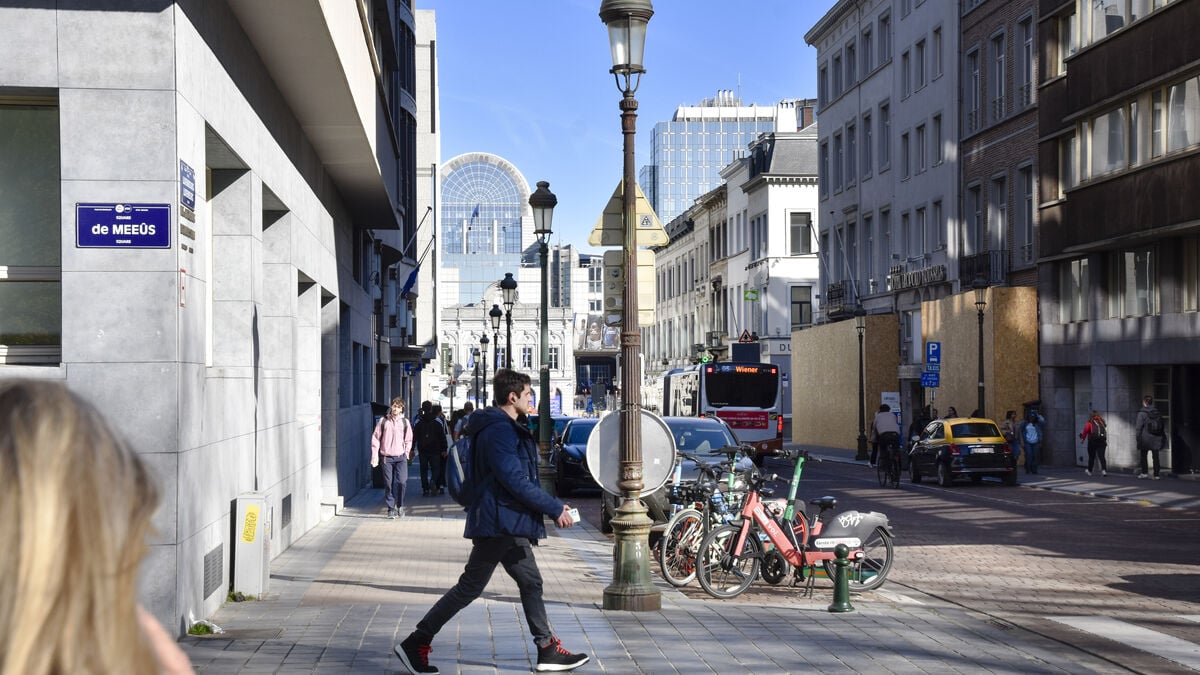
The old green lampposts at Luxembourg Square in Brussels' EU quarter serve as a reminder of the city's importance as one of the world's capitals of Art Deco architecture.
But they also symbolize something else: the poles have a notorious reputation as listening posts and are said to have been frequently filled over the years with equipment by various perpetrators who wanted to eavesdrop on what was going on nearby.
On the square is the main building of the European Parliament, with countless commission buildings and national representation offices nearby.
The area is one of the most monitored in the world, where states, organizations and companies compete to learn the most.
"Brussels is one of the world's largest spy centers with hundreds of active intelligence agents targeting our institution," the European Commission warned in a memo to its employees in 2024, according to the news site Politico Europe.
Wiretapped journalist
This became clear, not least in the run-up to the Hungarian parliamentary elections in April, when a mobile phone conversation between a journalist at the news site Politico and a close associate of EU top official Ursula von der Leyen was posted online in full and cited by pro-government media in Hungary.
No one seems to know who was behind it, how or why. Neither side claims to have found any spyware on the phones, which were quickly taken out of service.
Shortly afterwards, tape recordings of extremely sensitive telephone conversations between the Hungarian foreign minister and his Russian counterpart were released - again of unknown origin.
Both Hungary and journalist organizations in Brussels have reacted angrily to the wiretapping.
“A chilling message not only to journalists working in Brussels, but also to our sources,” Dafydd ab Iago, chairman of the correspondents’ organization API-IPA, wrote in a communiqué.
Tape player in the wall
At the same time, it is no secret that discussions in Brussels can rarely be held with complete protection from unauthorized persons.
Embassies and national missions are certainly doing what they can, for example by building closed meeting rooms where no one is allowed to bring a phone or other equipment. Important messages to the capitals are sent in encrypted form or by courier.
However, that is not always enough. As early as 2003, recording equipment was discovered built into the walls in four places inside the Justus Lipsius, the main building of the Council of Ministers, which at the time was also used for EU summits.
At that time, fingers were mainly pointed at the US or Israel. Now, Russia and China are primarily suspected in various revelations.
In 2019, the EU's foreign service warned that it counted at least 250 Chinese and 200 Russian spies in Brussels.
Good night!
Former US ambassador to Belgium Howard Gutman told the newspaper Die Welt in 2018 that he most often shouted "good night" to the roof of his residence.
"You always have to expect to be intercepted by the Russians and Chinese at any time," Gutman told the newspaper.
The Belgian security service has estimated that 10–20 percent of the staff at some countries' missions may be spies - in a city with over 25,000 registered diplomats.
Or as a former US intelligence official put it anonymously to Politico the other year.
You all probably don't understand how careful you should be.
Brussels (Bruxelles in French, Brussel in Dutch) is located on the now partially covered river Senne in the province of Brabant in central Belgium.
The city is the headquarters of both the EU and NATO and is also home to a wide range of international organizations, embassies and large companies.
Brussels has a total of approximately 1.2 million inhabitants in the 19 contiguous municipalities that make up the capital region.