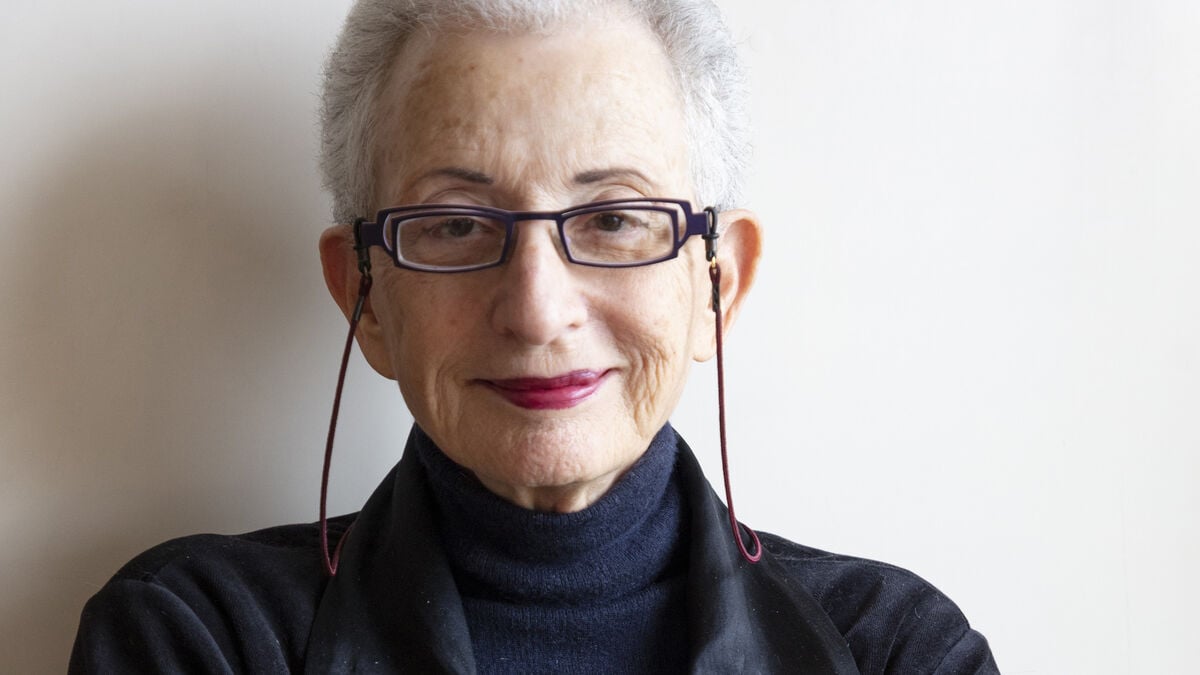
The French writer, philosopher, feminist and playwright Hélène Cixous receives the Swedish Berman Prize of one million kronor for the poetic memoir "From Osnabrück Station to Jerusalem".
"When you receive a prize, it is a great honor for literature," says Cixous, who ultimately ended up accepting it "humbly."
"It was because they gave first place to David Grossman, whom I respect immensely. He carries the weight of Israel - a very good writer, that was crucial."
“Unusual way”
At the same time, she resists the initial part of the prize's framework. The Berman Prize winner is supposed to work "in the spirit of the Jewish tradition," according to the statutes, but Hélène Cixous refuses to be cornered.
"I am not a representative of what one might call the Jewish tradition. My way of being Jewish is an unusual way. I do not write Jewish books, my country and my belonging is literature," she says, continuing:
"I could say that I am as much a Jew as a cat. I am perhaps more competent as an animal. In all humility I should say that I have no Jewish culture."
But those born into a universe where the word “Jewish” circulates simultaneously receive “countless experiences” and “a great moral responsibility,” according to Hélène Cixous, who grew up in Algeria.
Her mother came from Osnabrück, Germany, which she had left before the war but which was revived in "a hundred stories about the year."
"My mother was German and Jewish; there are a huge number of contradictions and paradoxes."
Equally complicated
“From Osnabrück Station to Jerusalem” is about her maternal family, some of whom managed to escape the Nazis and their death camps, but many did not. For Cixous, Osnabrück was as complicated a destination as Jerusalem.
"I traveled to Osnabrück with enormous difficulty. What was important was the story of my mother, a woman I adored. She was extraordinary. She was a midwife and that was her identity; she helped little Algerians into the world."
She describes her own identity as a complex mixture.
"I am anti-colonialist, anti-racist; I am against the current Israeli government. I have never been a Zionist. That is very much the case."
Facts: The Berman Prize
Established in 2020, it is given to an author who works in the spirit of the Jewish tradition and whose work strives for the universally human.
Last year, allegations of corruption and political censorship led to a major conflict. The awards ceremony was canceled and the jury withdrew.
The new jury includes Anders Rydell, Jens Liljestrand, Natalie Bloch, Lizzie Scheja, Hynek Pallas and Mats Almegård.
This year's laureate Hélène Cixous was born in Oran, Algeria, in 1937. "One of the most important writers, playwrights and thinkers of our time," according to jury chairman Anders Rydell.