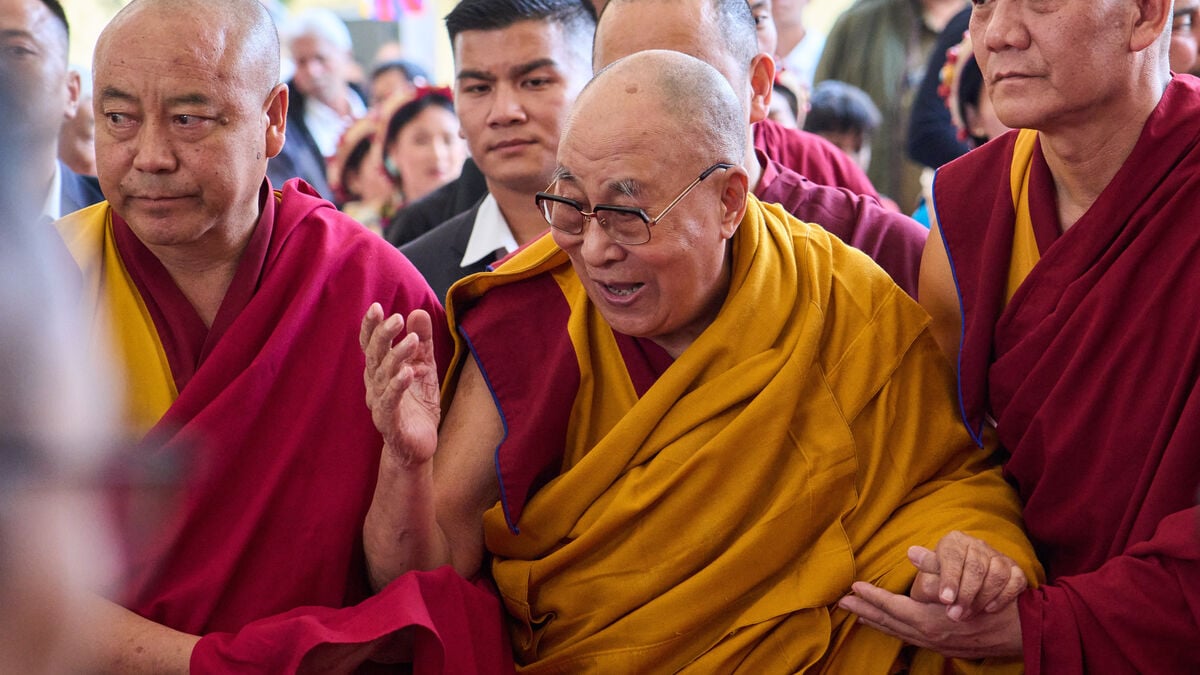
The escalating conflict over the Dalai Lama's successor pits ancient traditions against a strict Chinese political framework. There is a risk that there will be one Dalai Lama in exile who is recognized by Tibetans and the West - and another inside Tibet who is recognized by China and its allies.
The successor will be born in the “free world,” the Dalai Lama said last year, shortly before his 90th birthday. The reincarnation will be chosen by the Dalai Lama’s India-based official foundation, he said, a significant announcement for many Tibetans who had feared a future without a spiritual leader.
The foundation, Gaden Phodrang Trust, has maintained that no external political party has the right to interfere in the reincarnation process.
Wants to consolidate authority
China still wants to appoint a new Dalai Lama who follows Chinese laws and regulations, and claims that the successor must be chosen within the country's borders. The plan is seen as part of a broader strategy to consolidate authority in Tibet, as a future Dalai Lama could exercise his leadership more in line with the interests of the Chinese state.
Beijing's control over the autonomous region of Tibet has tightened, and Tibetans' opportunities to practice their religion and culture have been severely restricted. The Dalai Lama has accused Beijing of committing "cultural genocide" against the population.
Beijing is still stuck in its own absurd logic: an atheist party that does not believe in past lives insists that it alone can approve reincarnation, Dibyesh Anand, professor of international relations at the University of Westminster in London, told The Diplomat.
Cohesive leader
The Dalai Lama has been a spiritual guide and unifying symbol for the people of Tibet for hundreds of years. A controversial reincarnation process could shatter that unifying force, especially at a time when many younger Tibetans have grown up in exile.
Börje Ljunggren, former ambassador to Beijing, senior fellow at the Swedish Institute for International Policy and at Harvard's Asia Center, sees the current Dalai Lama as almost irreplaceable.
A new Dalai Lama will be weaker, he says.
The current Dalai Lama was born in 1935 in northeastern Tibet. At the age of two, he was recognized as the reincarnation of the 13th Dalai Lama. He thus became the 14th Dalai Lama and has worked for nonviolence, compassion, and Tibetan cultural identity under Chinese rule.
After all the years in the role, he has become a unifying leadership figure. When it comes to the question of a successor, the question of legitimacy is crucial for Tibetans.
The most important thing for them is that he is appointed in the way the entire reincarnation process requires so that he becomes legitimate. Beijing can never achieve legitimacy, says Börje Ljunggren.
It is a prerequisite for having a religious position that is credible. Might does not make right.
Candidates are tested
The process of selecting the next Dalai Lama begins after the current one passes away. After 49 days of mourning, the Dalai Lama Foundation begins its work to find potential successors, who can sometimes be children. The work involves consulting oracles, sacred texts, sites, and visions. The entire process can take two to three years.
The candidates who are found are subjected to a series of tests in the hope that a connection to the former Dalai Lama will be established, the American think tank CSIS writes in a report.
When a person is found and considered to be the reincarnation of the Dalai Lama, they are appointed as the next Dalai Lama. If the person is young, years of religious study await. In that case, the successor is represented in the meantime by another person.
Geopolitical issue
Many other countries are watching with interest the succession issue, which could affect geopolitical relations in the region. India finds itself in a difficult position as the succession is likely to take place on Indian soil. The relationship is already strained, as India hosts the Tibetan government-in-exile.
If India supports a new Dalai Lama on its soil, tensions with China could increase further. If India were to choose not to, however, it would be seen as a betrayal of the large number of Buddhists and Tibetans who see India as a spiritual refuge.
But other countries cannot do much to influence developments, says Börje Ljunggren.
For example, the EU cannot do much except to protect human rights and religious freedom and the position of Tibetans in various ways. But at the same time, this must be done in a way that does not provoke Beijing.
Tibet, often called the “roof of the world,” is formally an autonomous region in western China.
China's leaders claim that Tibet has been part of China for several hundred years, while Tibetans believe that the area has been a separate kingdom with independent rule for periods.
In 1950, Chinese forces invaded and forcibly annexed the area. The Tibetans were forced to recognize Chinese sovereignty in return for promises of Beijing's respect for Tibetan religion and customs. In practice, however, the country began to be fully incorporated into China.
After a series of uprisings and a failed revolt in 1959 – resulting in the deaths of several thousand Tibetans – Tibet's fourteenth Dalai Lama, Tenzin Gyatso, fled. Together with a hundred thousand followers, a government in exile was established in the Indian mountain town of Dharamsala.
Beijing's control over Tibet is described as total, with very little opportunity for the residents to use their language and practice their religion and culture. According to a series of reports over the years, Tibetans have virtually zero political and civil rights.
Source: Country Guide/UI, Human Rights Watch (HRW), Freedom House