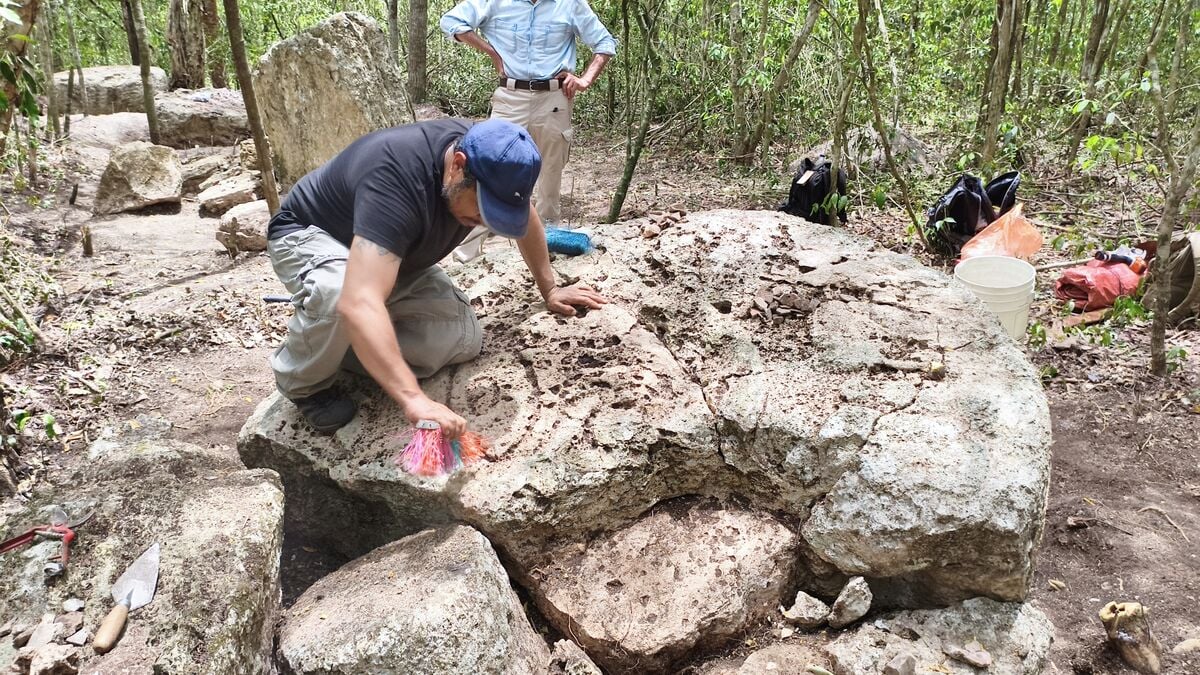
The previously unknown ruins on Mexico's Yucatán Peninsula are astonishing researchers.
“It was a discovery, a big surprise for us,” says Slovenian archaeologist Ivan Sprajc in a press release.
The isolated site was photographed from above 13 years ago, but has not been explored in detail until now. To get there, Sprajc's team first had to fight their way with machetes through several kilometres of dense jungle. Then they continued by quad bike and then walked for about six kilometres.
First time
“Compared with other places where we have worked, it was much more difficult to get here. But in the past three years, this is the first place we have found intact, without signs of looting,” Sprajc said in a press release from INAH, the Mexican authority responsible for the country's cultural heritage.
In addition to a 13-metre-high pyramid-shaped temple, archaeologists found several palatial and religious buildings, as well as agricultural terraces and water channels. They also found rows of altars and monuments (steles), one of which featured a sculpted beheading scene.
“It's the first time I've found a temple that is largely well-preserved, and a stele that still bears glyphs,” says Sprajc.
The Golden Age of Calakmul
The city was named Minanbé from the Mayan words "mina'an" ("there is none") and "be" ("path"), due to its inaccessible location in the deepest rainforest of the state of Campeche.
Archaeologists have dated the approximately 15-hectare ruin complex to between 600 and 900 AD. It coincides with the golden age of Calakmul, one of the largest and most powerful cities in the Mayan empire, according to El País.
“The monument and the hieroglyphic texts provide new insights into the last centuries of the Mayan civilization,” writes Mexican Culture Minister Claudia Curiel de Icaza on X.
The Mayan Empire stretched across northern Central America, from present-day southern Mexico down through Guatemala, Belize, western Honduras and El Salvador.
Mayan-speaking people (Huastecs) are believed to have existed in the highlands of Guatemala and Belize more than 4,000 years ago. The earliest known Mayan pottery dates to 2500 BC.
The people usually lived in smaller villages, some of which grew into ceremonial centers where architecture, art and trade flourished. The Maya culture was strongly religious and the architecture was often magnificent, with substantial temples and pyramids where various rites and sacrificial rituals to the gods were performed. Human sacrifice is also believed to have occurred. Among other things, sky, sun and fertility goddesses were worshipped.
The Maya culture began to decline around the 9th century, and many settlements were abandoned and taken over by the jungle. The cause of the decline is not fully understood, but is believed to have been a combination of climate change (drought), internal strife, crop failures and disease.
When the Spanish conquistadors arrived in Central America, the Maya civilization consisted of several rival kingdoms, primarily in the Mexican Yucatán Peninsula. New diseases, crop failures and poor defenses led the Spaniards to quickly conquer large areas. The Maya people were Christianised and forced into forced labour.
Today, the many Mayan peoples constitute an indigenous population that is increasingly working for ethnic, economic, social and political rights.
Source: NE, Illustrated Science