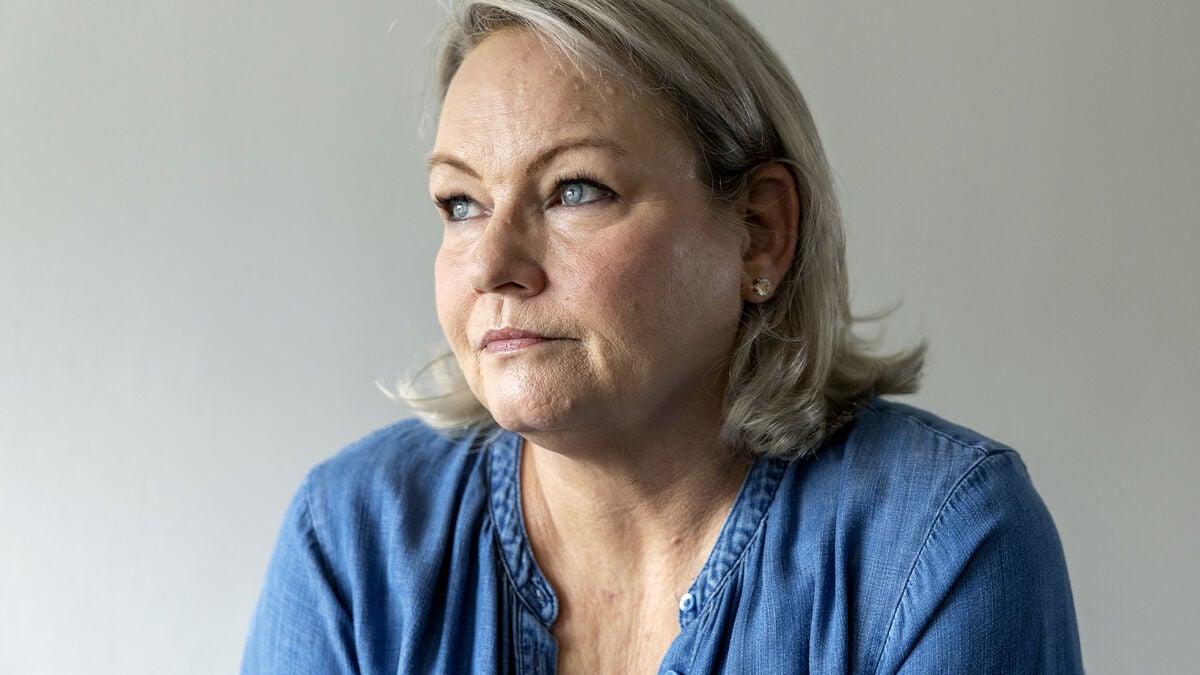
We are easily overlooked. We are a grateful group to be deprioritized.
In Alzheimer's, small clumps called amyloid plaques form on the nerve fibers in the brain. The communication pathways between nerve cells are blocked, and impulses increasingly struggle to reach different parts of the brain.
Last year, medications that reduce the amount of plaque in the brain were approved for the first time by the European Medicines Agency (EMA).
But whether they will be used in Sweden is far from decided.
“Became unsustainable”
Jessica Söderfjord, now 56, has had several bouts of fatigue and depression and was diagnosed with ADHD at 52. During a follow-up check-up, she told the doctor that she could no longer keep track of what was hot and what was cold on the tap and had difficulty reading numbers. It was becoming increasingly difficult to cope with her job as a healthcare administrator.
It became unsustainable. I couldn't fix it in the end.
At the memory clinic, samples were taken of her spinal fluid and it was clear that she had early Alzheimer's.
For the first three weeks, I cried as soon as I woke up, because I didn't want to wake up. I couldn't imagine facing what was coming.
Now she is receiving medication that has some effect, but the one that attacks plaque in the brain is still out of reach for her and for all other Swedes.
“Uncertain effect”
The decisive factor will be the recommendation from a joint body for Swedish regions, the NT Council, which is expected in the spring.
For the NT Council, a statement from the Dental and Pharmaceutical Benefits Agency (TLV) will carry weight. TLV has pointed to a number of uncertainties with the first of the new medications it has examined, Leqembi.
TLV has concluded that the medication does have a significant effect on plaque in patients with mild Alzheimer's, but that it is uncertain how this affects their cognitive ability.
If the medication is introduced, the pressure on healthcare will increase. The medication must be given intravenously in hospital every two weeks and patients must be followed up with regular MRI examinations.
Overall, this will be very expensive and could crowd out other healthcare services, putting other patient groups at risk, according to TLV.
“Was disappointed”
Chief Physician Anne Börjesson Hanson has worked with clinical trials of dementia drugs for over 20 years, including Leqembi.
We have patients who have had this for five years now, who are stable and still work in quite demanding professions and can handle it.
The uncertainty TLV points to is because the only large study conducted, which includes some of her patients, examines the effect only after 18 months.
It takes a long time to develop symptoms of Alzheimer's, and it takes time before the clinical effect of the medication becomes clear.
There is no evidence that it has an effect in the long term because we have not done any double-blind studies for more than 18 months. There is four-year data, but these are not double-blind studies. They show better effects the longer you treat.
She questions TLV's calculation of the cost of introducing the medicine in Sweden, for example that it would cost more than 9,000 kronor per administration to give the medicine intravenously.
I was disappointed with the analysis.
“Terrible waiting time”
Henrik Zetterberg, professor of neurochemistry, believes that Sweden is now in a "terrible waiting situation."
It is absurd, because the drug that is now used in the US and many other countries with good results was developed in Sweden with taxpayer funds.
According to Henrik Zetterberg, the consequence of Sweden, like several other European countries, waiting is that some are now looking abroad.
You can go to Finland and get infusions if you are wealthy in Sweden. We have Swedish patients who go to London.
He is clear that the medicine is not suitable for everyone and that it is not a miracle cure.
There is a growing consensus in countries where the drug is available that it is not obvious that patients generally respond well to it, but that some respond very well. The average is about a 30 percent slowdown.
Late
Jessica Söderfjord has been told by her doctor that she is a suitable candidate for the new Alzheimer's medication. But that only applies now, when the disease is in its early stages; after that it will be too late.
My loved ones and I cannot understand how there can be medicines that are actually researched in Sweden that we cannot access.
She feels that an outdated view of Alzheimer's as a disease of the elderly leads to fewer resources for memory clinics and delays in the introduction of new medications.
Many of us are younger and are developing the disease now. We are a little more on our toes and demand a little more.
Facts: Alzheimer's
Alzheimer's is the most common dementia disease. In Sweden, just over 100,000 people are affected.
A characteristic of the disease is that brain tissue is gradually destroyed.
The most important risk factors are old age and heredity. Lifestyle also has an impact.
The likelihood of being affected increases significantly after the age of 65.
According to studies, approximately 40 percent of disease cases can be traced to lifestyle factors. These include high blood pressure, diabetes and other metabolic diseases, as well as physical inactivity.
Source: Alzheimer's Foundation and Dementia Center