
We have had a fantastic team and we have been stubborn as hell. There are many with a huge heart who have been here and I believe that is the solution, says Andreas Jezek.
If you count every single bay, it was a 2.5 km shoreline that was affected in a sensitive environment with otters, seals, resting migratory birds and nesting bird colonies.
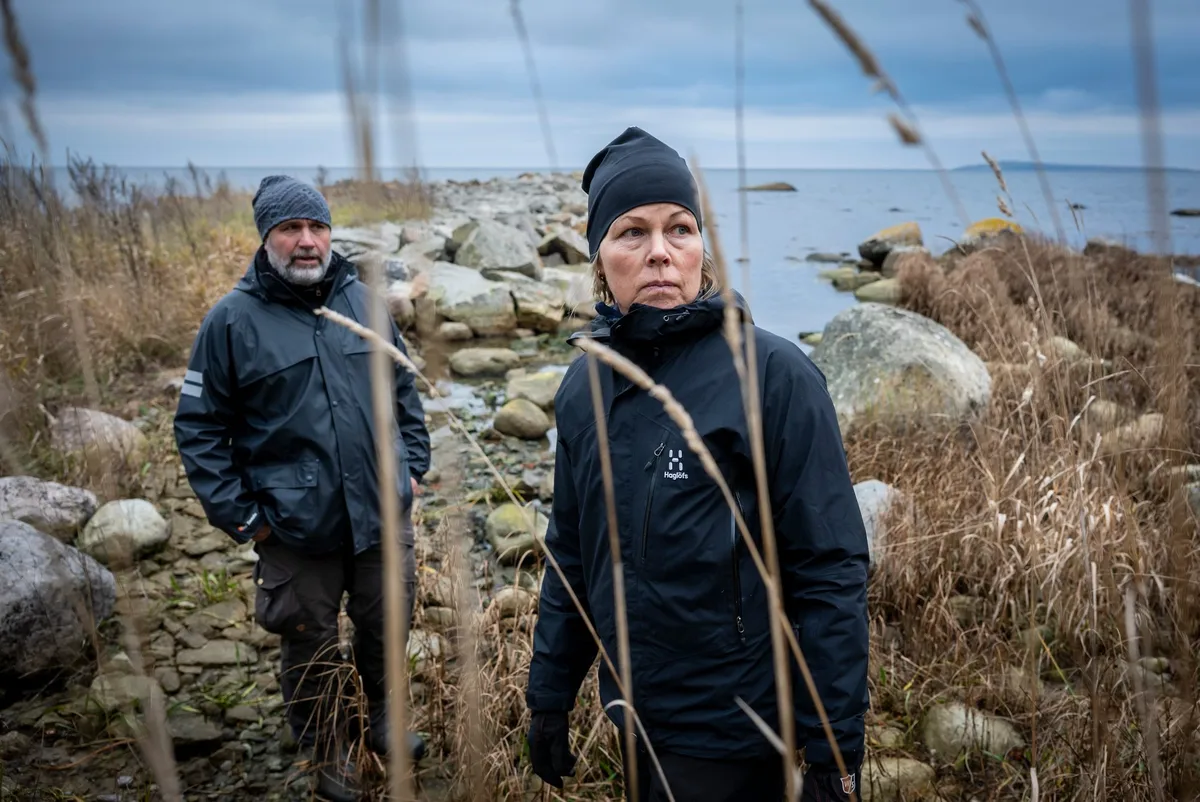
Cleanup managers Andreas Jezek and Sara Stenbeck at one of the most oil spill-affected and now cleanup sites during the final inspection of the beach between Spraglehall nature reserve and Hörvik.
Initially, rough clean-up was carried out with a shovel and bucket under great time pressure. The oil tank hit everyone who approached and the clean-up workers needed both a respirator and full protective clothing.
It was autumn and a few days after the spill there was a storm and high tide. Then the oil ended up 50–70 meters up in the low-lying, rocky terrain.
The two cleanup leaders, Andreas Jezek and Sara Stenbeck, who worked on behalf of the municipality, initially worked with more than 60 people who signed up as volunteers and were paid by the municipality.
Like thick pizzas
Many were from the local area, with good seamanship and local knowledge. They were determined to give everything they had. Oil lumps lay like thick pizzas in the terrain, describes Andreas Jezek.
They had to cut them away from the grass. It was quite hard work at the beginning.
In the next phase, there were 40 people, divided into four groups. The cleanup workers became like hunting dogs and had to turn over every single stone.
To this day, there are traces of the spill, many stones are still black on their sides.
Our goal was to be able to press the palm of your hand on top of the stone without getting oil on your hand, says Sara Stenbeck, placing her hand on an oil-stained stone.
The oil on the sides is considered to cause less damage to wildlife and would have been even more difficult to remove.
It would have taken 80,000 more hours, says Sara Stenbeck.
350 tons
A total of 350 tons of oil-contaminated sand and plant matter have been transported away. Much of the oil ended up on the seabed and new oil is still coming to the beaches. But it has tapered off. This year, 30–50 kilos have been picked up.
Andreas Jezek takes a bag of oil lumps out of his pocket that he picked that morning. He breaks them open and lets us smell them, a strong oil smell hits your nose.
Several researchers have studied the effects in nature. Lund University, in collaboration with the Marine Center in Simrishamn, has compared blue mussels from here with blue mussels from less affected parts of Listerlandet.
Our clearest result is that we do not see such a huge impact, says Helena Filipsson, professor of marine geology.
The shells and hulls of the mussels have been compared, as well as how much toxic PAHs they contain, both in 2024 and 2026. PAH stands for polycyclic aromatic hydrocarbons. They are both carcinogenic and genotoxic, which means that they can damage the genetic material and cause mutations.
“Fantastically good news”
She is convinced that the work of the decontamination workers has been absolutely crucial.
This is actually fantastically good news, that it seems that the decontamination worked and that the impact was not that great, at least as far as we know so far, says Helena Filipsson.
IVL Swedish Environmental Institute has also carried out measurements, commissioned by the County Administrative Board. In its final report a year ago, IVL stated that hazardous substances from the leaked oil are still being spread.
We have seen that the levels have decreased in mussels and water, as is known to happen, and then that the levels in the sediment have increased, says senior researcher Maria Granberg at IVL.
The oil spill from the Marco Polo was not very large by international standards, an estimated 60,000 liters. But it may have resulted in several tons of PAHs contaminating the Baltic Sea, she points out.
Without the cleanup, it would have been a disaster, says Maria Granberg.
Stressed sea
Everyone emphasizes that the Baltic Sea is already quite stressed. The pressure is heavy from environmental toxins, ship traffic, buildings, noise, littering, eutrophication, climate change and fishing.
The Marco Polo also continued after the first grounding, because the personnel on board did not initially realize that the ship had been damaged. The leaking ship followed the coast and released oil from very close range until the second grounding.
The largest amount of discharge consisted of thick bunker oil, which could be scooped up like a sticky syrup in the first few days.
You cannot measure the effect of an oil spill by the number of liters, says Sara Stenbeck.




What do you think?