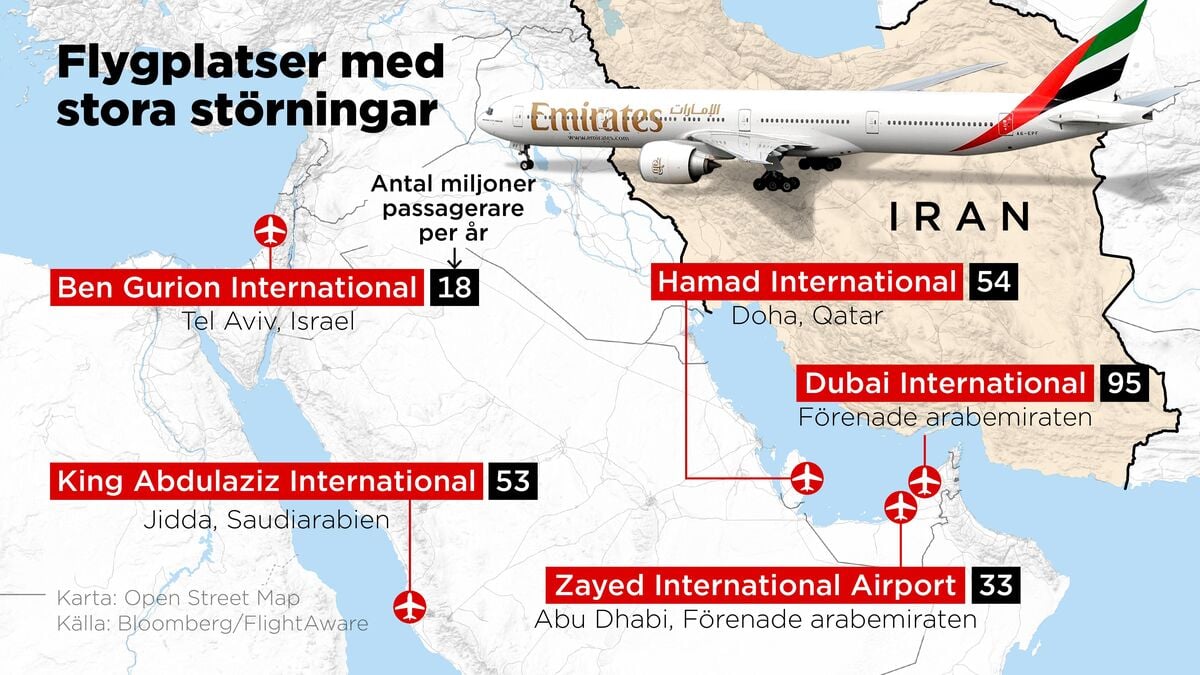
On Sunday, approximately 3,400 flights were canceled in the Middle East region, according to the website Flightradar24. The start of Monday looked similar, with some of the world's largest airlines affected in connection with the attacks.
Emirates Airlines will resume flights from Dubai on Monday evening, albeit on a limited basis. Etihad Airways has done the same from Abu Dhabi, while Qatar Airways has canceled all Monday evening flights from Doha. In addition to these three, a number of European and Asian companies have had to cancel flights.
Pauses flights
For the Scandinavian side, this has meant, among other things, eight cancelled flights from Kastrup on Monday. For example, Norwegian tells TT that it is now pausing all Dubai flights until Wednesday while monitoring developments. SAS is simultaneously cancelling all flights to Tel Aviv and Beirut, Expressen reports, among others.
Dubai Airport is one of the world's busiest, handling almost 100 million passengers last year. It and many other airports in the Middle East have become vital hubs for flights between Europe and Asia, especially with the closure of Russian airspace.
For the aviation industry and companies, this is described as the worst scenario since the outbreak of the pandemic. For hundreds of thousands of travelers who are either on their way to or from the region, it will also have major consequences. Travelers who are stuck in the Middle East, for example, are entitled to help, depending on which company and where they are flying from, says Fanny Forsling, lawyer at the Swedish Consumer Agency.
It depends on which trip you have booked. If you have a ticket with an airline within the EU, you have the right to rebook and to accommodation and meals during the trip, she tells TT.
Rules are different
For airlines that are not part of an EU country, such as Emirates, the rules are different. If the flight departs from an airport within the EU/EEA, you are entitled to compensation. However, travel to the EU with non-EU companies is not covered.
In such cases, you should contact the respective airline, says Fanny Forsling.
When it comes to package tours, the organizers are responsible for the trip.
Then you should contact the organizers; they will make sure you get home, says Fanny Forsling, who at the same time advises saving all receipts and expenses.
Trygg-Hansa also announces that it has chosen to expand the conditions for compensation. The insurance company will cover the costs of four nights' accommodation as well as other expenses, which may be increased depending on how the situation develops.