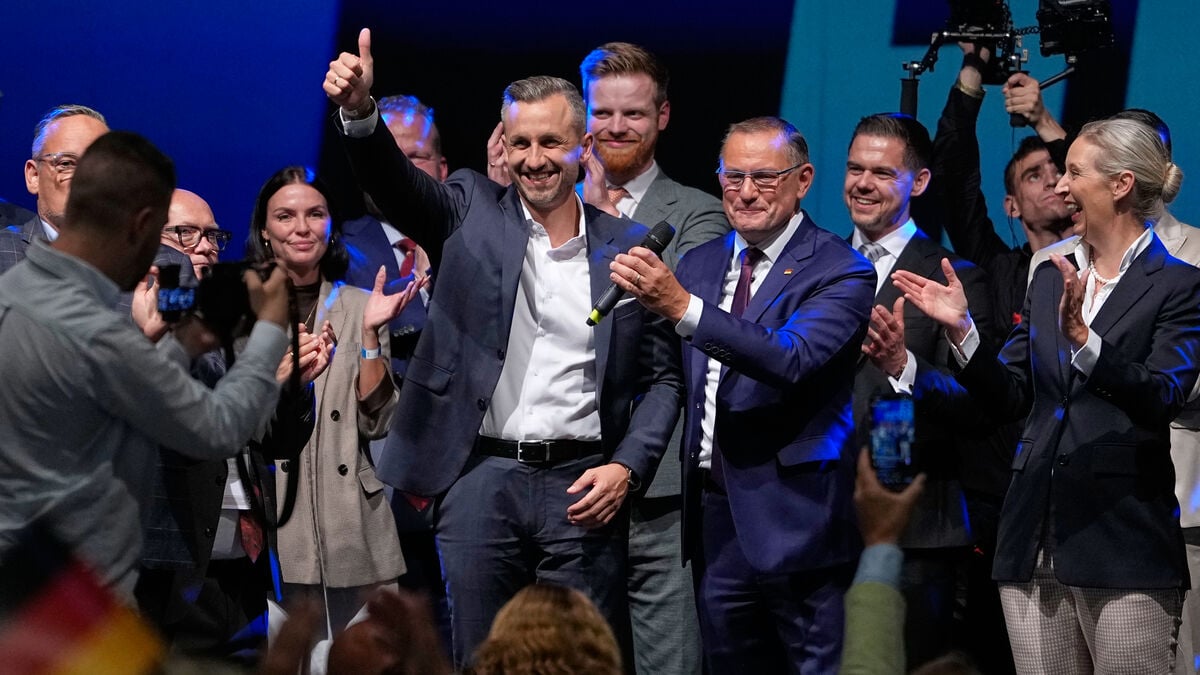
The Alternative for Germany (AfD) wins a landslide victory with 43.8 percent of the vote. However, the left-wing breakaway party Sahra Wagenknecht's BSW passed the threshold, thus shattering the AfD's dream of its own majority.
"We have taken back our country. Our goal was not only realistic, it was what the people wanted," Ulrich Siegmund cheers at the election vigil.
This is a result not only for Saxony-Anhalt, but for all of Germany.
Alice Weidel, one of the party's two leaders, is attacking Chancellor Friedrich Merz after the victory in Saxony-Anhalt. The result shows that "the people expect change," she says, according to AFP:
No previous chancellor has been as unpopular as Friedrich Merz, who has become a major burden on Germany's positive development.
CDU halved
The question of forming a government remains. So far, no traditional party has wanted to cooperate with the AfD, and in the television election vigil, senior representatives of the other established parties continue to say clearly no. Ulrich Siegmund himself said on Monday morning that the party has begun negotiations with “individual parliamentary groups and politicians.”
The top candidate for the liberal BSW party in the state, Claudia Wittig, is open to cooperation with the AfD on individual issues such as energy policy. She believes that a state government without the AfD would be “completely undemocratic.”
We want to do what is good for the country, then we'll see if it's with or without AfD, she says.
Chancellor Friedrich Merz's CDU halves its share of the vote to 17.2 percent, but still becomes the second largest party. In the last state election, in 2021, the figures for the two parties were the opposite - then the AfD received 20.8 percent and the CDU 37.1.
Pro-Russian
With just over two million inhabitants, Saxony-Anhalt is one of Germany's smaller states. But the election is seen as symbolically important and an indication of the AfD's potential for similar success nationally.
Among other things, the party wants to fundamentally overhaul migration policy, invest in more Russian language teaching in schools and "good relations" with Moscow, scrap wind farm construction and close down public service media.
The message seems to be hitting home in the former GDR, where the party has the greatest support.
The CDU will never win an election again, party leader Alice Weidel tells ARD.
In two weeks, there will be state elections in two of the other eastern federal states, Berlin and Mecklenburg-Western Pomerania.
So the election went.
Right-wing nationalist AfD: 43.8 percent (20.8 in the 2021 election)
Christian Democratic Party CDU: 17.2 percent (37.1)
Left Party Die Linke: 8.6 percent (11.0)
Social Democratic SPD: 9.3 percent (8.4)
Liberal FDP: 2.6 percent (6.4)
The Greens: 8.9 percent (5.9)
Left-wing conservative BSW: 5.3 percent (-)
According to the television channel MDR, the turnout was record high. As of 4 p.m. on Sunday, over 65.3 percent had voted, which is more than in any local election in Saxony-Anhalt since German reunification in 1990.
Alternative for Germany (AfD) was founded in 2013 with a focus on the consequences of the euro crisis, which was considered to have been mishandled by the Merkel government.
The party quickly gained a boost in public opinion but failed to enter the Bundestag that same year.
In 2016, a new party program was adopted, in which opposition to immigration and criticism of Islam were given a more prominent place.
Since then, the party's political orientation has become increasingly radical. In several states, the party is monitored by security services after being classified as far-right and deemed to pose a threat to democracy.