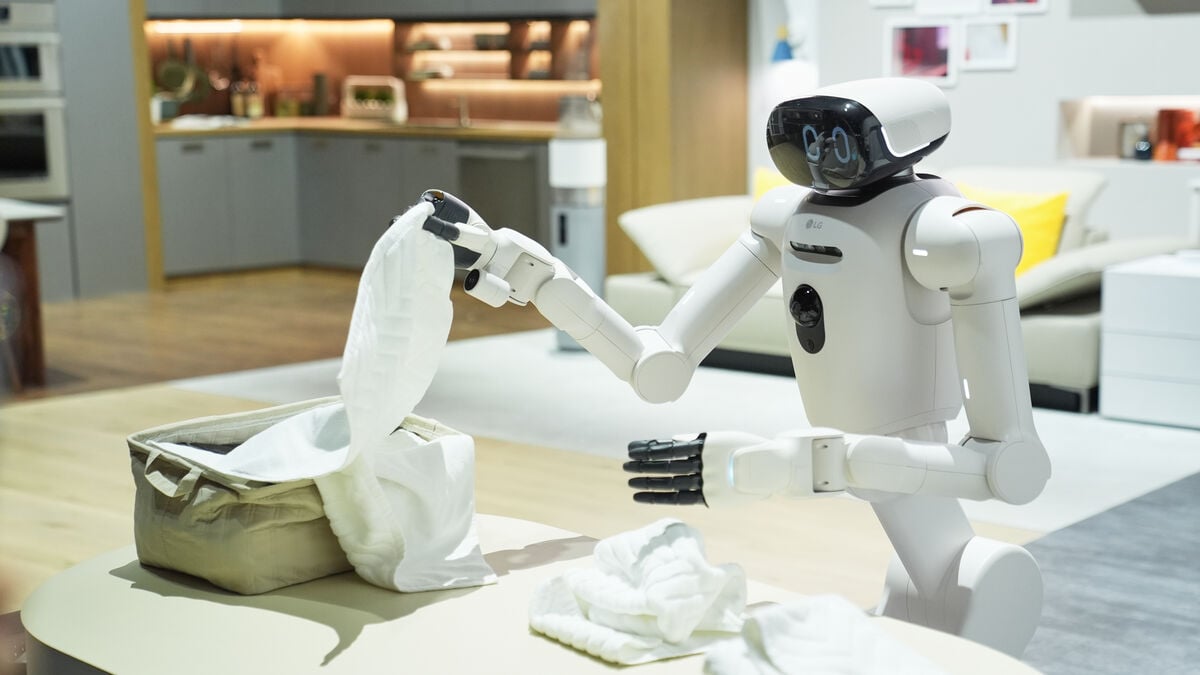
At the annual consumer technology show CES this week, the Cloid robot from South Korea's LG was shown for the first time. About 1.5 meters tall, with human-like features, such as eyes on its facial display, the robot took its place on stage and waved to the audience.
But when it came time for the main task, putting laundry in a washing machine and then folding it, things got harder. Bloomberg's reporter described Cloid as "painfully slow."
This applies to the robotics industry as a whole. Expectations are huge, but development is moving slowly. Humanoids, that is, robots that resemble humans, are seen as the future in the industry.
LG also showed how Cloid could pick up a baking sheet of croissants and put them in the oven for a tired owner in the morning. There was just one problem: the robot forgot to close the oven door.
Far from autonomy
The challenges are also significant before these robots can become autonomous. The AFP news agency notes that the AI revolution is not really reaching robots that cannot benefit from information vacuumed up from the internet via AI services such as ChatGPT.
"If you want robots to learn and imitate human movements, you would have to be able to place them inside a human body," Henny Admoni, a professor at Carnegie Mellon University, told AFP.
However, the Chinese robotics company Engine AI, which is working with Meta and Amazon to give its robots AI capabilities, is blunt about what is realistic for one of their robots that performed a kung fu show in Las Vegas.
"We try to imitate humans, but robots will never be human because a human is emotional and so much more," founder Evan Yao told AFP.
Increased capability
But despite all this, the capacity has increased significantly. A Chinese competitor, Robotera, has shown off a variant that is intended to participate in the Beijing Marathon later this year. At the same time, the organizers of CES estimate that the robotics industry will have revenue of around $179 billion by 2030.
The lion's share of that sum, however, is expected to be linked to industry rather than to households or everyday consumers. At the trade fair in Las Vegas, a variant called "Atlas" from Hyundai and Boston Dynamics received a lot of attention. Around 1.8 meters tall, it can lift about 45 kilograms and the intention is that the robot will be used in the car manufacturer's factories, among other things. The hope is that Atlas will begin its first work shift in a factory in two years.